





How to evaluate noise data from a silent diesel genset manufacturer
Start With the Test Condition, Not the Decibel Number
A published noise value is useful only when it describes a reproducible test condition. A silent diesel genset manufacturer may state that a unit is rated at a certain sound-pressure level, but that number cannot be compared fairly with another quotation unless the measurement distance, load, operating mode, environment, and standard are aligned.
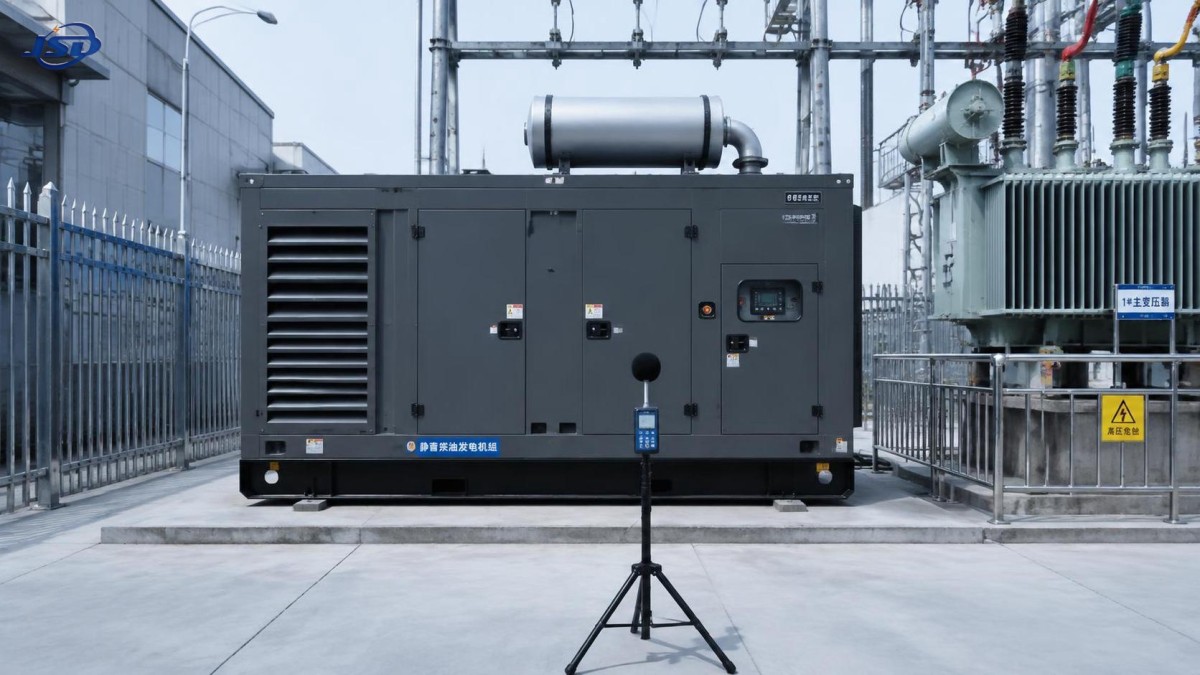
For a technical evaluator, the first question is simple: what exactly was measured? A figure taken at 7 metres in a free-field condition is not equivalent to one taken at 1 metre, at a different load point, or inside a partially enclosed factory yard. Neither figure is automatically wrong. They answer different questions.
Noise must also be identified correctly as either sound pressure or sound power. Sound pressure level is what a receiver measures at a specified position. It is often the more practical figure for a project boundary, operator location, or nearby building. Sound power level describes the acoustic energy emitted by the machine and is more useful when predicting site performance with an acoustic model. A quotation that gives only “low noise” or a single dB value without stating which quantity is being reported leaves too much room for interpretation.
Before comparing suppliers, request a noise-data sheet that identifies at least:
- the measured parameter, such as A-weighted sound-pressure level or sound-power level;
- the measurement distance and microphone height;
- the generator load during the test, including power factor where relevant;
- the operating condition, such as prime, standby, rated speed, or idle;
- the acoustic environment, including whether it was free field, semi-reverberant, or affected by reflecting surfaces;
- the applicable test method or standard edition;
- whether the reported value is a single-point result, an average over several positions, or a guaranteed maximum.
A supplier that can provide this context gives the evaluator something that can be verified. A supplier that only repeats a catalogue rating may still have a capable enclosure, but the claimed performance cannot yet be used as a design input.
Load Point Changes the Noise Profile
Diesel generator noise does not remain constant across all operating conditions. Engine combustion noise, exhaust noise, cooling-fan noise, alternator electromagnetic noise, and structural vibration respond differently as load and speed change. For many sets operating at fixed frequency, engine speed is held broadly constant, yet the acoustic balance can still shift significantly between low load and full load.
This matters because a project requirement is rarely based on an abstract “rated” condition. A hospital backup set may be expected to meet a boundary limit during periodic exercise and during an emergency transfer. A construction installation may spend much of its operating time at partial load. A data facility may have several generator sets operating together during a utility outage. Each scenario produces a different acoustic question.
Ask the manufacturer for noise data at the duty points that matter to the project. If only one formal test point is available, the technical submission should state which point it represents and avoid implying that the same number applies everywhere. A full-load reading cannot simply be treated as a universal guarantee, and an unloaded or lightly loaded reading should not be used to predict emergency operation.
Frequency content deserves attention as well. Two generator sets can show similar A-weighted readings while producing very different nuisance effects. A low-frequency exhaust component may travel farther outdoors and pass through building facades more readily than higher-frequency fan noise. Tonal components from rotating equipment, vibration of enclosure panels, or resonances in the intake and exhaust path may also be more objectionable than the overall level suggests.
For sites close to residences, offices, control rooms, or sensitive equipment, request octave-band or one-third-octave-band information where the project acoustic consultant needs it. The aim is not to demand excessive reporting for every small installation. It is to avoid a situation where a compliant headline value conceals a frequency problem that becomes expensive after installation.
Check Whether the Enclosure Is Being Evaluated as a System
A silent genset is an acoustic system, not merely an engine with sheet-metal panels around it. The enclosure, intake path, radiator discharge, exhaust silencer, doors, cable openings, base frame, and vibration isolators all affect the final result. A well-designed canopy may perform poorly if air openings bypass acoustic treatment or if door seals deteriorate under repeated service access.
Cooling airflow is one of the most common areas where brochure claims and installed performance diverge. The engine and alternator need adequate ventilation, especially in high ambient temperatures or restricted locations. Adding baffles, acoustic louvres, or attenuators may reduce breakout noise, but it can also increase airflow resistance. If the cooling system is not assessed as part of the enclosure design, the set may experience elevated temperatures, reduced output capability, or excessive fan noise.
Technical assessors should therefore ask for the configuration behind the stated noise rating. Is the value based on an open set with a separate acoustic enclosure, an integrated weatherproof canopy, or a containerized arrangement? Does it include the supplied exhaust silencer? Is the radiator mounted within the acoustic package? Are intake and discharge attenuators included, optional, or assumed to be supplied by others?
Door and service-panel construction should be reviewed in proportion to the required noise limit. A low-noise package depends on gasketing, latches that maintain compression, lining materials that tolerate heat and contamination, and panel stiffness sufficient to avoid rattling or radiation from large vibrating surfaces. A supplier should be able to explain how routine maintenance access is retained without creating unattenuated leakage paths.
The same approach applies to vibration isolation. Structure-borne vibration can transfer through a skid, housekeeping pad, exhaust support, fuel piping, cable containment, or adjacent steelwork. Once vibration enters a building structure, an apparently quiet outdoor genset can produce audible secondary noise indoors. The generator supplier’s acoustic report should distinguish airborne noise from vibration-control assumptions and identify the installation work required to preserve the tested result.
Do Not Treat the Manufacturer Test as the Site Result
Factory or controlled-field data is necessary for comparing equipment, but it is not a substitute for installation-specific prediction. Nearby walls, roof canopies, narrow service corridors, hard paving, elevated platforms, and acoustic barriers can all alter propagation. Reflections may increase levels at some points, while shielding reduces them at others. Exhaust outlets and radiator discharges are directional, so the orientation of the set can matter as much as the enclosure rating.
This distinction becomes particularly important in power distribution projects. A diesel genset may support a low-voltage emergency bus while being located near a transformer room, switchgear building, or distribution yard. The surrounding electrical equipment can introduce its own sound sources. Transformer core noise is usually characterized differently from diesel engine noise, and it may continue whenever the transformer is energized, while the genset operates intermittently or under emergency duty.
For example, a facility using a 13.8kV Distribution Transformer to step down power for industrial loads should evaluate the acoustic environment as a combined installation. The transformer’s no-load sound, the genset’s running noise, cooling equipment, ventilation fans, and reflected sound from nearby structures may all affect the receptor point. Selecting components separately against separate headline values does not demonstrate compliance for the assembled site.
A disciplined specification separates three layers of responsibility:
- Equipment performance: the generator package must meet a defined noise level under defined test conditions.
- Installation design: the contractor or project engineer must provide foundations, ducting, exhaust routing, barriers, and clearances consistent with the acoustic assumptions.
- Site compliance: the completed installation must meet the applicable limit at the required receptor locations and operating scenarios.
Without this separation, a dispute can emerge after commissioning. The manufacturer may point to a valid factory test; the installer may point to the delivered equipment; the owner may still have a boundary exceedance. Clear documentation before purchase is far less costly than adding silencers, barriers, or major duct modifications after the set is in place.
Read Standards Claims With Precision
Standards references can strengthen a submittal, but only when the reference is specific. An evaluator should look for the test method, scope, instrumentation approach, operating condition, and acceptance criterion rather than accepting a generic statement that the unit is “tested to international standards.” A standard may describe how sound is measured without setting the project’s allowable noise limit. Those are separate matters.
The project specification should state whether the requirement is a maximum sound-pressure level at a defined distance, a maximum at a property boundary, or a sound-power limit used for acoustic modelling. It should also state the relevant operating condition. If a local authority, owner standard, or environmental permit establishes a receptor-based criterion, that criterion should govern the final installation assessment even when the genset package has passed a recognized factory test.
Measurement uncertainty should not be ignored where the design margin is very small. Acoustic testing has uncertainty arising from instrumentation, environmental conditions, test setup, machine variation, and calculation methods. A proposal that sits exactly on the stated limit provides little practical allowance for installation variability. A more robust procurement decision considers whether the selected package leaves enough margin for the expected site conditions.
It is also sensible to distinguish between a guaranteed value and a typical value. “Typical” may be useful during preliminary budgeting, but it should not be the contractual basis for a sensitive project. A guarantee should identify the configuration, duty point, distance, test method, and any conditions that must be met by the purchaser or installer. Optional silencers, louvres, remote radiators, or special exhaust treatment should be listed explicitly rather than buried in exclusions.
Questions That Expose Weak Noise Submissions
When reviewing bids from a silent diesel genset manufacturer, a short set of targeted questions often reveals more than a long marketing brochure. Request the acoustic test report or a traceable summary, then ask whether the tested configuration matches the proposed bill of materials. Confirm the number and location of measurement positions. Ask which accessories were fitted, whether the exhaust outlet was included in the reading, and whether the unit was tested with the same radiator, fan, and enclosure arrangement proposed for the project.
For multiple-set installations, establish whether the quoted level applies to one generator or to the required operating combination. Sound from independent sources adds logarithmically, so several sets running together cannot be assessed by simply repeating the single-set figure. The acoustic design should also account for synchronized operation, load sharing, and the practical orientation of multiple radiator discharges and exhaust stacks.
Ask how the supplier controls production variation. An acoustic design can be sound on paper yet vary with panel fit-up, insulation placement, fan selection, silencer installation, or engine configuration. Useful evidence may include documented inspection points for enclosure assemblies, verification of supplied acoustic components, and a clear process for handling deviations from the specified configuration. This is particularly relevant when a standard enclosure is modified for unusual ambient conditions, alternate fuel systems, or restricted-space installation.
Finally, consider access and maintainability. Acoustic performance depends on panels, seals, attenuators, and exhaust components remaining in their intended condition. An enclosure that makes normal filter replacement or inspection difficult may invite poor reassembly after service. Maintenance requirements should identify how acoustic seals, flexible connections, silencer supports, and vibration isolators are inspected over the equipment life.
Use Noise Data to Make a Defensible Selection
The best submission is not necessarily the one with the lowest isolated dB number. It is the one that gives a transparent test basis, matches the project duty cycle, identifies the supplied acoustic configuration, and can be carried into a credible site assessment. For straightforward outdoor installations with generous separation from receptors, a well-defined equipment rating may be enough. For dense industrial sites, buildings, hospitals, mixed-use developments, or installations near occupied areas, noise data should become part of the wider layout and commissioning strategy.
A technical evaluator should be able to trace the decision from project requirement to manufacturer test condition, proposed equipment configuration, installation assumptions, and final verification point. That chain is what turns a “silent” genset claim into an engineering judgement that can withstand procurement review, commissioning, and operational use.

Get a Quote
Regardless of whether you require general advice or specific support, we are happy to help you.
Send Us Your Inquiry Today

Jinshida Electric remains committed to contributing to global energy development through professional manufacturing and superior service.