





What lead-time risks should you check at a diesel genset factory?
Lead Time Is a Schedule Risk, Not a Quotation Field
A delivery promise from a diesel genset factory should be treated as a chain of commitments, not as a single number on a quotation. A supplier may be able to assemble a standard generating set quickly while still facing delays in the engine, alternator, controller, enclosure, test slot, export documents, or vessel booking. For procurement teams working against a commissioning date, the relevant question is not simply, “How many weeks is the lead time?” It is, “Which events must occur before this unit can leave the factory, and which of them are outside the factory’s direct control?”
The risk is highest when a genset is tied to a critical path: temporary construction power, a data facility backup system, a process plant shutdown, an infrastructure handover, or a site where civil works and electrical installation crews have already been scheduled. A late unit can create costs well beyond expedited freight. It can leave installers idle, delay energization, extend rental-generator use, or force an incomplete handover.
Lead-time review should therefore begin before the purchase order is released. The buyer needs an evidence-based production plan, clear technical freeze points, and contractual definitions of what “delivery” actually means.
Separate Standard Assembly Time From the Real Supply Chain
The first risk is accepting a factory’s standard lead time as though it applied to the exact configuration being purchased. Many diesel genset factories can build familiar open-type sets in common ratings with relatively predictable workflows. That does not mean the same timeline applies to a sound-attenuated unit, containerized package, high-voltage alternator, synchronized multi-set system, automatic transfer equipment, remote fuel arrangement, or a generator built to a project-specific electrical specification.
Ask the supplier to identify the long-lead items by model and configuration. In a genset package, these commonly include the engine, alternator, control system, circuit breaker, radiator arrangement, acoustic enclosure, fuel tank components, and specialized electrical protection equipment. The response should distinguish between items physically in stock, items reserved against a supplier order, and items that will only be ordered after the purchaser approves drawings or releases an advance payment.
This distinction matters because “available” is often used loosely. A factory may have a similar engine in its supply network but not the exact emissions version, governor arrangement, voltage rating, or coupling specification required for the order. Likewise, an alternator that is available for a standard 400 V package may not support the required insulation, terminal box, excitation system, or high-voltage output configuration.
- Request a bill-of-materials status for the critical items rather than a general statement that materials are available.
- Ask which components are manufactured in-house and which are purchased from named external sources.
- Require the factory to state the last date by which each critical component must arrive to preserve the promised shipment date.
- Check whether the quoted schedule depends on component substitutions, and require written approval rights for any substitution.
Component sourcing is especially important when the specification names a particular engine or alternator brand. The buyer should not assume that a branded offering guarantees immediate availability. A factory’s authorization status, allocation arrangement, and access to the specified model can materially affect delivery certainty.
Capacity Claims Need a Production-Slot Check
Factory output capacity and available production capacity are different things. A supplier may have large workshops, multiple assembly bays, and impressive annual output figures, yet have no practical slot for the buyer’s order during the required period. Assembly can also be completed before test capacity, enclosure work, painting, inspection, and packing become bottlenecks.
For a project-sensitive order, request a milestone schedule that starts with order acknowledgement and ends with the agreed handover point. It should show engineering release, procurement completion, incoming inspection, assembly, enclosure fabrication where applicable, testing, purchaser inspection, packing, documentation, and collection or port delivery. The schedule does not need to expose every internal work instruction, but it should make dependencies visible.
One useful question is: which milestone will trigger an escalation if it slips? If the factory cannot identify a controlled manufacturing schedule or assign an accountable project contact, the delivery date may be an estimate rather than a managed commitment.
Testing deserves particular scrutiny. A genset can be mechanically assembled but unable to ship because a load-bank test, synchronization test, protection test, or customer witness inspection has not been completed. For packages with multiple generator sets, paralleling controls and load-sharing performance should be verified as a system; testing units one by one does not prove that the final installation will behave as specified.
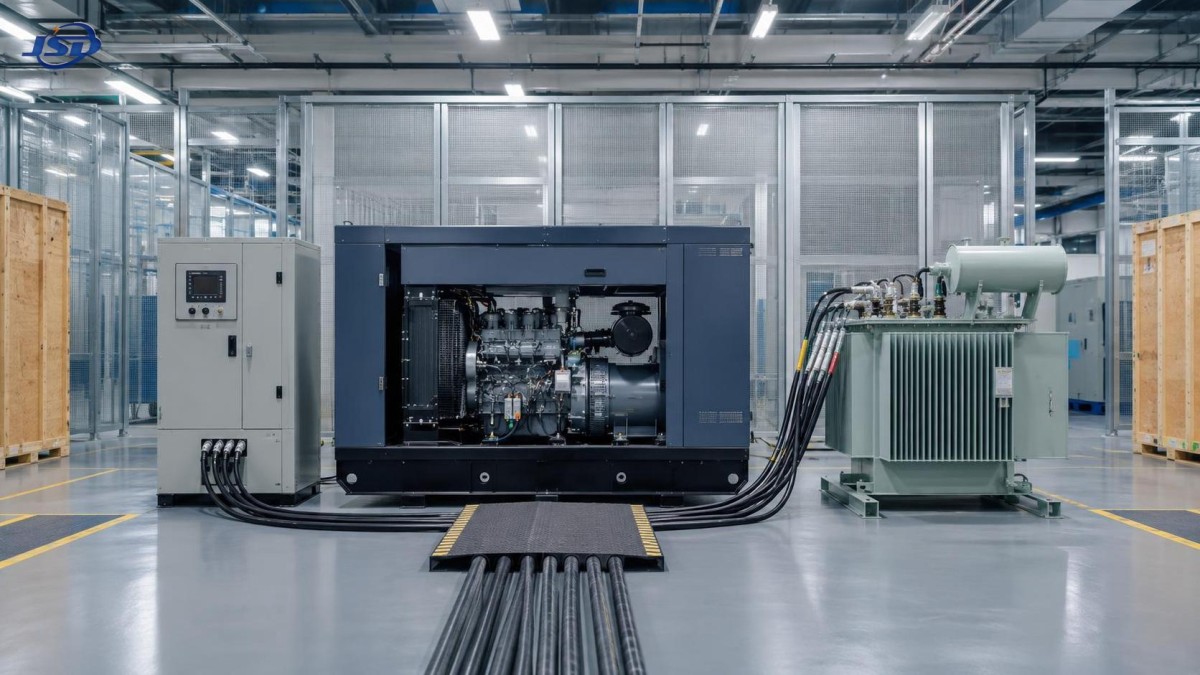
Buyers should also confirm whether the factory’s test arrangement can handle the rated capacity and voltage of the ordered unit. If testing must be outsourced or a shared test bay is required, that introduces a separate scheduling dependency. Agree early on whether the factory will issue a test procedure for approval, what records will be supplied, and how a failed or incomplete test affects the shipment date.
Customization Often Creates the Largest Hidden Delay
Customization is a normal part of industrial genset procurement, but each custom request needs to be translated into an engineering and supply-chain consequence. Some changes are low risk: a paint color, a label language, or a routine cable-entry preference. Others can reopen design work or require parts that are not used in the factory’s standard package.
Common delay triggers include nonstandard voltage or frequency, a large fuel tank integrated into the base frame, special sound limits, containerized layouts, additional protection relays, remote monitoring protocols, unusual circuit-breaker specifications, high ambient temperature requirements, marine or corrosion protection, and site-specific exhaust routing. A request for “equivalent” equipment can also create delay if the buyer’s consultant must review each proposed substitute.
The practical control is a technical freeze. Before the supplier starts full production, confirm the approved general arrangement, single-line diagram, control philosophy, interface points, cable direction, fuel arrangement, acoustic configuration, and required documents. The purchase order should state what constitutes a change after this point, how the revised schedule will be assessed, and who is authorized to approve the change.
Do not let unresolved technical comments sit outside the production plan. A comment that appears minor to a procurement team may stop panel wiring, enclosure fabrication, or final testing. The factory should flag open items that can affect the critical path rather than continuing to report a nominal delivery date.
Review the Electrical Interface Beyond the Generator Itself
A diesel genset is frequently purchased as one part of a wider power system. Lead time can be lost when the generator is ready but the interface equipment is not: automatic transfer switches, synchronization panels, medium-voltage switchgear, step-up transformers, protection panels, cables, or site-installed fuel systems. The procurement package should identify who is responsible for each interface and whether equipment from different suppliers has compatible ratings, protection logic, physical connections, and delivery milestones.
This is particularly relevant for medium-voltage backup or distributed-power projects. A generator package may require transformation equipment between the alternator output and the distribution network. When the project also calls for a low-loss distribution transformer, a specification such as the SBH15 Amorphous Alloy Transformer may be considered for applications where continuous operating efficiency and noise are material selection factors. Its procurement timeline, voltage ratio, vector group, tap arrangement, outdoor installation details, and IEC 60076 requirements should be reviewed alongside the genset schedule. Treating the transformer as a later electrical accessory can leave a complete generator package waiting for a missing grid interface.
The same principle applies to control integration. A factory can deliver a compliant diesel generator, but a project may still be delayed if the automatic transfer sequence, remote monitoring points, breaker interlocks, or synchronization scheme are not agreed across suppliers. Procurement should ask for interface drawings early enough to resolve these points before cabinets are wired and equipment is dispatched.
Define the Point at Which “Delivery” Has Happened
Lead-time disputes often arise because buyer and supplier use different delivery definitions. “Ready in eight weeks” may mean the unit has completed assembly. It may mean it is ready for factory acceptance testing. It may mean it is packed and available for collection. It may also be presented as an estimated arrival date, even though ocean transit, port handling, customs clearance, and inland delivery are outside the manufacturing schedule.
The order should use a specific delivery term and a location. For example, the agreed milestone could be factory acceptance completion, readiness for collection at the factory, delivery to a named port, or arrival at a designated project site. Each has a different risk allocation. A supplier should not be evaluated as late for ocean freight disruption if the agreed term is ex works, but a buyer also should not assume site availability when the supplier has only promised factory readiness.
Export packing and documentation need the same attention. Large gensets may require special lifting arrangements, moisture protection, container planning, oversized cargo handling, certificates, packing lists, origin documents, manuals, and inspection records. Errors in these areas can prevent collection or customs release even after manufacturing is finished.
For imported equipment, ask who is responsible for freight booking, whether the shipment requires special handling, how long documentation preparation normally takes within the agreed workflow, and when final shipping dimensions and weights will be issued. Avoid reserving installation cranes or delivery windows based only on a provisional factory completion date.
Use Commercial Terms That Encourage Early Visibility
Lead-time risk cannot be removed solely through liquidated damages or late-delivery clauses. Those provisions may provide leverage or compensation, but they do not recover a missed commissioning window. The more useful commercial structure is one that forces early visibility of risk and gives the buyer practical options before the delay becomes irreversible.
Consider requiring regular milestone reporting for critical orders, with the report tied to objective evidence such as approved drawings, component arrival records, assembly completion, test booking, test reports, and packing photographs. The frequency should match the urgency of the project. A monthly update may be sufficient for a routine replenishment order, while a project with a narrow installation window may need more frequent reporting as shipment approaches.
Payment milestones should also be aligned with meaningful progress. Large payments made solely on order placement and nominal factory completion provide limited control if testing, documentation, or shipment readiness remain unresolved. Where commercially appropriate, retain a portion until agreed inspection or shipment conditions have been met.
There is also a procurement discipline issue: avoid making the supplier responsible for delays caused by the buyer’s own slow approvals. Assign a named technical approver, set response deadlines for drawings and submittals, and consolidate comments. Repeated fragmented revisions are one of the most avoidable causes of schedule movement in customized generator packages.
Questions to Put to the Factory Before Award
A short set of focused questions often reveals more than a broad supplier questionnaire:
- What is the confirmed shipment milestone, and what exact event does it represent?
- Which three to five components control the delivery date for this configuration?
- Are those components in stock, allocated, ordered, or pending technical approval?
- What factory production and test slots have been reserved for this order?
- Which customer approvals are required before procurement or fabrication can proceed?
- Can the specified unit be tested at rated conditions in the factory, and when is the test slot available?
- Which external suppliers, inspection bodies, freight providers, or ports could affect the schedule?
- What evidence will be provided at each milestone, and who will notify the buyer of a forecast delay?
A credible diesel genset factory will not always promise the shortest date. It should, however, be able to explain the schedule in enough detail for the buyer to see where risk sits and what can be controlled. That transparency is generally more valuable than an aggressive lead-time figure that depends on unstated assumptions.
For procurement teams, the decision is less about finding a supplier that claims certainty and more about selecting one whose delivery plan can withstand normal variation. When component status, engineering approvals, test capacity, electrical interfaces, and shipping responsibilities are visible before award, the promised date becomes something the project team can manage rather than simply hope for.

Get a Quote
Regardless of whether you require general advice or specific support, we are happy to help you.
Send Us Your Inquiry Today

Jinshida Electric remains committed to contributing to global energy development through professional manufacturing and superior service.