





How to assess a distribution transformer manufacturer's drying process
How to assess a distribution transformer manufacturer's drying process
A transformer’s long-term insulation reliability depends heavily on how effectively moisture is removed during manufacturing. For technical evaluators, assessing a distribution transformer manufacturer’s drying process requires more than checking equipment specifications. It means examining process controls, moisture acceptance criteria, and traceable production records—and checking what happens after drying, before the insulation is protected by oil.
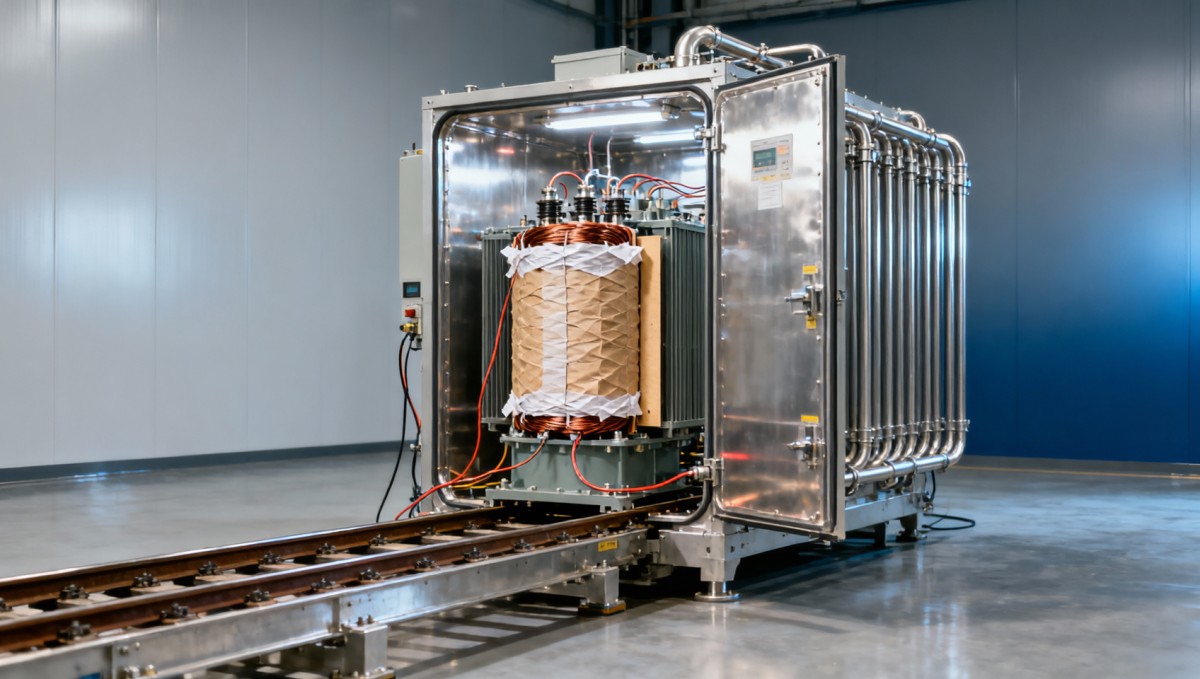
The most revealing question is not “How powerful is your vacuum plant?” It is “Show me how you decided this particular active part was dry enough.” A supplier that can answer with linked production records is offering stronger evidence than one presenting an impressive chamber photograph.
Define what the drying process must achieve
For oil-immersed distribution transformers, the main concern is moisture retained in cellulose insulation: winding paper, pressboard barriers, spacers, and other absorbent components. Moisture affects dielectric behavior and insulation aging. Removing it is not simply a matter of drying the surrounding air or treating the insulating liquid.
Start by confirming the transformer design, insulation materials, liquid type, and manufacturing sequence. This assessment focuses on cellulose-insulated, liquid-filled units; cast-resin transformers require a different review of resin preparation, casting, and curing. Even within oil-immersed designs, a drying recipe qualified for one insulation build should not automatically cover a substantially thicker or heavier assembly.
Ask for the manufacturer’s residual-moisture target, its basis, and the verification method. Do not impose a universal percentage without specifying whether it refers to solid insulation or liquid, how it is measured, and which purchase specification applies. A number without a measurement basis is not an acceptance criterion.
Judge the method against the actual production load
Manufacturers may use hot-air ovens, vacuum drying with controlled heating, vapor-phase equipment, or combinations of these. Equipment choice matters, but it does not determine process quality on its own. A well-qualified conventional process can be more dependable than sophisticated equipment operated with poorly defined loading rules.
Hot-air heating can remove moisture, but its effectiveness depends on temperature, airflow, incoming moisture, insulation thickness, and time. Vacuum-assisted processes encourage moisture removal at reduced pressure, yet still require adequate heat transfer into the insulation. Vapor-phase drying uses condensing solvent vapor to transfer heat and requires appropriate solvent management and recovery controls.
The useful audit question is how the supplier qualified its process for the products you intend to buy. Request the permitted load size, arrangement, insulation range, and recipe-selection rules. If small and large active parts share a batch, ask how the slowest-drying assembly is identified. Chamber utilization should not quietly become the deciding factor for cycle duration.
Read temperature and vacuum trends together
A temperature setpoint proves what the controller was instructed to do—not what the coldest insulation actually experienced. Review sensor placement and the evidence used to establish temperature uniformity. During qualification, representative measurements should demonstrate that difficult-to-heat regions receive adequate treatment without overheating more exposed materials.
Routine production may use fewer sensors than qualification trials. That can be reasonable if the supplier can explain the relationship between monitored temperatures and the validated load. What is harder to accept is a drying timer that starts as soon as chamber air reaches its setpoint, with no demonstrated allowance for the assembly’s thermal lag.
For vacuum records, confirm that pressure is stated as absolute pressure and that units are consistent. Examine pressure at the chamber, not merely the pump’s advertised ultimate vacuum. Gauge location, calibration, connecting pipework, leakage, and water-vapor loading all affect how the reading should be interpreted.
Request a complete cycle trace showing heating, evacuation, hold stages, interruptions, and release. Temperature and pressure should make sense together. A low pressure reading while the load remains too cool does not establish that moisture has migrated out of thick pressboard.
Compare an ordinary batch with one that required an extended cycle. Ask what triggered the extension and who approved release. This reveals whether operators follow an endpoint decision or simply run a fixed schedule regardless of load condition.
Check how “dry enough” is established
Elapsed time is a process parameter, not direct proof of dryness. A fixed recipe can be acceptable when qualified for a defined product family and controlled incoming conditions, but the manufacturer should still explain how that qualification was established and when it must be repeated.
Useful endpoint evidence may include moisture-extraction trends, pressure-rise testing, exhaust moisture or dew-point measurements, and representative solid-insulation moisture testing. Each has limits:
- Collected water: Declining collection can support the assessment, but poor heat input, collection losses, or a change in load can distort the trend.
- Pressure-rise testing: Pressure after isolation reflects leakage and outgassing as well as moisture. Test temperature, duration, and acceptance limits must be defined.
- Dew point: The result depends on sampling location, gas pressure, temperature, and sample-line condition. It is not automatically a direct measurement of paper moisture.
- Solid-insulation samples: Sampling can provide stronger material evidence, but witness pieces must represent the load. A thin, exposed sample may dry faster than insulation within a winding.
Where Karl Fischer testing is used, check the sampling, extraction, or oven method and handling precautions. Exposing a sample to humid air can undermine the result before testing begins. The method should be suitable for the material being evaluated.
A distribution transformer manufacturer should explain how these indicators support its release decision. Treat routine dielectric tests as complementary evidence, not a retrospective moisture measurement. Passing a factory withstand test does not, by itself, demonstrate the intended residual moisture level in cellulose.
Follow the active part from drying to oil filling
A credible drying cycle can be undermined by uncontrolled handling afterward. Cellulose can reabsorb moisture during cooling, assembly, inspection, and transfer. Walk this route during the factory assessment rather than stopping at the drying chamber door.
Look for defined exposure limits, environmental monitoring where applicable, and a clear response when the permitted interval is exceeded. Depending on the process, protection may involve dry-air handling, sealed transfer, a controlled atmosphere, or prompt filling. There is no single exposure time suitable for every factory climate and insulation temperature.
The records should link drying release, chamber opening, tanking, and filling times. If assembly is delayed overnight, the procedure should specify whether protection, reassessment, or redrying is required. “We normally fill immediately” is weaker than a documented rule supported by actual timestamps.
Review oil preparation separately. Confirm moisture and gas-control requirements, sampling points, transfer cleanliness, and filling conditions. Low water content in freshly treated oil does not prove dry cellulose. Also verify that vacuum filling is performed only within the tank’s qualified vacuum capability; not every distribution transformer tank is designed for the same pressure differential.
Test traceability with a real serial number
Choose a completed unit and ask the supplier to reconstruct its drying history. This is usually more informative than reviewing a blank quality form. For batch processing, the records must connect the transformer serial number to the chamber load and its release decision.
The evidence package should identify the recipe revision, equipment used, relevant instrument calibration status, cycle trends, endpoint results, operator, and release authority. Deviations deserve particular attention: interrupted heating, vacuum loss, instrument faults, and excessive post-drying exposure should have documented dispositions.
Power continuity belongs in this discussion. Ask what remains operational during an outage and how interrupted cycles are assessed. For limited auxiliary or temporary backup duties, a 50kW/100kWh Portable Trailer Energy Storage System may be relevant, subject to load, runtime, and electrical-compatibility checks. Its LiFePO4 battery, BMS, and EMS do not establish suitability for the drying plant itself; heaters, pumps, and starting currents require a separate assessment.
A backup source also does not replace restart rules. The manufacturer must decide whether an interrupted batch can resume, needs an extended cycle, or requires requalification against its established criteria.
Make supplier approval conditional on evidence
Separate missing paperwork from missing process understanding. An incomplete record may be correctable. A supplier unable to explain its endpoint, load qualification, or exposure controls presents a more fundamental concern. New transformer designs, changed insulation builds, and major equipment modifications should trigger a documented review of recipe applicability.
Jinshida Electric Power Technology Co., Ltd. focuses on power transmission and distribution equipment for grid, industrial, renewable-energy, and infrastructure applications. Its stated emphasis on manufacturing processes and quality management should be assessed through the same evidence-led approach: product-specific procedures, traceable records, and technically justified release decisions—not general assurances.
Before approval, request one representative drying dossier and agree on the outstanding acceptance criteria in writing. If the temperature history, endpoint evidence, and protected transfer cannot be connected to the transformer being supplied, the drying process has not yet been adequately demonstrated.

Get a Quote
Regardless of whether you require general advice or specific support, we are happy to help you.
Send Us Your Inquiry Today

Jinshida Electric remains committed to contributing to global energy development through professional manufacturing and superior service.