





Open-frame or enclosed: which industrial genset fits a remote site?
Open-Frame or Enclosed: Which Industrial Genset Fits a Remote Site?
Choosing between an industrial open frame genset and an enclosed unit can directly affect uptime, safety, maintenance costs, and project delivery at remote sites. For project managers, the decision is rarely just about generator price or rated output. It depends on environmental exposure, noise limits, fuel logistics, transport access, operator availability, and the reliability of the wider electrical system connected to the generator.
A remote quarry, mining camp, construction site, pumping station, renewable-energy substation, or temporary industrial plant may have no dependable utility supply. In such settings, the genset often becomes the foundation of the site’s power plan. If it is poorly matched to the operating conditions, a seemingly minor issue—dust entering the radiator, an inaccessible service point, a voltage dip during motor starting, or insufficient sound control—can delay work well beyond the time required to repair the engine.
The practical question is not whether open-frame or enclosed generators are “better.” Each configuration solves a different set of problems. The right choice begins with the site, then moves through load behavior, distribution design, maintenance strategy, and deployment constraints.
What changes when the frame is left open?
An industrial open frame genset exposes the engine, alternator, control panel, cooling system, and associated components without an integrated weatherproof acoustic canopy. It is commonly selected where the generator will sit inside a purpose-built plant room, beneath a suitable shelter, or within a containerized power module that already provides environmental and security protection.
Its strongest advantage is access. Technicians can inspect belts, hoses, filters, battery connections, exhaust components, and electrical terminations with fewer physical barriers. This matters on projects with competent maintenance teams and planned servicing routines. Open units can also be easier to integrate into custom layouts, particularly where fuel tanks, exhaust routing, switchgear, ventilation ducts, and transformer equipment must fit within a restricted structure.
The reduced enclosure weight and simpler structure may also help when a generator must be positioned in a basement plant room, lifted into a skid package, or incorporated into a larger electrical house. However, “open” does not mean the unit can simply be placed outdoors. Exposure to rain, windblown sand, salt-laden air, direct sun, wildlife, or unauthorized access can quickly undermine the advantages of easy maintenance.
An open generator also transfers responsibility for sound attenuation, ventilation, drainage, fire separation, and guarding to the project design. That can be entirely appropriate, but it requires coordination early in the programme. A plant room with inadequate air paths can create overheating; a poorly designed exhaust route can raise backpressure; an improvised cover can trap heat instead of protecting the machine.
Why enclosed gensets are often the safer remote-site default
An enclosed genset incorporates a canopy or housing around the generating set. Depending on the configuration, the enclosure may provide weather protection, acoustic treatment, security features, integrated lifting points, and space for controls or auxiliary equipment. For a remote site with limited infrastructure, this packaged approach can remove several construction tasks from the critical path.
The enclosure is especially valuable where the generator must operate outside for months or years. It helps protect electrical connections and mechanical components from direct environmental exposure, while lockable access doors reduce casual interference. Where workforce accommodation, nearby communities, or environmental permit conditions create noise constraints, an acoustic enclosure can be a decisive factor. The required sound level must still be confirmed at the relevant distance and under actual operating conditions; “silent generator” is not a meaningful engineering specification by itself.
There are trade-offs. Service access can be tighter, particularly if the enclosure is installed close to a fence, wall, or embankment. In hot climates or at altitude, cooling performance deserves close review because the engine and alternator depend on properly managed airflow. A canopy does not eliminate the need for maintenance. It can make a neglected maintenance plan less visible until a fault becomes serious.
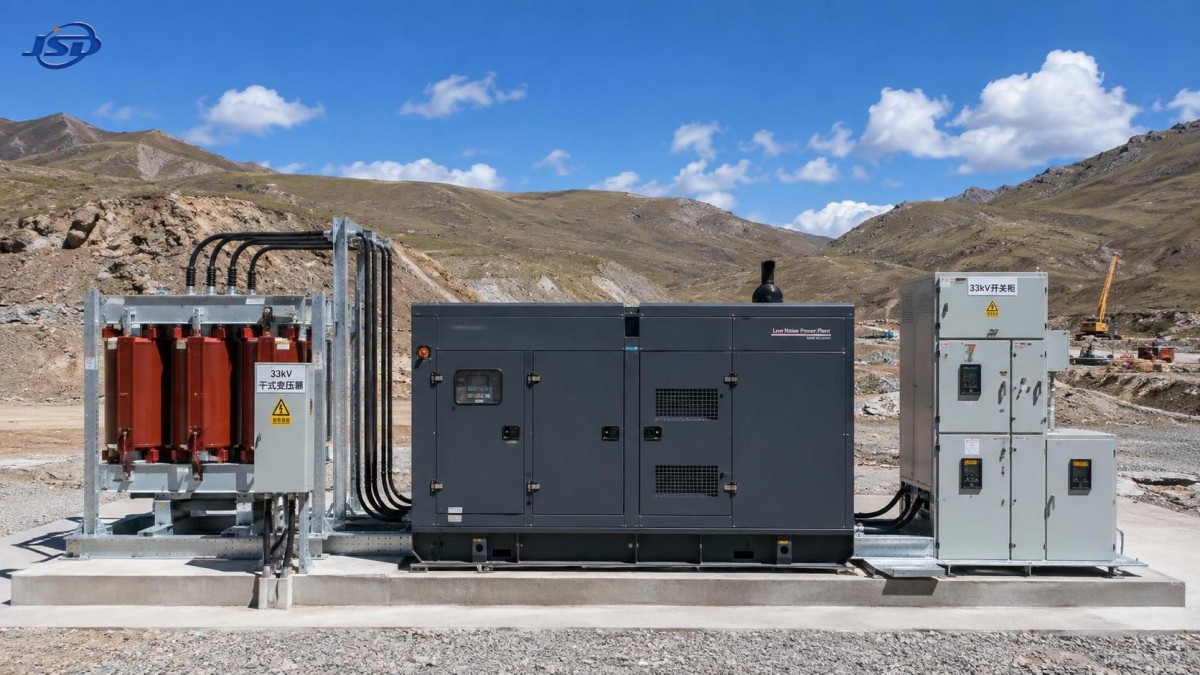
For temporary works, enclosed units are often easier to mobilize as self-contained assets. Yet transport dimensions, gross weight, lifting arrangements, and route restrictions should be verified before procurement. A canopy that suits a paved logistics route may be difficult to move over narrow mountain roads, soft ground, or a site reached only by small-capacity lifting equipment.
Compare the generator against the operating reality
This comparison is useful, but it should not replace a load and installation review. A poorly sized enclosed unit remains poorly sized; a correctly sized open-frame generator can perform well for years in an appropriately designed power house.
Start with the load profile, not the nameplate total
Remote projects frequently make the mistake of adding up equipment nameplates and selecting a generator from the total. That does not reveal how the load behaves. Motor starting, welding equipment, crushers, pumps, compressors, variable-speed drives, battery chargers, and transformer energization can all affect generator voltage and frequency differently.
Project teams should map continuous load, expected peak load, step-load changes, starting sequence, power factor, harmonic-producing loads, and future expansion. The genset’s standby, prime, or continuous-duty rating also needs to match the intended operating regime. These ratings are not interchangeable. If the site depends on generation as its normal source of power, the duty-cycle discussion becomes more important than a headline kVA figure.
Transformer selection belongs in the same conversation. When generation is distributed across a medium-voltage network, the generator, protection scheme, cable runs, transformer impedance, earthing method, and low-voltage loads must operate as one coordinated system. Inrush current during transformer energization, for example, can be relevant to generator sizing and protection settings, especially where multiple transformers are switched in sequence.
Do not treat the transformer as a downstream detail
At a remote industrial site, a genset may supply low-voltage loads directly, feed a step-up transformer for a medium-voltage distribution loop, or support a transformer that reduces incoming medium voltage for local equipment. The configuration changes the questions that must be asked. Voltage ratio, vector group, impedance, protection coordination, neutral arrangement, fault level, and cable length can all affect whether the system behaves predictably during a disturbance.
Where indoor distribution equipment is needed near sensitive operations, dry-type transformers may be considered because they avoid the oil-leakage risk associated with oil-filled designs and can offer strong fire-performance characteristics. The 33kV Cast Resin Dry-Type Distribution Transformer is designed for 33kV input and 0.4kV output applications, with listed capacities from 30 to 2500 kVA. Its stated 175kV lightning impulse withstand capability, 6% short-circuit impedance, temperature protection options, and F1-class fire performance may be relevant where the project specification calls for a cast-resin transformer. Final suitability still depends on the network study, installation environment, required standards, and the generator’s transient performance.
This is where a power-equipment supplier should contribute more than a catalogue. Jinshida Electric Power Technology works across the research, manufacturing, and application of transmission and distribution equipment, supporting projects in grid construction, industrial manufacturing, new energy, and infrastructure. In generator-linked installations, the useful early-stage discussion is usually about interfaces: rated voltage, capacity, frequency, connection group, loss requirements, protection philosophy, installation space, and how equipment will be maintained after commissioning.
Environmental risks are more specific than “outdoor use”
Remote sites are rarely uniformly harsh. A desert project may have low humidity but severe dust and high daytime temperatures. A coastal facility may face salt corrosion and wind-driven rain. A high-altitude installation may need derating considerations because air density affects cooling and engine performance. Cold regions introduce fuel treatment, starting reliability, battery performance, and condensation concerns.
Ask the supplier to review the actual exposure rather than accepting a generic “weatherproof” description. Consider the air intake path, radiator protection, enclosure coating, drainage routes, fuel-water separation, cable entry sealing, anti-condensation arrangements, and whether doors can be safely opened during high winds or snowfall. For very dusty locations, the maintenance interval for filters and radiator cleaning may matter more to availability than the original enclosure choice.
Fuel is another frequent weak point. A generator can be electrically well designed and still fail operationally because daily fuel supply, bulk storage, filtration, transfer pumps, or spill containment were treated as separate packages. Review fuel autonomy against realistic access conditions, not ideal delivery schedules. Also confirm whether the tank arrangement changes transport weight, service access, or local fire-safety obligations.
Maintenance access should be designed before delivery
The difference between an open-frame and enclosed generator becomes less important if no one can safely service either one. Before finalizing the layout, identify which panels must open, where filters are changed, how oil is drained, where batteries are isolated, and how a radiator or alternator would be reached if major work became necessary. Check crane access, lifting beams, floor loading, door widths, and escape paths.
For an unattended site, remote monitoring can provide meaningful protection only when alarm responsibilities are clear. Alerts for low fuel, high coolant temperature, battery issues, abnormal voltage, overload, and failed start should connect to a defined response process. A monitoring screen does not repair a generator, and spare parts held hundreds of kilometres away do not solve a time-critical shutdown.
It is also worth separating routine service from fault recovery. Routine work may be manageable by local technicians, while alternator controls, synchronizing systems, transformer protection, or medium-voltage switching often require specialist support. That distinction can influence whether a modular enclosed package is preferable to a custom open-frame installation.
A practical decision path
Choose an industrial open frame genset when the project already has a properly ventilated, secure, and maintainable generator room or container; when custom integration is central to the design; and when the team can take responsibility for external noise, weather, and safety measures. It is a strong engineering option, not a lower-tier option, when its installation environment is controlled.
Choose an enclosed generator when speed of deployment, outdoor resilience, basic acoustic control, and equipment security are priorities. It is often the more practical route for temporary sites or isolated facilities without a finished power house. Even then, verify cooling performance, canopy access, lifting logistics, noise requirements, and the limitations of the supplied enclosure.
Before issuing a purchase order, bring the generator supplier, transformer supplier, electrical designer, civil contractor, and operations team into the same review. Confirm the load schedule, starting sequence, distribution voltage, protection philosophy, environmental conditions, fuel plan, access route, maintenance space, required documentation, and acceptance testing scope. That coordination is usually what determines whether remote power remains dependable after the commissioning team has left site.

Get a Quote
Regardless of whether you require general advice or specific support, we are happy to help you.
Send Us Your Inquiry Today

Jinshida Electric remains committed to contributing to global energy development through professional manufacturing and superior service.