





How industrial transformer losses affect a plant’s energy costs
It often starts during a routine budget review. Electricity spending has risen, production volume has not changed enough to explain it, and the utility bill offers little detail beyond total consumption and demand. Maintenance may confirm that motors, compressors, and process equipment are operating normally. Yet one cost source is easy to overlook: energy lost inside the plant’s transformers every hour they remain energized.
This matters because transformer losses are not tied only to obvious production activity. A transformer can consume energy when the plant is quiet, during shifts with reduced loading, and even when downstream equipment is switched off. If an older or poorly matched unit stays in service for years, those small continuous losses become an operating-cost issue rather than a technical footnote. For anyone reviewing equipment purchases, an industrial transformer should therefore be assessed as a long-term energy asset, not simply as a piece of electrical infrastructure with a purchase price.
The cost problem hidden behind a stable power supply
Transformers are expected to be reliable and uneventful. When lights remain on and production lines keep running, there may be little reason to question them. That is precisely why loss-related costs can remain unexamined. The unit may be functioning within its operating limits while still using more energy than a newer design or a better-sized replacement would require.
Two broad loss categories determine the financial picture. They behave differently, so treating them as one general efficiency number can lead to poor purchasing decisions.
- No-load loss, also called core loss or iron loss, occurs whenever the transformer is energized. It is associated mainly with the magnetic core and remains relatively constant regardless of the load supplied.
- Load loss, commonly called copper loss, rises as current passes through the windings. It varies with loading and increases approximately with the square of the load current.
In practical terms, no-load loss is paid for throughout energized hours. Load loss becomes more important when a transformer routinely carries substantial current. A plant operating around the clock may place considerable weight on no-load loss. A facility with a heavily loaded distribution section may find that load loss deserves equal or greater attention. The right conclusion depends on the actual load profile, not on a generic claim that one loss type is always more important.
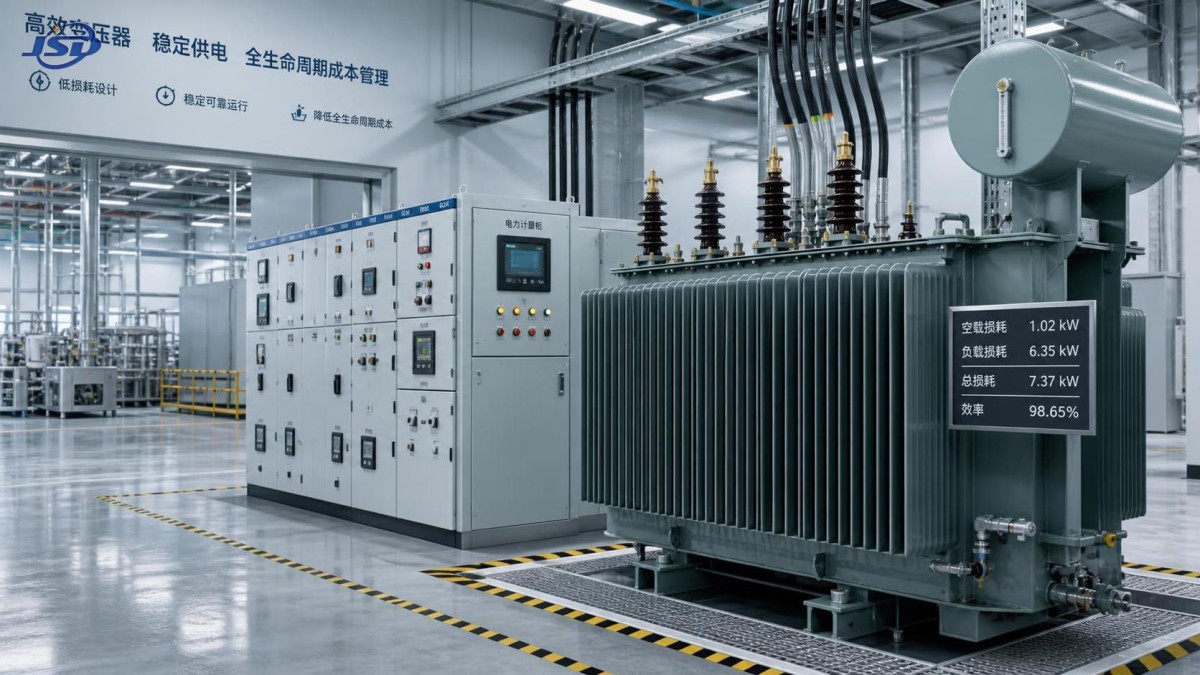
A common planning mistake is to compare transformer quotations by rated capacity and purchase price alone. That comparison can look clear on a procurement sheet, but it does not answer the more useful question: which option will cost less to own while meeting the required operating conditions? A lower initial price may be offset by higher losses over the service life. Conversely, a low-loss model may not be financially justified if its premium does not match the site’s operating hours, energy price, and loading pattern.
Start with the operating pattern, not the nameplate
Before requesting replacement quotations or approving a new installation, build a basic picture of how the existing transformer is used. This does not require invented precision. It requires enough reliable information to avoid making a capital decision from a single annual electricity total.
First, identify how many hours the transformer is energized. A warehouse that operates one shift may still leave its distribution transformer energized overnight and through weekends. A process plant may maintain continuous operation but experience large seasonal or batch-related load swings. The energized schedule establishes the period during which no-load loss accumulates.
Next, examine loading. Useful sources include interval meter data, supervisory system records, power quality measurements, and demand records. If only limited data are available, gather readings across representative working days, non-production periods, and high-demand conditions. The objective is not to create a perfect model immediately. It is to distinguish between a transformer that is lightly loaded most of the time, one that operates near its design range, and one that faces frequent overload risk.
It is also worth separating normal demand from exceptional peaks. A transformer selected only for a brief peak may run lightly loaded for most of its life. In some facilities that is necessary for reliability or planned expansion. In others, it is an inherited sizing decision that was never revisited. The financial consequence is that continuous core losses are being carried by capacity that may not be needed under ordinary conditions.
Questions that make the review more useful
Instead of asking whether a transformer is “efficient,” ask for the information that reveals where cost is created:
- What are the stated no-load and load losses at the relevant rating and reference conditions?
- What is the typical, not merely maximum, operating load?
- How many hours each year is the transformer energized?
- Will future production, electrification, or new machinery materially change the load profile?
- Does the transformer serve sensitive equipment that may impose harmonic or power-quality considerations?
- Are there existing temperature, noise, maintenance, or space constraints that limit replacement choices?
These questions turn a vague energy-efficiency discussion into a decision that can be reviewed alongside other capital expenditures.
Turning loss figures into an ownership-cost comparison
The calculation concept is straightforward, even if the final model needs technical input. Annual no-load energy is estimated from no-load loss multiplied by energized hours. Annual load-loss energy is estimated from the rated load loss, adjusted for the actual load level over time. Because load loss changes sharply as loading changes, using only the nameplate rating can overstate or understate the result.
For a simplified comparison, a team may begin with the following relationships:
Annual no-load energy ≈ no-load loss × energized hours
Annual load-loss energy ≈ rated load loss × load factor squared × operating hours
The load factor should reflect representative demand rather than an assumed full-load condition. Where demand varies significantly, divide the year into operating bands—such as low-production, normal-production, and high-demand periods—and calculate each period separately. This provides a more credible estimate than one average figure applied to every hour.
After estimating annual energy losses, apply the electricity cost used for internal investment evaluation. Depending on the site, the model may also need to consider demand charges, time-of-use pricing, standby arrangements, and expected energy-price changes. Those elements should be handled carefully. If they cannot be supported by available tariff information, it is better to document the assumption than to hide it inside a single savings estimate.
A useful approval document shows the assumptions beside the results. It should state the transformer alternatives, loss values supplied for each option, expected operating profile, electricity-cost basis, installation costs, and the period used for comparison. This makes the analysis easier to challenge constructively. If someone believes the plant will operate longer hours or at a different load, the input can be revised without rebuilding the entire case.
Where selection decisions commonly go wrong
One frequent error is oversizing without a defined reason. Extra capacity can be prudent where expansion is committed, where starting currents are significant, or where reliability requirements justify margin. But “larger is safer” is not a complete economic argument. A larger transformer may bring higher no-load losses, and if demand remains modest, the plant pays that cost continuously.
The opposite error is selecting a unit too close to expected demand. This can increase load losses, elevate operating temperature, limit future flexibility, and create avoidable operational concerns. The goal is not the smallest possible transformer. It is a rating and design suited to real duty, credible growth plans, ambient conditions, and the electrical characteristics of the connected loads.
Another weak approach is to use efficiency expressed at only one load point as the deciding factor. A transformer may perform very well at a stated percentage load while the plant rarely operates there. Request loss data and evaluate it against the facility’s own load pattern. An industrial transformer purchase becomes more defensible when the projected use case is visible rather than implied.
Harmonics also deserve attention where variable-speed drives, rectifiers, welding equipment, data systems, or other non-linear loads are present. Harmonic currents can contribute to additional heating and losses. A financial comparison that ignores a known power-quality condition may look favorable on paper but fail to describe actual operating stress. Technical review and commercial review should meet at this point: the lowest evaluated energy cost is relevant only if the proposed equipment is appropriate for the application.
A practical route from concern to purchase decision
When electricity costs raise questions but replacement is not yet justified, begin with verification rather than assumptions. Confirm transformer ratings, age, present loading, maintenance history, and loss data available from documentation. Compare those records with meter trends and production schedules. If the unit is unusually warm, noisy, frequently overloaded, or supporting changed loads, involve qualified electrical personnel to investigate before drawing financial conclusions.
For a planned expansion or new facility, include loss evaluation during the design stage. This is usually easier than revisiting the decision after equipment is installed. Ask suppliers to provide comparable technical data for the proposed ratings and specify the operating scenario used in the commercial evaluation. Ensure that bids are compared on equivalent bases; otherwise, one quotation may appear less expensive simply because it omits a required accessory, protection feature, or installation allowance.
Power continuity should be reviewed in parallel. Transformer efficiency reduces recurring losses, but it does not replace a contingency plan for grid interruptions or maintenance shutdowns. Where an independent temporary or standby power source is part of the operating plan, equipment such as an Open Type Diesel Generator Set may be considered within that separate resilience discussion. Its role is to provide generation support when appropriate, not to reduce transformer core or winding losses. Keeping these functions distinct prevents a backup-power purchase from being mistakenly presented as an energy-loss remedy.
Records worth retaining after installation
Once a transformer is commissioned, retain the nameplate details, factory loss information, test records supplied for the project, protection settings, and baseline load measurements where available. These records support later budget reviews and make it easier to identify whether operating conditions have changed. They also help when a site considers consolidation, expansion, or replacement years later.
Periodic monitoring does not need to become a burdensome reporting exercise. A sensible approach is to review demand trends after major production changes, compare actual loading with the original planning assumptions, and investigate unusual temperature or energy patterns. The point is to catch a mismatch before it becomes accepted as normal operating cost.
Making the approval case credible
The strongest capital request does not claim that a high-efficiency transformer will automatically solve every energy-cost problem. It shows where losses occur, how the site operates, which assumptions drive the estimate, and what risks remain outside the calculation. It also distinguishes energy savings from reliability benefits, maintenance considerations, and future capacity needs.
If the analysis shows only a modest difference between options, that is still useful. It may indicate that installation disruption, serviceability, lead time, or expansion plans should carry more weight. If the loss difference is material over the expected operating period, the decision can be framed as a lifecycle-cost choice rather than a premium equipment request.
Transformer losses are easy to ignore because they are silent, continuous, and distributed across the utility bill. Bringing them into the purchasing process creates a clearer basis for evaluating cost, risk, and fit. The right choice is not automatically the lowest-loss unit or the lowest-priced unit. It is the one whose loss profile, capacity, operating conditions, and project requirements match the plant’s real financial and electrical needs.

Get a Quote
Regardless of whether you require general advice or specific support, we are happy to help you.
Send Us Your Inquiry Today

Jinshida Electric remains committed to contributing to global energy development through professional manufacturing and superior service.