





What testing documents to ask from a transformer manufacturer
Meta Title: What Testing Documents to Ask From a Transformer Manufacturer
If you are qualifying a transformer manufacturer before purchase, the most useful documents are not glossy brochures or general quality claims. What matters is a clear set of test records that prove the transformer was designed, built, and verified against the required standard. For most projects, that means checking routine test reports first, then confirming type test evidence, special test records if your application needs them, and the basic compliance and quality certificates behind the factory process. This is where many sourcing decisions either become safer or much riskier.
A short answer, if you need one: ask for routine test reports for the exact unit or batch, valid type test reports for the same design family, any project-specific special test reports, material and component certificates where relevant, the nameplate and drawing package, and the manufacturer’s quality system certificates. If any of those are vague, outdated, or mismatched to the offered transformer, treat that as a warning sign.
What you should ask a transformer manufacturer for first
In practice, testing documents fall into two groups. The first group proves the transformer you are buying was actually tested before shipment. The second group proves the design itself has been validated under recognized standards.
Start with these:
- Routine test report for the exact transformer being supplied
- Type test report for the same rating, design, and insulation class where applicable
- Special test report, if your specification requires non-standard checks
- Factory inspection record or final inspection release note
- Nameplate data sheet and approved general arrangement drawing
- Quality management certificate such as ISO 9001, if required by your supplier qualification process
- Component or material certificates for critical parts when contractually required
That sounds straightforward, but the detail that trips people up is document matching. A report can be technically real and still be useless if it belongs to a different rating, different tap range, different cooling method, or a previous design revision.
Routine test reports: the one document you should never skip
For quality and safety teams, the routine test report is usually the most important document in the file. It relates to the actual manufactured unit, not just a similar transformer tested years ago.
Depending on transformer type and the applicable standard, a routine test report often includes items such as winding resistance, voltage ratio, vector group verification, no-load loss and current, load loss and impedance voltage, applied voltage test, induced voltage test, insulation resistance checks, and sometimes leakage checks or oil tests for oil-immersed units.
The exact list depends on whether you are buying a distribution transformer, power transformer, dry-type transformer, cast resin transformer, or a special design. That is why the report should always be checked against the purchase specification and the governing standard, not read in isolation.
When reviewing a routine report, do not stop at “pass.” Check whether the report shows:
- Transformer serial number
- Rated power, voltage, frequency, and phase
- Tap positions tested
- Referenced standard and test method
- Actual measured values, not only pass/fail remarks
- Test date, signatures, and traceable approval
If the document is just a generic template with blanks filled in loosely, it does not give much protection to your project.
One common mistake is assuming routine tests alone are enough. They are essential, but they do not replace design validation.
Type test reports tell you whether the design has been proven
A competent transformer manufacturer should be able to provide type test evidence for the offered design family, especially for standard products used in utility, industrial, renewable energy, and infrastructure projects.
Type tests are not usually repeated on every unit because they are more extensive, more time-consuming, and often more expensive. Instead, they demonstrate that the transformer design can meet the required performance under the specified conditions.
Depending on the transformer and standard, type test documentation may cover:
- Temperature rise test
- Lightning impulse withstand test
- Short-circuit withstand capability, often supported by test evidence or design verification
- Sound level measurement
- Dielectric performance beyond basic routine testing
Here is the practical judgment point: a type test report is only meaningful if the tested transformer is genuinely comparable to the offered one. Similar voltage class is not enough. Core design, winding arrangement, insulation system, cooling method, and impedance may all matter.
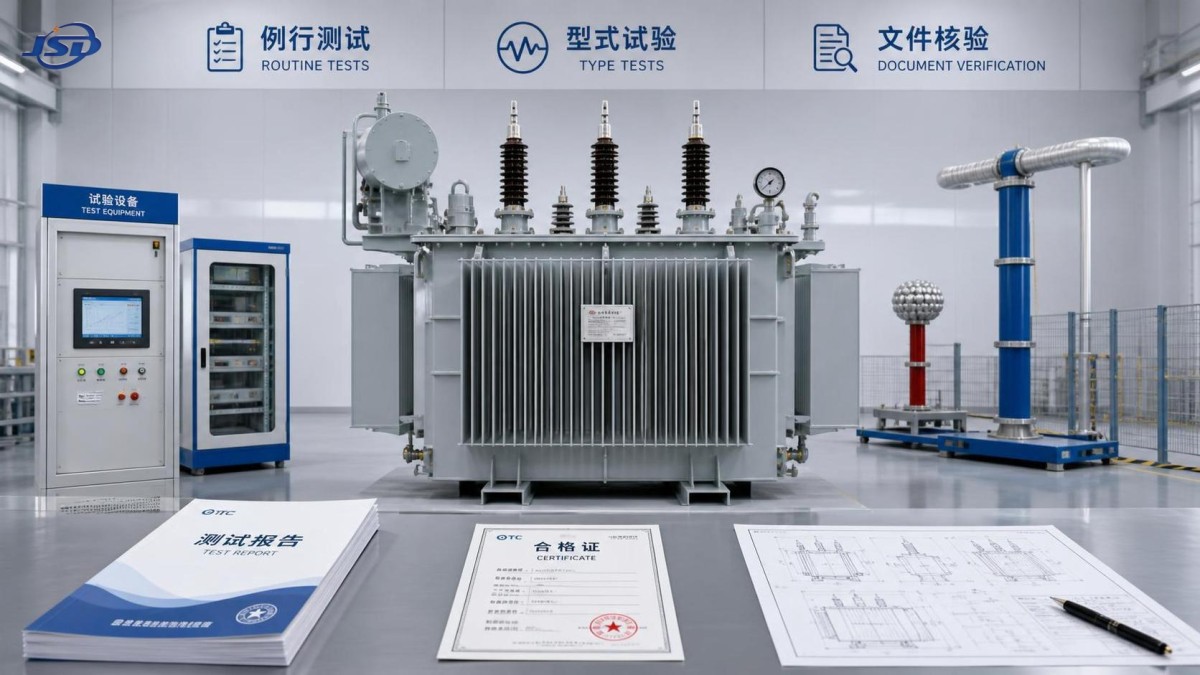
If a supplier sends a type test report for a loosely related model and says “same series,” ask them to explain the design equivalence in writing. That single follow-up question often reveals how disciplined the manufacturer really is.
Special tests are not optional when the application is demanding
Some projects need more than the standard routine and type test package. Safety managers usually see this when the transformer will operate in a hospital, data center, tunnel, renewable plant, high-harmonic environment, corrosive location, or a site with difficult maintenance access.
In those cases, ask early whether special tests are needed, because they affect schedule, witness planning, and sometimes factory capability.
Examples may include:
- Partial discharge measurement for dry-type or higher-spec insulation requirements
- Zero-sequence impedance measurement
- Capacitance and tan delta tests
- Vacuum or pressure leak tests for sealed oil-filled units
- Coating thickness and corrosion protection checks
- Temperature monitoring system verification
- Fire behavior or environmental class evidence for dry-type transformers, where specified
Not every project needs these. Asking for every possible test can slow procurement and create noise in the review process. The better approach is to map test documents to the actual failure risks of the installation.
Certificates matter, but they do not replace test records
A lot of buyers feel more comfortable when they see certificates. That is understandable, but it is also where procurement files become misleading.
An ISO 9001 certificate shows that the transformer manufacturer operates under a documented quality management system. It does not prove your transformer passed dielectric testing yesterday. A product conformity statement may support compliance. It does not replace a measured loss report. A raw material certificate may be useful for traceability. It does not confirm the assembled unit performs correctly.
Use certificates for what they are good at:
- Verifying management system control
- Confirming process discipline
- Supporting regulatory or contract compliance
- Tracing major components or materials when needed
But keep the testing package at the center of the review.
In supplier assessments, some manufacturers do a better job because they connect production, engineering, and documentation cleanly. Companies positioned around rigorous quality management and technical manufacturing capability, such as Jinshida Electric Power Technology Co., Ltd., typically present their test and inspection packages as part of a broader quality control process rather than as scattered afterthoughts. That is a useful sign when you are comparing factories, though the documents still need to be checked line by line.
Which standards should the documents reference?
This depends on your market, project owner, and transformer type. In many international projects, buyers expect references to IEC standards. In other markets, IEEE, ANSI, GB, or locally mandated standards may apply. The safe approach is simple: the test report should clearly state the standard used, and that standard should match the purchase specification or approved technical deviation list.
If the manufacturer uses an alternative standard, do not reject it automatically. First confirm whether the technical requirements are equivalent for your project. This needs engineering review, not just document control review.
Another point often overlooked: revision status matters. A report aligned with an older standard edition may still be acceptable in some projects, but only if the contract allows it.
What experienced reviewers check beyond the test values
People new to transformer procurement often focus only on whether measured values are within tolerance. Experienced reviewers usually go further. They look for consistency across the whole document package.
For example:
- Do the losses on the test report match the guaranteed technical schedule?
- Does the impedance value align with system studies and protection settings?
- Does the vector group match the approved single-line diagram?
- Do the serial number and rating match the nameplate drawing?
- Are there unexplained corrections, overwritten values, or missing signatures?
These are not minor paperwork details. A mismatch in vector group or impedance can become an installation or commissioning problem. A missing tap setting on a report can create disputes later if field results differ from expectations.
Common document gaps that should slow down approval
Several issues come up repeatedly in factory document review:
- Type test reports from a non-equivalent model
- Routine test report issued without full traceability to the offered unit
- Loss values reported differently from the bid schedule, without explanation
- Certificates attached, but no clear test data for the actual transformer
- Unclear standard references or missing edition numbers
- Special test requirements omitted because they were never translated from the project specification into the manufacturing test plan
When these gaps appear, the right move is usually not immediate rejection. Ask for clarification first, but do it in a structured way. A disciplined manufacturer will answer with revised documents, cross-reference tables, or engineering justification. A weak one will respond with broad assurances.
A practical document request list for pre-shipment review
If you want a usable checklist, keep it lean enough that people will actually use it. A solid request package usually includes:
- Approved technical datasheet
- General arrangement drawing and nameplate drawing
- Routine test report for each supplied transformer
- Type test reports relevant to the offered design
- Special test reports, if specified
- Inspection and test plan records, if contractually required
- Oil test reports for oil-immersed transformers, where applicable
- Accessory test or calibration records for critical devices, where relevant
- Quality certificate and any required conformity declarations
- Packing, handling, and storage instructions for site safety and preservation
The last item is often ignored, but it matters. A transformer can leave the factory in good condition and still arrive at site compromised by poor transport control, moisture ingress, or incorrect storage.
FAQ
Is a factory acceptance test witness always necessary?
Not always. For standard, low-risk orders, complete and traceable documentation may be enough. For critical applications or first-time suppliers, witness inspection is often justified.
Can I accept a type test report from another rating in the same series?
Only if the manufacturer can demonstrate valid design equivalence and your engineering team accepts that basis. “Same series” by itself is not strong evidence.
Are ISO certificates enough to approve a transformer manufacturer?
No. They support supplier qualification, but they do not replace routine and type test evidence for the actual product.
What is the biggest mistake in document review?
Approving reports that look complete but do not match the transformer being purchased. Mismatch is a bigger risk than missing decoration or formatting issues.
Closing thought
When you ask a transformer manufacturer for testing documents, you are really asking one question in several forms: can this unit be trusted in service, under the conditions we expect, with evidence strong enough to survive technical review later? The best suppliers answer that question with traceable reports, relevant standards, and documents that line up from drawing to final test. If the file package feels vague, disconnected, or overly polished without hard data, pause before approving. In transformer procurement, paperwork is not bureaucracy. It is one of the clearest early warnings you will get.
Image Placeholder List
Suggested placement: near the section explaining the difference between routine, type, and special tests
Suggested image content: a simple review flow or annotated document comparison for transformer test records
Suggested alt text: Transformer testing document review checklist from manufacturer
Internal Link Anchor Text Suggestions
- Transformer routine test report explained: guide to a technical article or knowledge base page
- IEC transformer testing standards: guide to a standards-related page
- How to evaluate transformer factory quality control: guide to a supplier assessment page
- Dry-type vs oil-immersed transformer inspection points: guide to a comparison page
- Factory acceptance test checklist for transformers: guide to a downloadable checklist or blog page
External Authority Source Suggestions
- IEC or IEEE standard documentation related to transformer testing
- Government or utility technical procurement specifications for power equipment
- Accredited laboratory or certification body guidance on electrical equipment test reporting

Get a Quote
Regardless of whether you require general advice or specific support, we are happy to help you.
Send Us Your Inquiry Today

Jinshida Electric remains committed to contributing to global energy development through professional manufacturing and superior service.