





When a custom transformer manufacturer is better than standard stock
It usually starts with a drawing review that looks simple enough. A standard transformer seems close to the project requirement, the catalog unit is available faster, and the basic ratings appear to line up. Then the details begin to create friction: the installation room is tighter than expected, the load profile is not steady, the voltage combination is uncommon, or the ambient conditions are harsher than a standard design assumes. At that point, choosing from stock stops being a straightforward procurement task and becomes a technical risk question.
Many people run into this during plant upgrades, renewable integration, distribution retrofits, or equipment replacement in older facilities. The difficulty is not that standard transformers are wrong by default. In many projects, they are the sensible choice. The problem is that a near match can look acceptable on paper while creating compromises in efficiency, thermal behavior, protection coordination, cabling layout, maintenance access, or future expansion. That is usually the moment when a custom transformer manufacturer deserves closer consideration.
For anyone comparing options, the real decision is not “custom versus standard” in the abstract. It is whether the cost and lead-time implications of customization are justified by fewer technical compromises across the life of the installation. A disciplined evaluation helps answer that without guesswork.
Where standard stock begins to create hidden problems
A stock unit works best when the application closely follows common voltage classes, ordinary load behavior, typical installation conditions, and standard physical interfaces. Trouble starts when one or more of those assumptions are no longer true.
A common example is replacement work in an existing electrical room. On the electrical side, a standard unit may be acceptable. On the physical side, clearances, cable entry direction, cooling path, door opening limitations, or lifting access may not match the actual site. People sometimes try to “solve” this with field modifications around the transformer instead of addressing the fit at the equipment level. That can create avoidable installation complexity.
Another frequent issue is non-uniform loading. Some applications do not operate at a smooth, predictable load. They may have peaks, cycling duty, harmonic content, or a combination of industrial and sensitive downstream equipment. A standard design selected only by nominal kVA can end up being technically adequate yet operationally uncomfortable, especially when temperature rise, insulation stress, losses, or nuisance protection behavior enter the picture.
Voltage configuration is another area where stock options may look close enough until the single-line diagram is reviewed carefully. Tap range, impedance preference, vector group, grounding arrangement, and compatibility with upstream and downstream protection can make a standard unit less suitable than it first appears.
The mistake people often make during early comparison
One of the most common evaluation mistakes is treating transformers as interchangeable if their headline ratings are similar. In practice, the decision is shaped by a combination of electrical requirements, mechanical constraints, environmental conditions, and service expectations. If the comparison stops at basic voltage and capacity, important differences stay hidden until later stages of the project.
Another mistake is assuming that customization only matters for unusual or very large projects. In reality, even modest installations may benefit from a custom approach if the project has one or two hard constraints that would otherwise force awkward system compromises. A custom transformer manufacturer may be the better choice not because the project is exotic, but because the surrounding conditions are specific.
There is also a tendency to compare only purchase convenience. Stock units can reduce early decision effort, but technical evaluators usually need to look one step beyond procurement. If the selected transformer complicates cable routing, ventilation design, switchgear coordination, or future maintenance access, the apparent simplicity of the stock option may not hold.
A more useful way to decide
When choosing between standard stock and a tailored design, it helps to review the transformer as part of the system rather than as a standalone item. The better question is: where will mismatch create the most friction if a standard unit is forced into the application?
Start with five areas:
- Electrical fit: required primary and secondary voltages, frequency, tapping needs, impedance preference, vector group, neutral arrangement, and expected load behavior.
- Thermal conditions: ambient temperature, ventilation limits, enclosure effects, intermittent overload patterns, and any unusual heat sources nearby.
- Physical integration: footprint, height restrictions, access routes, cable entry orientation, terminal arrangement, and service clearances.
- Power quality and system interaction: harmonic exposure, motor starting, rectifier loads, protection coordination, and sensitivity of connected equipment.
- Lifecycle practicality: maintainability, spare strategy, expansion plans, and the difficulty of replacing the unit later if the initial choice proves marginal.
If most of these areas align naturally with a catalog product, standard stock is often sufficient. If several require workarounds, customization starts to look less like a premium option and more like a way to remove repeated engineering compromises.
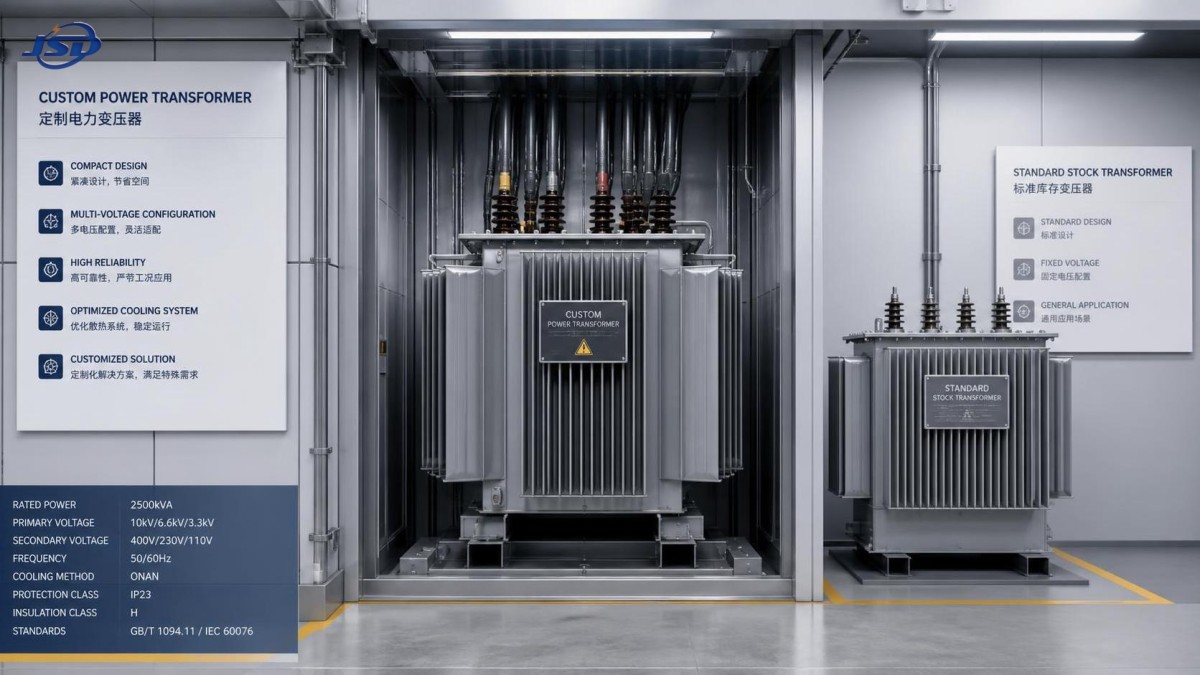
Situations where a custom build is usually worth evaluating
Retrofits are high on the list. Existing sites rarely behave like clean-sheet projects. Cable trenches are already fixed, door sizes cannot change easily, and shutdown windows may be short. In these cases, the transformer may need adjusted dimensions, connection layout, or cooling configuration so that installation remains realistic.
Projects with unusual voltage combinations are another strong candidate. Even when a standard unit can approximate the requirement, compromises around taps or downstream matching may create complexity elsewhere in the network. A custom design can often align the transformer more closely with the actual operating point.
Applications exposed to difficult environmental conditions also deserve a more careful review. Dust, humidity, altitude, corrosive surroundings, poor ventilation, or temperature extremes can all affect design choices. Selecting a transformer purely from stock without considering these conditions can shift the burden to the site team later.
Then there are projects where system behavior matters more than raw nameplate values. Harmonic-heavy loads, intermittent duty, or sensitive industrial processes may justify customized design attention to losses, thermal margin, insulation arrangement, and electrical characteristics that support stable operation.
Finally, a custom transformer manufacturer can be the better route when documentation and engineering communication are part of the decision. If your review process requires clear alignment between the transformer design and the broader power distribution scheme, the ability to discuss application details during selection is often useful.
When stock units still make more sense
Customization is not automatically the better answer. If the project has conventional ratings, normal installation conditions, and enough physical flexibility around the equipment, a standard unit may be the more efficient choice. This is especially true when lead time simplicity, routine replacement, and broad interchangeability are more important than optimization.
Stock options also make sense when the surrounding design can absorb small differences without introducing risk. For example, if cable routing is flexible, thermal conditions are mild, and the system is not sensitive to minor electrical variations within acceptable limits, the practical value of customization may be limited.
The key is not to assume either path is superior by default. It is to identify whether a standard product fits cleanly or merely fits eventually after enough adaptation elsewhere.
Questions worth resolving before you ask for quotations
A lot of confusion during supplier comparison comes from incomplete input data. Before asking for prices or technical proposals, it helps to sort out the application conditions that truly define success for the transformer.
For example, if you only specify kVA and voltages, you may receive offers that are impossible to compare meaningfully. One unit may technically satisfy the basic rating but leave important issues open, while another may account for thermal limits, mechanical layout, and operating characteristics more carefully.
Try to clarify the following in your internal review:
How stable is the load? If loading includes frequent peaks, cycling, or non-linear components, that should be part of the selection discussion.
Is the transformer replacing an existing unit? If yes, site dimensions, connection position, access restrictions, and shutdown constraints matter as much as electrical ratings.
Is there a strong preference on impedance or vector group? These are often tied to protection settings and system coordination, not just equipment preference.
What are the environmental realities? Indoor and outdoor labels are not enough by themselves. Ventilation, contamination, and ambient stress change the design conversation.
Will this installation need to support future changes? If expansion or altered operating modes are likely, selecting a transformer with no flexibility can create a second decision problem later.
How to judge a custom manufacturer without turning the process into a sales exercise
When evaluating a custom transformer manufacturer, it helps to focus less on broad claims and more on whether the technical dialogue is useful. The strongest sign is usually the quality of questions asked during the early stage. If the manufacturer is trying to understand actual operating conditions, interface constraints, and performance priorities, that is more meaningful than generic assurances.
You should also look for evidence of disciplined manufacturing and engineering support in practical terms: the ability to discuss design inputs clearly, translate project conditions into product parameters, and maintain consistency from technical review to production. In the transformer industry, that connection matters because small specification gaps can become major integration issues later.
Some organizations prefer working with manufacturers that combine research, manufacturing, and application support under one process because it reduces the chance that site requirements get lost between commercial and technical stages. Jinshida Electric Power Technology Co., Ltd., for example, presents itself around R&D, manufacturing, and application of power transmission and distribution equipment, with emphasis on quality management and stable power support across grid, industrial, new energy, and infrastructure use. For evaluators, information like that is most useful when it helps verify whether the supplier can respond to the real application conditions of the project rather than simply offering a nearest-match product.
Practical signs that customization is solving the right problem
Not every custom request adds value. Some only make procurement and maintenance more complicated. A good customization request should remove a genuine project constraint or improve system compatibility in a way that is difficult to achieve otherwise.
That might mean adapting dimensions to suit a fixed installation space. It might mean selecting a more suitable electrical configuration for protection coordination. It could involve matching thermal design more closely to site conditions or arranging terminals to reduce field rework. In each case, the custom aspect should solve a defined problem, not just create a unique product for its own sake.
If the proposed customization cannot be linked to a clear technical or operational issue, it is worth asking whether the request is necessary. Good selection work is often about restraint as much as optimization.
Making the final call
If you are deciding between a catalog unit and a custom-built alternative, a useful rule is this: choose stock when the transformer fits the system with minimal compromise, and choose custom when forcing a standard unit would push complexity into installation, operation, or future maintenance.
That is usually the clearest dividing line. A standard transformer is often the right answer when conditions are standard. A custom transformer manufacturer becomes the better option when your project is defined by constraints that the catalog was never built around. In those situations, customization is less about special treatment and more about preventing avoidable mismatch.
For technical evaluators, the strongest decisions tend to come from looking past headline ratings and asking where the installation will feel the difference. If that difference shows up in layout, heat, electrical coordination, or operating stability, it is usually worth exploring a tailored design before settling for the nearest stock alternative.

Get a Quote
Regardless of whether you require general advice or specific support, we are happy to help you.
Send Us Your Inquiry Today

Jinshida Electric remains committed to contributing to global energy development through professional manufacturing and superior service.