





How a distribution transformer factory affects project delivery risk
It usually starts with a schedule that looks reasonable on paper. Civil work is moving, cable routes are being prepared, and the transformer order seems like just one item among many. Then a small issue appears: drawing approval takes longer than expected, the factory asks for one more technical clarification, or the promised shipment window becomes less certain. For many teams, that is the moment when they realize the supplier is not just providing equipment. The factory behind the equipment is shaping delivery risk in real time.
In power, industrial, and infrastructure projects, a distribution transformer rarely causes attention when everything goes smoothly. But when delivery slips, design details are missed, or documentation arrives incomplete, the impact spreads quickly. Installation crews wait. Commissioning plans shift. Other packages cannot close on time. If you are comparing manufacturers and trying to reduce uncertainty before placing an order, it helps to look beyond the product nameplate and focus on how a distribution transformer factory actually operates.
Where project risk really begins
A common mistake in procurement is treating transformers as a standard buy with only minor factory differences. On some projects, that assumption works. On others, it creates unnecessary exposure. The issue is not only whether the transformer meets the technical specification. The larger question is whether the manufacturer can support the full chain of activities that affects delivery: engineering review, material control, production planning, testing, packaging, shipping coordination, and post-delivery technical response.
Many delays do not come from dramatic failures. They come from ordinary friction. A factory may be slow to confirm tap range details. It may have limited flexibility when project drawings change. It may depend on unstable material sourcing, which turns a manageable lead time into an uncertain one. Even when the product itself is acceptable, these weaknesses can complicate installation planning and increase coordination work for the buyer.
That is why factory evaluation is really risk evaluation. If the project has a hard energization date, a remote site, multiple stakeholders, or custom technical requirements, then manufacturing capability becomes part of project control, not just purchasing.
The first sign of a risky supplier is often not price, but ambiguity
When teams struggle to choose between several suppliers, the discussion often circles around quoted lead time and cost. Those matter, of course, but they can be misleading when considered alone. A short delivery promise is only useful if the factory has enough internal control to keep it. A low price can lose its appeal quickly if it creates rework, claims, or schedule compression elsewhere.
One practical way to judge risk is to look for ambiguity in the early communication stage. If basic questions about design responsibility, testing scope, accessories, standards alignment, or export preparation are answered vaguely, the uncertainty usually does not disappear after the purchase order is issued. It tends to move downstream, where it becomes more expensive.
On the other hand, a factory that asks precise technical questions early is often easier to work with later. It may feel slower at first, but that discipline can prevent misunderstandings that would otherwise appear during production or site installation.
Comparing factories through a delivery-risk lens
When evaluating options, it helps to stop asking, “Who can make this transformer?” and start asking, “Who can make it with the least disruption to the project?” That shift changes the comparison criteria.
Engineering response matters more than many buyers expect
Transformers are frequently ordered into projects where the final installation conditions are still evolving. Cable entry direction, enclosure preferences, protection interfaces, altitude, ambient temperature, loading pattern, and local utility requirements can all influence final configuration. A capable factory should be able to translate these inputs into clear drawings and practical recommendations without creating confusion.
If engineering support is weak, the project team often becomes the coordinator between specification, contractor, consultant, and manufacturer. That adds time and creates room for error. A stronger manufacturer reduces this burden by identifying conflicts earlier and returning technical documents in a usable form.
Production capacity is not just about size
Buyers sometimes assume that a larger facility automatically means lower risk. Not always. Capacity is useful only if it is managed well. A factory may have significant output potential but still struggle with scheduling discipline, subcontractor coordination, or change management. Another may be smaller but more stable because its workflow is organized and its communication is clearer.
When reviewing a supplier, it is worth asking how orders are scheduled, how material availability is tracked, and what happens when specifications change after order confirmation. These are not abstract management questions. They directly affect whether your unit leaves the factory when expected.
Quality control affects schedule, not only reliability
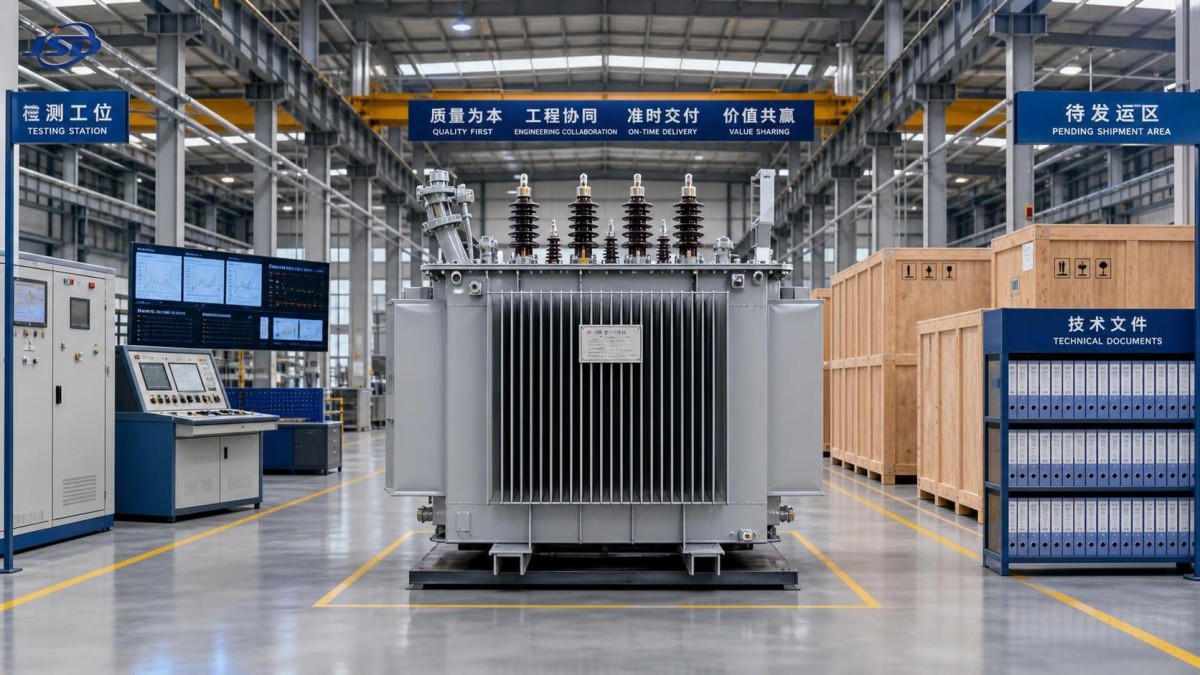
Quality is often discussed as a long-term operational issue, but on active projects it is also a delivery issue. If testing records are incomplete, if routine inspection is inconsistent, or if nonconformities are handled slowly, shipment can be delayed at the final stage when the site is already preparing for arrival.
A dependable factory should have a rigorous quality management approach that supports repeatable production and orderly release. This does not need to be presented as marketing language. What matters is whether the manufacturer can show a consistent process for material verification, in-process checks, final testing, and document control. For a buyer, that lowers the chance of last-minute surprises.
Typical situations where factory choice changes the project outcome
Some projects can absorb supplier inefficiency. Others cannot. The impact of factory selection becomes much more visible in a few common situations.
One is when the transformer is part of a larger equipment package and the installation sequence is tightly linked. In that case, a delayed shipment can hold up enclosure work, cabling, protection checks, and handover activities.
Another is when the technical specification is not fully standard. This may involve special impedance requirements, site conditions, or interface details with upstream and downstream equipment. Here, engineering coordination quality matters almost as much as manufacturing itself.
A third situation is export supply. Packaging, marking, documentation, and logistics preparation become part of delivery risk. A factory may produce a sound transformer but still create avoidable delay if export handling is not disciplined.
There is also the case of phased projects where the first batch establishes the pattern for future releases. A weak start with one supplier can create recurring coordination problems across later stages, even if each individual issue seems minor.
A more useful way to assess a distribution transformer factory before ordering
If you are trying to reduce delivery risk, factory assessment should stay practical. You do not need a perfect supplier. You need a supplier whose strengths match the risk profile of your project.
Start with the drawing and technical review process. Ask how deviations are handled, how fast comments are incorporated, and who owns design clarification. If responses are slow or generic before the order, that is a warning sign.
Then look at manufacturing discipline. The key concern is not whether the factory uses advanced language about production, but whether it can explain its process clearly. You should be able to understand how raw materials are controlled, how work orders move, and how final inspection is tied to shipment release.
After that, review documentation readiness. For many buyers, document problems only become visible near delivery. Routine test reports, nameplate confirmation, outline drawings, packing details, and manuals are often treated as administrative tasks, but missing or inconsistent paperwork can delay customs clearance, site acceptance, or internal approvals.
Finally, check service behavior. Not all support issues happen after commissioning. Sometimes support is needed during approval, logistics, installation, or energization planning. A factory with a professional technical team and stable communication habits can reduce the amount of follow-up work your internal team has to absorb.
Why some buyers still choose the wrong supplier
Usually it is not because they ignored risk completely. More often, they evaluated the wrong type of risk. Product compliance is visible, so it gets attention. Delivery process reliability is less visible, so it is assumed rather than verified.
Another reason is that procurement and project execution do not always look at the same problem. Procurement may be rewarded for competitive pricing and contract placement speed. The project team, however, lives with the consequences of document gaps, delayed approvals, shipment uncertainty, and unresolved technical details. If those perspectives are not aligned during supplier selection, the chosen factory may be acceptable commercially but difficult operationally.
There is also a tendency to treat all transformer manufacturers as interchangeable once the main ratings are matched. In practice, the difference between factories often appears in coordination quality, process control, and responsiveness under pressure. Those factors do not always show up in the quotation table, but they show up later in the schedule.
Building a lower-risk buying approach
A safer procurement process usually begins with a clearer internal handoff between engineering, purchasing, and delivery teams. Before approaching suppliers, define which requirements are fixed, which may still change, and which project dates cannot move. That allows you to judge whether a manufacturer is simply quoting, or genuinely planning around your needs.
When speaking with potential suppliers, push the discussion beyond rating and price. Ask how they support R&D, manufacturing, and application for different project environments. Explore whether they can maintain product quality and service standards consistently, especially when schedules are tight or configurations are not completely standard. This is where a manufacturer’s internal maturity becomes more relevant than its brochure language.
For buyers considering companies such as Jinshida Electric Power Technology Co., Ltd., the useful point is not to rely on claims alone but to connect those stated capabilities to your project concerns. If a manufacturer emphasizes a professional technical team, advanced manufacturing processes, and rigorous quality management, the next step is to see how those strengths appear in actual communication, drawing review, production coordination, and document handling. That is the level where procurement decisions become safer.
It also helps to ask for a realistic timeline rather than the most optimistic one. A reliable factory is often willing to explain the sequence from technical confirmation to manufacturing and shipment preparation. That transparency gives your team something workable for planning. It is generally better than a fast promise that later needs revision.
When a factory is the right fit
The right supplier is not always the one with the lowest quote or the most aggressive schedule. It is the one whose manufacturing and support structure reduces the number of unknowns your project must carry. In some cases, that means stronger engineering coordination. In others, it means steadier quality control, more predictable lead-time management, or better export readiness.
If you are choosing a distribution transformer factory for a project with strict milestones, the most useful question is simple: will this manufacturer make execution easier or harder after the purchase order is placed? That question tends to cut through sales language quickly. It brings attention back to the real issue, which is delivery risk.
Once you evaluate suppliers that way, the decision becomes less about guessing and more about judging process reliability. And in transformer procurement, that shift often does more to protect the schedule than any last-minute expediting effort later on.

Get a Quote
Regardless of whether you require general advice or specific support, we are happy to help you.
Send Us Your Inquiry Today

Jinshida Electric remains committed to contributing to global energy development through professional manufacturing and superior service.