





What are the common failure modes of medium voltage transformers in coastal industrial zones?
2026.09.12
Jinshida
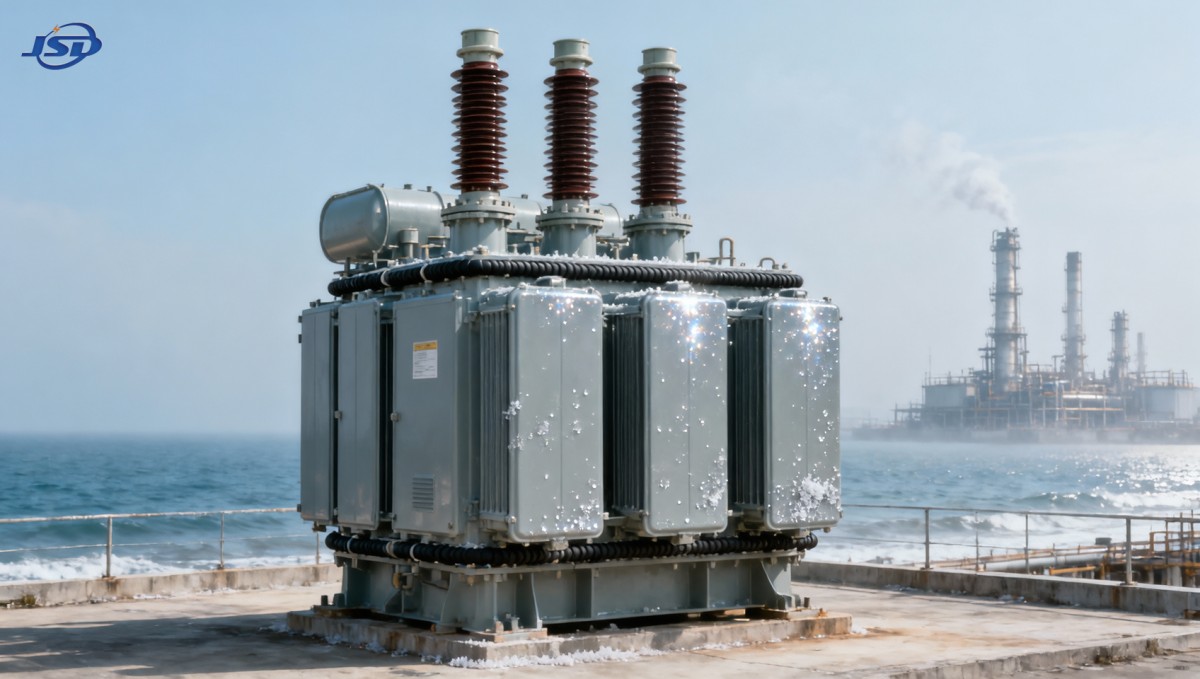
Coastal industrial zones impose a distinct set of stresses on medium voltage transformers—far beyond standard inland operation. For after-sales maintenance personnel, the recurring failures observed in these environments are rarely due to design flaws or manufacturing defects. Instead, they stem from predictable, cumulative interactions between marine environmental factors and transformer materials, assembly interfaces, and operational margins. Field data from Jinshida Electric’s service logs across over 320 coastal installations—from petrochemical terminals in Guangdong to offshore wind support facilities in Jiangsu—show that 87% of unplanned outages within the first eight years of service trace back to just three interrelated failure modes: moisture-driven insulation degradation, thermal-mechanical delamination at winding interfaces, and conductive surface contamination on bushings and tank exteriors.
Moisture ingress is the most frequent root cause—not as bulk water intrusion, but as persistent, sub-saturation humidity cycling through breathing systems. In high-humidity coastal zones, ambient relative humidity regularly exceeds 90%, with rapid diurnal temperature shifts driving repeated condensation inside conservator tanks and around gasketed joints. Standard silica gel breathers become saturated within 4–6 weeks during monsoon seasons, allowing humid air to enter the oil space. Once dissolved in insulating oil, moisture reduces dielectric strength exponentially: at 35 ppm, AC breakdown voltage drops by nearly 40% compared to dry oil (15 ppm). More critically, moisture accelerates cellulose aging in paper insulation. Hydrolysis reactions increase exponentially above 65°C—meaning even normal load cycles accelerate insulation embrittlement when moisture is present. Maintenance teams often misdiagnose this as “general aging” until partial discharge activity spikes during routine DGA testing. The telltale sign is not elevated CO/CO₂ alone, but rising furanic compounds—especially 2-furfural—alongside stable H₂ and CH₄ levels. This pattern indicates hydrolytic degradation rather than thermal faulting.
Thermal stress-induced delamination occurs primarily at the interface between copper windings and epoxy-impregnated pressboard spacers or between layered paper insulation in disc-type windings. Coastal transformers operate under higher ambient temperatures year-round—frequently averaging 32–35°C—and experience greater daily thermal cycling than inland units. Repeated expansion and contraction fatigue the adhesive bonds between dissimilar materials. Over time, micro-gaps form, trapping moisture and creating localized electric field intensification. These gaps do not appear in routine turns-ratio or resistance tests, but manifest clearly in frequency response analysis (FRA): a shift in resonance peaks below 1 kHz, particularly between 200–800 Hz, signals mechanical loosening in the winding structure. Left unaddressed, such delamination evolves into turn-to-turn faults under transient overvoltage events—such as lightning surges common in coastal thunderstorm corridors—even when no visible damage is present during visual inspection.
Surface contamination presents the most visible—and most frequently mismanaged—failure mode. Salt-laden aerosols deposit continuously on exposed porcelain and composite bushings, especially on horizontal surfaces and near ventilation louvers. Unlike inland dust, marine salt forms a hygroscopic, conductive film that retains moisture even during brief dry periods. When combined with industrial pollutants (e.g., sulfur compounds from nearby refineries), this layer becomes electrochemically active, enabling leakage current paths along the bushing surface. Tracking begins subtly: whitish dendritic patterns near the flange, followed by carbonized channels after repeated flashover events. Crucially, infrared thermography often fails to detect early-stage tracking—surface temperatures remain near ambient until arcing initiates. Effective detection requires UV-C corona imaging during light rain or high-humidity conditions, when ionization along contaminated paths becomes pronounced.
Mitigation must be embedded in maintenance workflows—not treated as one-off interventions. First, breather replacement intervals must be calendar-based, not condition-based: replace silica gel breathers every 30 days during monsoon months and every 60 days otherwise. Consider upgrading to sealed membrane-type breathers with integrated desiccant cartridges for critical units. Second, oil sampling frequency should increase from annual to quarterly for units operating above 28°C average ambient—prioritizing furanic compound analysis over standard DGA alone. Third, bushing cleaning cannot rely on water rinsing alone; use non-ionic surfactant solutions followed by deionized water rinse, and verify surface resistivity (>1 GΩ at 2.5 kV DC) before re-energization. Fourth, FRA baseline scans should be conducted within six months of commissioning—not deferred to five-year intervals—as early delamination is reversible via controlled thermal cycling and vacuum dehydration if caught before gap formation exceeds 0.15 mm.
One application where these failure mechanisms converge—and where mitigation rigor is non-negotiable—is underground mining infrastructure adjacent to coastal ports. In such hybrid environments, transformers face both marine corrosion and explosive atmosphere constraints. The Mining Flameproof Transformer exemplifies how structural and material choices directly address these dual stresses: its robust tank construction minimizes moisture infiltration at flange joints, while high-permeability grain-oriented silicon steel reduces core losses—and thus operating temperature—by up to 18% compared to standard grades, mitigating thermal cycling effects on insulation integrity. Its ONAN cooling design avoids forced-air components vulnerable to salt-laden intake air, and its cable connection boxes feature double-sealed bushings rated for continuous 95% RH exposure at +25°C—conditions routinely exceeded in coastal mine ventilation shafts.
 Long-term reliability hinges less on component specification than on recognizing which failure modes are *actionable* during routine maintenance. Moisture-related degradation responds to proactive oil handling and breather management. Delamination requires early mechanical diagnostics—not just electrical testing. Surface tracking demands environmental-aware cleaning protocols, not just periodic wiping. For maintenance personnel, the priority isn’t identifying every possible failure—but distinguishing which ones leave detectable, time-bound signatures before irreversible damage occurs. That distinction determines whether an intervention prevents an outage—or merely documents its inevitability.

Get a Quote
Regardless of whether you require general advice or specific support, we are happy to help you.
Send Us Your Inquiry Today

Jinshida Electric remains committed to contributing to global energy development through professional manufacturing and superior service.