





How do IEC 60076-11 and IEEE C57.12.00 differ in testing requirements for power distribution transformers?
2026.09.12
Jinshida
Understanding transformer testing standards isn’t just about ticking boxes—it’s about safeguarding grid resilience, preventing costly field failures, and honoring the quiet trust customers place in every winding, core, and bushing. For quality control and safety management professionals overseeing power distribution transformer procurement or commissioning, the question *“How do IEC 60076-11 and IEEE C57.12.00 differ in testing requirements?”* isn’t academic—it’s operational. It shapes factory acceptance test plans, influences design margins, and determines whether a unit clears customs or stalls at border inspection.
At first glance, both standards govern dry-type and liquid-immersed distribution transformers up to 36 kV—overlapping significantly in scope. But beneath that surface harmony lies a landscape of divergent philosophies: IEC 60076-11 leans on harmonized, risk-informed verification rooted in European and global supply chain practices; IEEE C57.12.00 reflects North American utility priorities—emphasizing robustness under transient stress, long-term thermal endurance, and field-serviceable validation protocols.
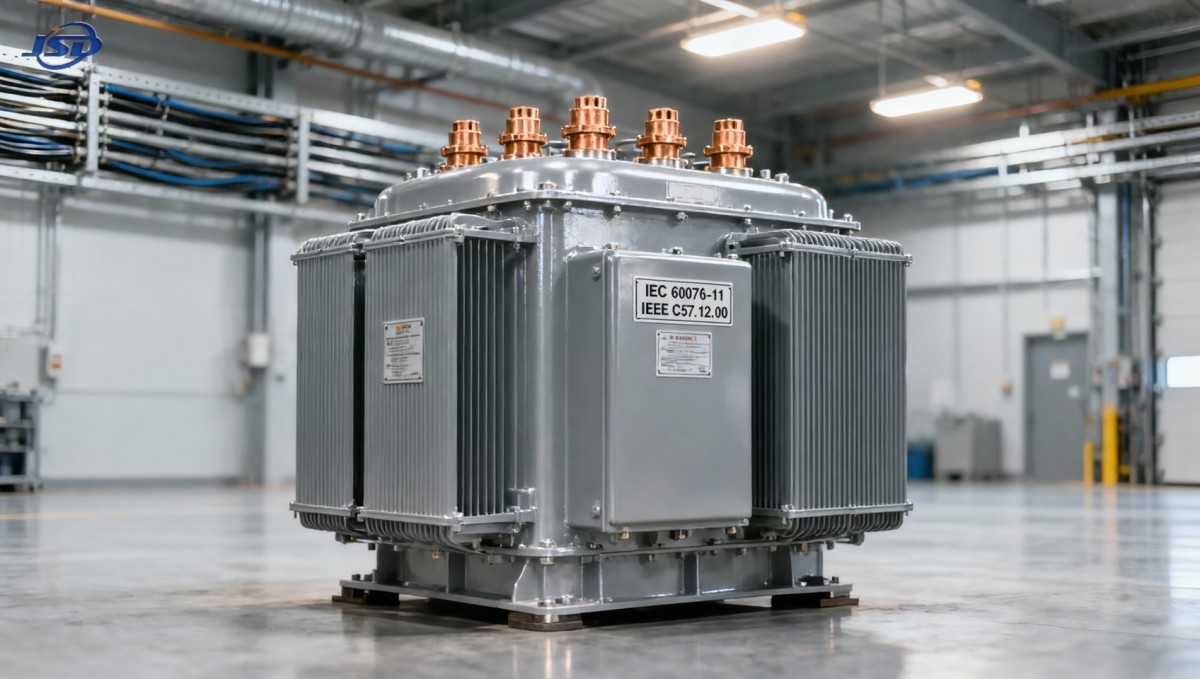
Let’s start with *type tests*, the gatekeepers of design integrity. IEC 60076-11 mandates impulse voltage tests (LI and SI) at specified crest values and waveshapes, but allows statistical sampling for series production—provided manufacturing consistency is proven via process audits and routine test traceability. IEEE C57.12.00, by contrast, requires full lightning impulse (LI) testing on *every* unit rated above 15 kV—no exceptions. That’s not bureaucracy; it’s legacy learning from decades of substation surges and insulation coordination studies across diverse grounding systems. For a 13.8kV Distribution Transformer deployed in lightning-prone industrial zones or coastal grids, this distinction directly impacts how Jinshida Electric validates its high-voltage copper wire winding technology—ensuring dielectric strength isn’t just calculated, but *demonstrated* under real-world overvoltage waveforms.
Temperature rise testing reveals another fault line. IEC 60076-11 permits measurement via resistance change (for windings) and thermocouples (for oil or top-oil), with allowable deviations based on load profile assumptions—often referencing IEC 60076-2’s “equivalent load” methodology. IEEE C57.12.00 insists on *direct measurement* using calibrated sensors placed at hot-spot locations—especially critical for foil-wound low-voltage coils where eddy current losses concentrate unpredictably. Jinshida’s adoption of low-voltage foil winding technology means our engineers don’t just meet the letter of either standard—they map thermal gradients across each unit using infrared scanning during final burn-in, aligning with IEEE’s empirical rigor while maintaining IEC’s efficiency-aware calibration logic.
Short-circuit withstand capability? Here, the divergence sharpens. IEC 60076-11 references IEC 60076-5, requiring mechanical integrity verification through simulated short-circuit currents—but accepts analytical validation backed by FEA modeling if supported by prior physical testing on representative units. IEEE C57.12.00 demands *full-scale dynamic short-circuit testing* for units above 10 MVA or with special application profiles—even if scaled down, the test must replicate actual fault duration, current asymmetry, and mechanical restraint conditions. For Jinshida’s S-M series 13.8kV Distribution Transformer, designed for industrial mining sites where fault currents can exceed 40 kA, this means every prototype undergoes physical short-circuit trials—not as compliance theater, but as a fidelity check on our low-magnetic-leakage, high-mechanical-strength structural design.
Noise measurement standards also diverge meaningfully. IEC 60076-10 specifies sound level limits measured at 1 m distance in free-field conditions, with allowances for ambient correction. IEEE C57.12.00 adds *weighted octave-band analysis*, requiring evaluation of tonal components that contribute disproportionately to perceived annoyance—particularly relevant for urban substations near schools or hospitals. Jinshida’s attention to silicon steel cutting precision and core stacking control isn’t only about minimizing no-load loss; it’s about suppressing harmonic magnetostriction noise before it ever reaches the microphone—delivering measurable compliance *and* community acceptability.
Then there’s the matter of routine tests—the daily heartbeat of factory QA. Both standards require ratio, polarity, impedance, and insulation resistance checks. But IEEE C57.12.00 explicitly requires *turns ratio verification at multiple tap positions*, including extreme taps, and mandates phase-angle error reporting beyond ±0.5%. IEC 60076-11 allows simplified ratio checks if tap changers are verified separately. In practice, Jinshida’s SQA system does both: automated turns-ratio testers sweep all 17 tap positions on our 13.8 kV units, logging phase-angle deviation against ANSI/IEEE thresholds—because “routine” shouldn’t mean “redundant.”
What ties these threads together isn’t compromise—it’s contextual intelligence. A transformer destined for a Brazilian utility may need CB Scheme certification aligned with IEC 60076-11’s modular test structure; one bound for Ontario Hydro must pass IEEE’s full LI + short-circuit sequence. Jinshida Electric doesn’t retrofit standards onto products—we engineer *from* them. Our ISO 9001-certified quality management system embeds dual-standard checklists into every stage: design review gates reference both IEC and IEEE clauses; raw material specs cite IEC 60296 (mineral oil) *and* ASTM D3487 (for North America); even our KEMA and UL certifications are pursued concurrently—not as parallel tracks, but as converging validation paths.
 That convergence matters most when expectations collide—not in labs, but in the field. Consider a 13.8 kV unit installed in a mixed-use commercial complex in Singapore: it must satisfy local EMA regulations (IEC-aligned), yet interface seamlessly with backup generators sized per IEEE 1547 fault contribution models. Or a unit shipped to Chile’s mining belt—where seismic qualification (per IEC 60068-2-64) meets IEEE’s vibration endurance expectations for mobile substations. Jinshida’s global verification across more than 50 countries isn’t just marketing—it’s feedback loops built into design iteration, where every returned field report informs next-gen insulation coordination or cooling optimization.
For quality and safety professionals, the takeaway isn’t “choose one standard.” It’s recognizing that IEC 60076-11 offers scalability and supply-chain agility; IEEE C57.12.00 delivers granular, physics-grounded assurance for mission-critical environments. The smartest specifiers don’t ask *which* standard applies—they ask *how deeply* their supplier understands the *why* behind each test requirement. And that understanding shows up not in certificates stacked on a shelf, but in how a transformer breathes under overload, sings under load, and holds steady when lightning strikes.
Because at the end of the day, compliance isn’t about passing tests—it’s about earning trust, one validated waveform, one measured hotspot, one silent operation at a time.
Hot News
- 00
0000-00
How U.S. DOE efficiency rules affect distribution transformer manufacturers - 00
0000-00
How american type pad mounted transformer seismic qualification affects installation in California utility grids? - 00
0000-00
Do european compact substation transformer EMC compliance tests include conducted emissions up to 30MHz?
00
0000-00
{item.title}
Contact Us

Get a Quote
Regardless of whether you require general advice or specific support, we are happy to help you.
Send Us Your Inquiry Today

Jinshida Electric remains committed to contributing to global energy development through professional manufacturing and superior service.