





Substation Power Transformer Costs: What Drives Total Project Investment?
Substation Power Transformer Costs: What Drives Total Project Investment?
For financial decision-makers, evaluating a substation power transformer involves more than comparing equipment prices. The transformer is often one of the largest single items in a substation budget, but its purchase price is only part of the investment. Voltage rating, capacity, efficiency requirements, site conditions, transport restrictions, installation scope, testing, spares, and long-term maintenance can materially change the final project cost.
This is why an apparently low transformer quotation can become expensive after engineering clarification, civil works, logistics, or commissioning requirements are added. Conversely, a higher initial offer may be commercially sound if it reduces losses, avoids site modifications, improves delivery certainty, or supports a longer operating life. The right question is not simply “What does the transformer cost?” but “What investment is required to put dependable capacity into service and keep it available?”
For grid expansion, industrial plants, renewable-energy interconnection, and infrastructure projects, a disciplined cost model gives approvers a clearer basis for comparing alternatives. It also prevents a common procurement mistake: treating technically different offers as if they were directly equivalent.
The transformer nameplate is only the starting point
A substation power transformer is priced around its electrical duty, not merely its physical size. Rated power, high- and low-voltage levels, vector group, impedance, cooling arrangement, tap-changing requirements, insulation level, short-circuit withstand capability, and system frequency all influence design complexity and material use. Two units with a similar MVA rating can therefore have very different costs.
Voltage class is especially influential. Higher voltages generally require more insulation coordination, larger clearances, more demanding bushings, and a more robust tank and internal structure. A transformer intended for a utility transmission connection cannot be evaluated on the same cost basis as a unit serving an internal medium-voltage industrial network, even where nominal capacity appears similar.
Capacity selection also deserves scrutiny. Oversizing may create headroom for future load growth, but it increases capital expenditure and may produce avoidable no-load losses during lightly loaded years. Undersizing can lead to overload exposure, operating restrictions, premature expansion costs, or reduced resilience during contingency conditions. The financially sensible rating depends on the load forecast, expected load profile, redundancy philosophy, ambient conditions, and the consequences of lost supply.
Core losses, load losses, and the cost of energy
Transformer efficiency is often discussed as a technical feature, yet it is a financial issue over the asset’s operating life. No-load losses occur whenever the unit is energized. Load losses rise with current and are therefore shaped by how heavily the transformer is used. The value of reducing either loss category depends on energy price, annual operating hours, loading profile, project life, and the owner’s method for valuing future cost.
A procurement team should ask suppliers to state guaranteed loss values and the basis on which those values are assessed. If loss capitalization is used in bid evaluation, its assumptions should be explicit and consistent across all bidders. Without that discipline, a low purchase price can obscure a design that carries greater operating expense for decades.
There is no universal rule that the lowest-loss design is automatically the best financial choice. In a lightly loaded installation, minimizing no-load losses may carry more weight. In a high-utilization industrial or renewable application, load losses can become more consequential. The budget should reflect the actual duty cycle rather than a generic preference for either minimum first cost or maximum efficiency.
What belongs in a complete project cost model?
The transformer supply price is usually visible early. The surrounding costs often emerge later, when the electrical design, transport survey, and site execution plan become more detailed. A practical approval model separates equipment cost from project-enabling cost and from lifetime cost.
The table is not a substitute for a project estimate, but it helps expose omissions. For example, a transformer supplied without clearly defined terminal arrangements or protection interfaces may trigger additional engineering and switchyard work. Similarly, a technically appropriate unit can still be a poor fit if its delivery configuration exceeds bridge, port, road, or crane constraints at the site.
Transport and site conditions can change the economics quickly
Large power transformers are not ordinary freight. Weight, dimensions, center of gravity, transport oil condition, and the need to remove or ship accessories separately all affect logistics planning. Remote substations, mountain routes, constrained urban sites, and areas with limited lifting infrastructure deserve early review. If a route survey is deferred until after equipment selection, the project may face costly changes to transport method, temporary works, or even transformer design.
Site environment also affects the specification. High ambient temperature, altitude, salt-laden air, dust, flood risk, seismic conditions, and restricted maintenance access can require design measures beyond a standard installation. These additions are not cosmetic. They may influence cooling selection, corrosion protection, insulation margins, control enclosure protection, oil containment, and the layout around the transformer.
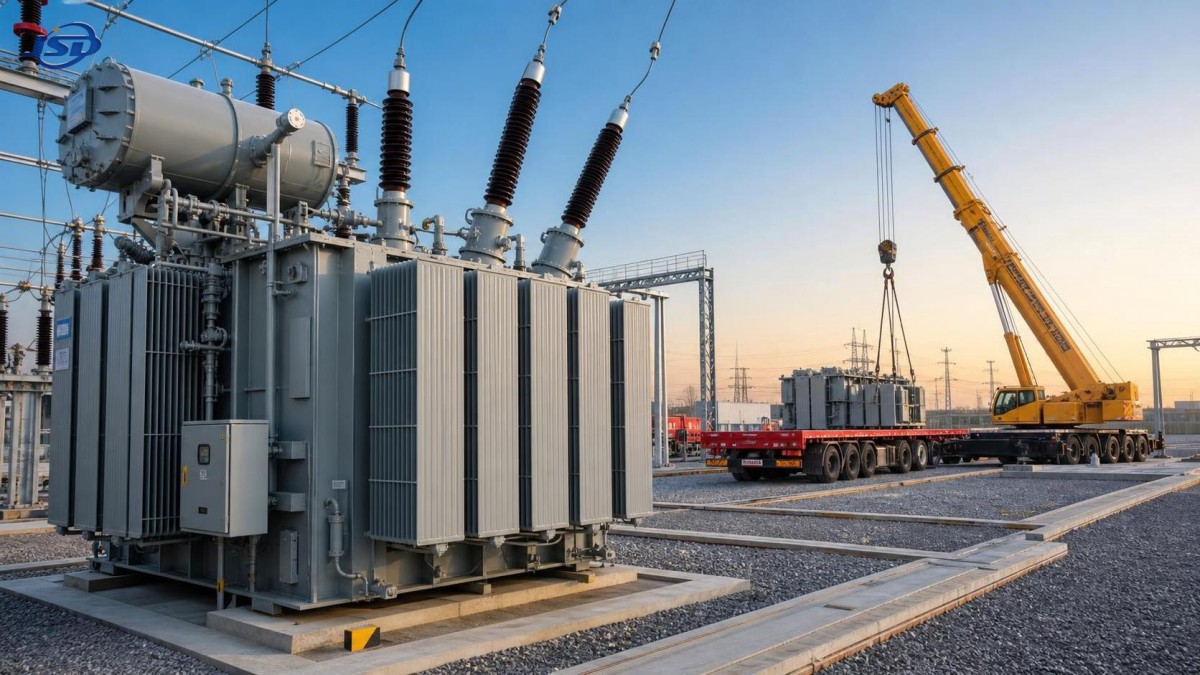
Financial reviewers should be cautious when a quotation says that certain site requirements are “by purchaser” without defining the boundary. That phrase may be reasonable, but it needs to be translated into a costed responsibility matrix. Who provides the foundation? Who supplies fire protection interfaces? Who performs oil filling and filtration? Who bears the cost if on-site testing identifies a connection or control mismatch? Clear ownership is often more valuable than a small discount on the unit price.
Reliability features should be evaluated against outage risk
Not every project requires the same reliability package. A transformer supplying a process plant with expensive downtime, a critical public facility, or a renewable collection network may justify a different design and monitoring approach from a unit serving a non-critical, easily backed-up load. The financial case depends on the cost of interruption, restoration time, spare-transformer strategy, and availability of technical support.
Useful questions include whether an on-load tap changer is genuinely required, what redundancy exists upstream and downstream, whether online condition monitoring is expected, and how quickly a replacement unit could be sourced or mobilized. A sophisticated specification is not always better; unnecessary complexity can increase capital cost and maintenance burden. Yet stripping out protection, monitoring, or testing scope simply to meet an initial budget can transfer risk into operations.
This balance is particularly important where temporary supply is part of the contingency plan. During construction, planned shutdowns, disaster recovery, or temporary events, mobile energy storage can reduce dependence on continuously running diesel generation for selected loads. For example, a trailer-mounted system with 100kW power and 215kWh LiFePO4 storage may support temporary 400V AC supply, with charging available from grid, solar PV, or a diesel generator. In suitable applications, the 100kW/215kWh Mobile Trailer Energy Storage System can be considered alongside—not as a replacement for—the transformer investment, particularly where rapid deployment and short-duration backup are relevant.
Why comparable bids are often not comparable
Procurement teams frequently receive offers that appear similar in rating and voltage but differ in hidden scope. One price may include factory testing, documentation, commissioning support, fittings, and a defined spare-parts package. Another may treat those items as exclusions or options. Differences in guaranteed losses, cooling equipment, tap changer make, control philosophy, terminal equipment, packing, and warranty conditions can also be commercially significant.
The most reliable comparison method is a technical-commercial normalization sheet. It should identify each requirement, state whether it is included, excluded, or qualified, and assign an owner for every external interface. Material deviations should be priced where possible rather than left as narrative comments. This gives finance teams a view of expected cost, not merely quoted cost.
Payment milestones warrant the same attention. A lower price accompanied by large advance payments, unclear inspection rights, or weak remedies for delayed delivery may impose more financing and schedule risk than the headline saving justifies. Transformer manufacturing lead time can affect the critical path of a substation project, so delivery commitments should be aligned with approved drawings, testing hold points, shipping readiness, and site civil completion.
A better approval process starts before the request for quotation
The strongest business cases are built from a reasonably stable technical basis. Before requesting final quotations, define the system voltage, expected loading, future expansion assumptions, losses evaluation method, location conditions, required interfaces, testing expectations, and delivery constraints. If those items remain open, the budget should include a transparent contingency rather than presenting a false sense of precision.
It is also useful to distinguish between decisions that must be made now and decisions that can be preserved as options. Future bays, spare foundations, monitoring provisions, or room for parallel operation may cost less when incorporated into the original site plan than when added after commissioning. But buying unused transformer capacity solely because expansion is possible can tie up capital. The appropriate choice rests on the credibility of the load forecast and the cost of later disruption.
Manufacturing discipline matters because the asset will be expected to operate for many years under conditions that may differ from the design office assumptions. Jinshida Electric Power Technology Co., Ltd. focuses on the research, manufacturing, and application of transmission and distribution equipment, with technical teams, advanced production processes, and quality management intended to support safe, energy-efficient, and stable power solutions. For buyers, that should translate into practical discussions around specifications, manufacturing inspection, documentation quality, and how the supplied equipment fits the project rather than a generic promise of performance.
The investment decision: lowest price or lowest credible cost?
A substation power transformer should be approved as a lifecycle infrastructure asset, not as an isolated purchase order. The lowest initial quote can be appropriate when scope, loss guarantees, site requirements, logistics, testing, and service obligations are genuinely equal. In practice, they often are not.
Before approving the budget, decision-makers should be able to answer a few straightforward questions: Is the selected rating based on an evidenced load and contingency case? Are energy losses valued consistently? Has the transport route been checked? Are civil, protection, fire, and commissioning interfaces costed? Are bid exclusions understood? Is there a workable plan for maintenance, fault response, and future expansion?
When these answers are documented, the project team can compare suppliers on a fair basis and defend the investment with greater confidence. The result is not necessarily the cheapest transformer. It is the solution with the lowest credible total cost for the required level of electrical performance, delivery certainty, and operational resilience.

Get a Quote
Regardless of whether you require general advice or specific support, we are happy to help you.
Send Us Your Inquiry Today

Jinshida Electric remains committed to contributing to global energy development through professional manufacturing and superior service.