





How to size a three phase dry type transformer for commercial loads
Sizing a three phase dry type transformer for commercial loads requires more than matching voltage and kVA ratings. Technical evaluators must assess connected demand, load diversity, power factor, future expansion, harmonic conditions, and installation environment to ensure safe, efficient, and reliable operation. A transformer that appears adequate on a schedule can still run hot, produce excessive voltage drop, or leave a project with no practical room to grow.
In commercial buildings, the load profile is rarely static. Office floors, retail areas, commercial kitchens, elevators, HVAC equipment, data rooms, lighting systems, and EV chargers all behave differently over the course of a day. The objective is not to select the smallest possible transformer. It is to select a rating that performs reliably at the expected operating condition while avoiding unnecessary first cost, no-load losses, and oversized distribution equipment.
Start with the load study, not the transformer catalog
The most dependable sizing process begins at the panel and equipment level. Build a load schedule that separates continuous loads, intermittent loads, motor loads, nonlinear electronic loads, and any planned future circuits. Connected load is a useful starting point, but it should not be treated as actual transformer demand.
For example, a commercial tenant fit-out may show 400 kW of connected equipment, yet the highest probable simultaneous demand may be much lower after diversity is considered. Conversely, a compact building with several rooftop units, a commercial kitchen, and EV charging can reach a high simultaneous demand even when the connected-load total initially looks manageable. The evaluator needs to understand when equipment operates together, not just how many nameplate ratings are listed.
Document these items before calculating transformer capacity:
- Utility or upstream distribution voltage and required secondary voltage.
- Total connected load in kW, kVA, HP, or amperes.
- Demand factors permitted by the governing electrical code and project design basis.
- Continuous loads, commonly evaluated at 125% where applicable.
- Motor starting requirements, elevator duty, and HVAC cycling behavior.
- Expected power factor at normal and peak operation.
- Nonlinear load percentage and harmonic mitigation requirements.
- Reserved capacity for tenant changes, equipment additions, or electrification plans.
This early work often prevents a familiar project problem: a transformer selected from a preliminary load list that becomes undersized once the final mechanical, kitchen, IT, or charging equipment is added.
Convert commercial demand into three-phase transformer kVA
Transformer capacity is rated in kVA, while many commercial load schedules are expressed in kW. The basic relationship is:
Required kVA = Demand kW ÷ Power Factor
If a calculated demand is 180 kW at 0.90 power factor, the apparent power is 200 kVA. In practice, the selected standard transformer size must also account for continuous loading, temperature conditions, harmonics, future growth, and available standard ratings. A nominal 200 kVA unit may therefore be too close to the operating edge, even though the arithmetic initially appears to match.
Where the load is known in secondary line current, use:
kVA = (√3 × Line-to-Line Voltage × Line Current) ÷ 1,000
At 480 V, a three-phase load drawing 240 A represents approximately 200 kVA. This formula is particularly useful when reviewing feeder data, existing switchboard measurements, or field load studies. It also helps check whether a calculated kVA aligns with the ampacity of the secondary conductors and protective devices.
Do not assume power factor is always 0.9 or 0.95 simply because modern equipment is present. Variable-frequency drives, LED drivers, UPS systems, capacitor banks, and lightly loaded motors can change the profile substantially. For an existing facility, interval metering or power-quality measurement is more valuable than a generic assumed factor. For a new facility, the best available equipment data and an honest design scenario should guide the estimate.
Demand factor and diversity: where commercial sizing becomes realistic
Demand factor recognizes that not every connected load will operate at full nameplate rating. Diversity recognizes that different loads may peak at different times. Both matter, but neither should be used casually to force a smaller transformer selection.
A multi-tenant office building may have diversified receptacle and lighting demand, while its central HVAC load can become highly coincident during a hot afternoon. A retail project may have moderate base load but a seasonal peak driven by refrigeration, signage, and extended operating hours. In a restaurant, kitchen appliances and ventilation may dominate the electrical demand during service periods. Each situation calls for a different judgment.
A useful review question is: What is the credible worst operating hour after the building is occupied? This is usually more revealing than applying a broad percentage reduction to the connected load. Consider the project’s climate, occupancy pattern, operating hours, and electrical expansion plan. If the transformer will serve a load with little diversity, such as a dedicated medical imaging area, a data-intensive suite, or a concentrated charging installation, conservative sizing is generally warranted.
Allow for continuous load and reasonable future growth
Commercial distribution systems are expected to remain serviceable for years, often through multiple tenant changes. A transformer that operates near its full rating under normal conditions leaves little flexibility and may have a shorter practical service margin in a warm electrical room.
Continuous loads should be identified separately because they can materially change the required capacity. Typical examples include certain lighting loads, server-room equipment, ventilation systems, refrigeration, and charging equipment operating for extended periods. The applicable code and local authority requirements remain the final reference, but the engineering principle is straightforward: recurring, long-duration demand should not be hidden inside a general diversity assumption.
Future allowance should be based on a real project pathway rather than an automatic oversizing percentage. If a shell-and-core commercial facility has empty tenant space, spare distribution sections, and likely future electrical loads, a larger transformer or a planned second-transformer location may be justified. If the electrical service is dedicated to a stable, fully defined process, a modest reserve may be more appropriate.
There is a trade-off. Oversizing reduces loading and can simplify expansion, but dry-type transformers have no-load losses that continue whenever they are energized. Selecting a substantially oversized unit for a lightly loaded building can increase lifetime energy consumption without delivering meaningful operational value. The best choice balances peak demand, expected load profile, loss performance, and expansion needs.
Check harmonics before choosing a standard dry-type design
Many commercial systems now include a significant nonlinear load component: computer power supplies, LED lighting, UPS equipment, VFD-driven HVAC, point-of-sale systems, medical electronics, and EV charging infrastructure. These loads draw non-sinusoidal current and can create harmonic heating in transformer windings, the neutral conductor, and associated distribution equipment.
A conventional transformer may be suitable for a modest nonlinear load percentage, but it should not be assumed adequate for every installation. Technical evaluators should request projected harmonic current distortion, the type and quantity of electronic loads, neutral loading expectations, and any harmonic study results. Depending on the results, a K-rated transformer, harmonic-mitigating design, oversized neutral arrangement, or other mitigation strategy may be appropriate.
Harmonic concerns are not limited to heat. They may also affect voltage distortion, breaker performance, conductor losses, and the reliability of sensitive equipment. A transformer selection that looks economical on a single-line diagram can become expensive if it later requires derating or correction after commissioning.
Motor loads, inrush, and voltage regulation deserve separate attention
Transformers do not need to be sized solely for every instantaneous motor-starting event, but starting duty must be reviewed. Elevators, pumps, compressors, air-handling units, and packaged HVAC equipment can create substantial inrush current. If several motors start under unfavorable conditions, the resulting voltage dip may affect controls, lighting, IT equipment, or other connected loads.
Review the motor starting method: across-the-line starting, soft starters, VFDs, and reduced-voltage arrangements impose very different demands on the system. Also evaluate transformer impedance, secondary feeder length, available fault current, and the sensitivity of downstream equipment. Lower impedance may improve voltage regulation but can increase available short-circuit current, affecting switchgear ratings and protection coordination.
For a commercial project, voltage regulation should be evaluated from transformer secondary terminals through the farthest significant load. A correctly sized transformer cannot compensate for an undersized feeder or an excessively long secondary run. The electrical room location, busway arrangement, and distribution architecture are part of the sizing decision.
Installation environment can change the practical rating
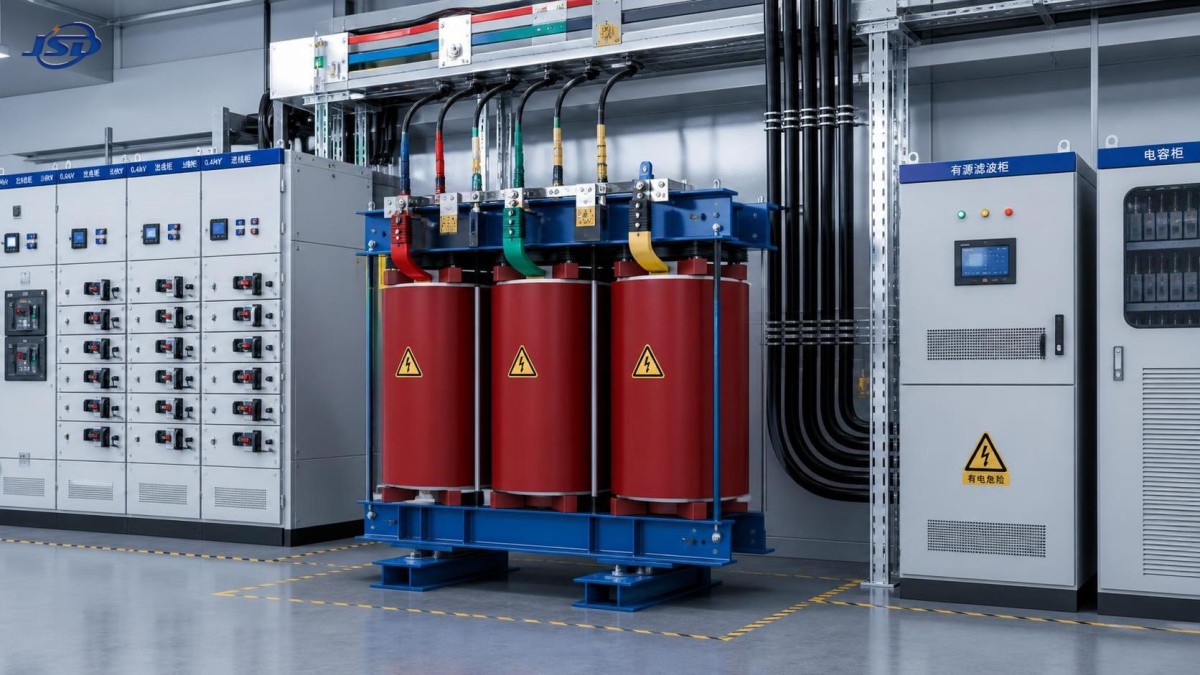
A three phase dry type transformer is often selected for indoor commercial applications because it avoids insulating liquid and can be installed close to the load when building conditions permit. Yet “indoor” is not enough information. Ambient temperature, ventilation, elevation, room size, clearance, access, acoustic limits, and fire-protection requirements all influence the final selection.
In a compact electrical room, heat rejection can become the limiting issue. Dry-type units release their losses into the room, so inadequate ventilation may raise ambient temperature and reduce operating margin. Evaluate the manufacturer’s ambient assumptions, temperature-rise class, and any applicable derating at elevated ambient temperature or altitude. Noise also deserves attention where transformers are close to offices, classrooms, retail areas, or occupied residential spaces.
Access is equally practical. Confirm that the transformer can be moved into the room, that cable bending space is sufficient, and that inspection and maintenance clearances remain available after switchboards and conduits are installed. These details are easily missed during early sizing but difficult to correct late in construction.
Use standard ratings as decision points, not as a shortcut
After calculating the adjusted demand, compare it with available standard kVA ratings and evaluate the loading percentage at normal and expected peak conditions. The decision should include loss data, impedance, winding material and configuration, taps, enclosure type, insulation system, temperature rise, and required standards for the project location.
For example, if the adjusted calculated demand falls just below a standard rating, choosing that rating may be reasonable only if future demand is limited, harmonics are controlled, ambient conditions are favorable, and peak loading is not prolonged. If several risk factors are present, moving to the next standard size may be the more defensible lifecycle decision. The goal is not to avoid loading; transformers are designed to carry load. The goal is to avoid an operating condition with no tolerance for reality.
Selection also needs to fit the upstream system. Confirm primary voltage, secondary voltage, vector group, grounding arrangement, taps, frequency, and protection scheme. A 480Y/277 V secondary, for instance, serves many commercial lighting and power applications efficiently, but the grounding and neutral requirements must align with the building distribution design.
Do not confuse distribution applications with transformer construction choices
Dry-type transformers are often appropriate inside commercial facilities, while oil-immersed units may be favored for outdoor utility-facing or pole-mounted distribution applications. The construction type should follow the installation environment, safety requirements, maintenance approach, and network architecture rather than a blanket preference.
For projects that also require overhead or rural distribution equipment upstream of a commercial site, Jinshida’s Pole-Mounted Oil-Immersed Single-Phase Transformer range illustrates the different selection logic. These units are intended for pole-hanging distribution duties and are available in capacities from 5 kVA to 500 kVA, with application options for rural and urban distribution networks. That is a separate use case from an indoor three-phase dry-type transformer, but it reinforces an important evaluation principle: transformer ratings, cooling methods, and mounting arrangements must match the actual distribution role.
A final pre-purchase review
Before releasing a transformer specification, ask the design team to verify the following:
- Is the load calculation based on probable demand rather than raw connected load alone?
- Have continuous loads, motor starting, and future additions been explicitly addressed?
- Does the assumed power factor reflect the actual equipment mix?
- Have nonlinear loads and neutral current been assessed?
- Will ambient temperature, ventilation, altitude, and noise constraints permit the intended duty?
- Are transformer impedance, fault duty, feeder voltage drop, and protective-device coordination compatible?
- Does the chosen kVA rating offer justified reserve capacity without imposing avoidable no-load losses?
A well-sized three phase dry type transformer is not simply a catalog item placed between a service and a panelboard. It is a decision that affects energy use, voltage quality, equipment reliability, room design, and the building’s ability to adapt. By treating demand data, load behavior, harmonics, environmental conditions, and future use as one connected evaluation, technical teams can specify a transformer that remains dependable long after the initial commissioning date.

Get a Quote
Regardless of whether you require general advice or specific support, we are happy to help you.
Send Us Your Inquiry Today

Jinshida Electric remains committed to contributing to global energy development through professional manufacturing and superior service.