





How to choose a transformer commercial building loads can grow into
How to Choose a Transformer a Commercial Building Loads Can Grow Into
Choosing a transformer for a commercial building is rarely about today’s load alone. In practice, the difficult part is not sizing for what is already on the drawing. It is making a sound decision for what the building may become over the next five, ten, or fifteen years. Office floors turn into mixed-use space, retail areas add HVAC and refrigeration, data rooms appear where none were planned, and EV charging often arrives later than the original electrical design expected.
That is why a transformer commercial project should be evaluated as a growth platform, not just a procurement item. Oversizing everything is not a smart answer either. It can raise first cost, increase no-load losses, and create installation issues without actually improving system performance. The better approach is to understand the load behavior, expansion path, voltage architecture, and service conditions before locking in capacity.
Technical evaluators usually have to balance three competing realities: the owner wants room for expansion, the contractor wants a practical unit that fits the site and schedule, and the operator wants stable long-term performance with minimal maintenance surprises. A good transformer choice sits in the overlap of those needs.
Start with load shape, not just connected load
One common mistake in commercial projects is using total connected load as the main sizing reference. That number matters, but by itself it can be misleading. Commercial buildings often have diverse loads with different duty cycles: lifts, lighting, chillers, pumps, tenant equipment, IT loads, kitchen systems, or future charging infrastructure. Some are highly intermittent. Others run continuously. A transformer sees the actual demand pattern, not the theoretical sum of every breaker label.
A more useful review usually includes peak demand, average loading, daily load variation, and the likelihood of harmonic-producing equipment. If the building includes a large share of VFD-driven HVAC, UPS-backed systems, LED drivers, or other nonlinear loads, transformer heating can differ from what a simple kVA estimate suggests. In those cases, asking whether the unit should be evaluated for harmonic impact is not overengineering. It is basic prudence.
If no operating profile is available, the safest path is to build a load forecast from actual building use assumptions rather than relying on a broad allowance factor. That forecast should separate firm future loads from speculative ones. There is a real difference between “Phase 2 tenant fit-out already budgeted” and “possible future EV chargers.” They should not always be treated the same in capacity decisions.
Leave growth room, but be specific about what kind of growth
“Future expansion” sounds simple until you ask what is expanding. More floor area? Higher cooling density? Additional retail tenants? Rooftop equipment? Longer operating hours? The right transformer margin depends on the nature of the growth.
For example, a building that may later add server rooms or high-density commercial kitchens changes the electrical profile more aggressively than one that simply adds general office partitions. Likewise, a property expected to install EV chargers later may need not only more capacity but also attention to load management strategy, power quality, and spare distribution infrastructure. In many projects, it is worth asking whether future growth should be handled by one larger transformer now or by planning space and switchgear arrangement for a second transformer later. That is a design and operations decision, not just an equipment decision.
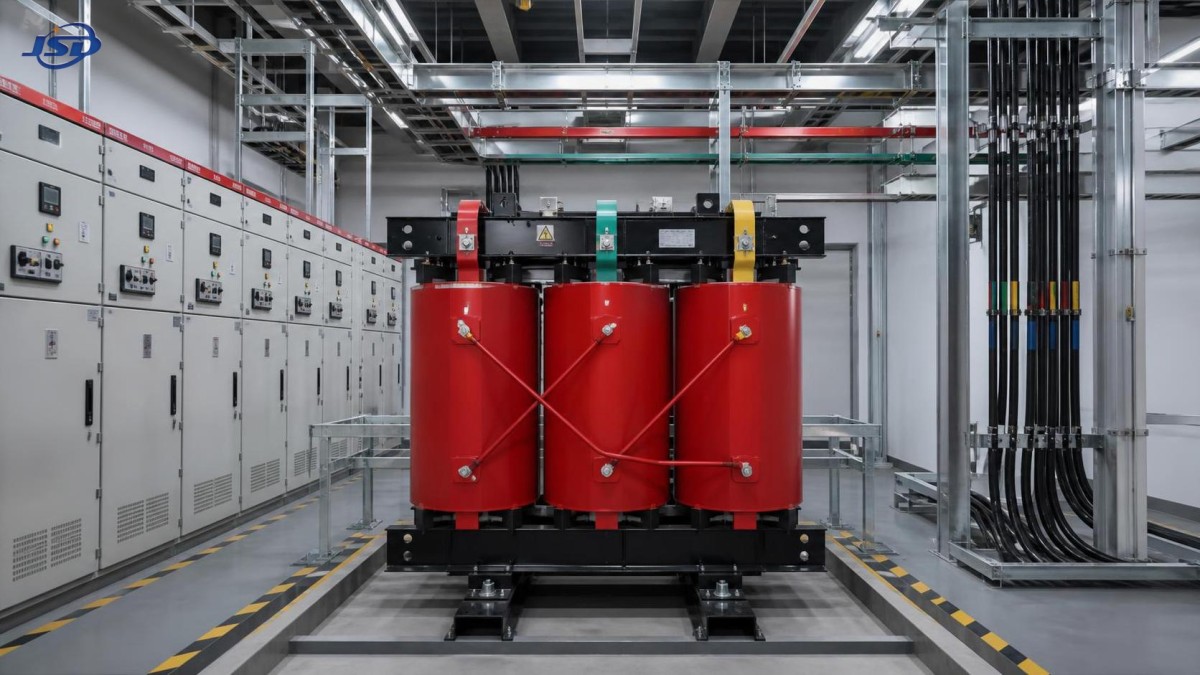
This is often where experienced manufacturers and engineering teams add value. Companies focused on transmission and distribution equipment development, such as Jinshida Electric Power Technology, tend to look beyond nameplate capacity and into the broader application environment: load development, installation constraints, efficiency expectations, and operating reliability over time. That perspective matters because a technically acceptable transformer on paper can still be the wrong commercial fit if it limits the building’s next upgrade.
Check the voltage plan early
Capacity gets the attention, but voltage matching is where expensive mistakes hide. The incoming utility service voltage, the building’s main distribution voltage, tenant power requirements, and the expected future sub-distribution structure all need to align. If the building may later support equipment with different voltage needs, that should be recognized before finalizing transformer selection.
In practical terms, evaluators should confirm:
- primary and secondary voltage compatibility with the local supply and building distribution plan,
- whether tap range is suitable for expected voltage variation,
- neutral and grounding arrangement, especially where sensitive electronic loads are expected,
- coordination with downstream protection and upstream fault contribution limits.
This becomes even more important in mixed-use or expandable sites where future renewable integration is under discussion. A building may not need generation-related transformer solutions today, but some projects eventually connect to broader site energy systems. In that context, it helps to work with suppliers that also understand adjacent applications, including equipment such as Transformer for Wind Power Generation, because the engineering questions around voltage stability, insulation coordination, and long-term operating reliability often overlap across sectors.
Dry-type or oil-immersed is not just a preference question
Commercial buildings often favor dry-type transformers for indoor installation, fire safety considerations, and easier integration into building services areas. But “commercial building” does not automatically mean dry-type is always the superior choice. The installation location, ventilation quality, acoustic limits, maintenance access, and local code requirements all matter.
Dry-type units can be very practical in occupied buildings, especially where space is close to electrical rooms and spill risk must be minimized. On the other hand, in some utility interface or outdoor service conditions, oil-immersed designs may still make technical and economic sense if local regulations and site layout allow them. The decision should be anchored in actual use conditions, not habit.
Noise is another issue that gets underestimated. A transformer room beside offices, retail areas, or hotel functions can create complaints long before anyone questions electrical performance. If acoustic sensitivity exists, that should be raised at evaluation stage, not after the installation is fixed.
Efficiency matters differently at low load and high load
When a building is expected to grow into its transformer, efficiency should be looked at across the loading journey, not only at full-load conditions. A heavily oversized transformer may run comfortably cool, but it also spends years carrying avoidable no-load losses if the actual demand remains modest. A tightly sized unit may look efficient on day one yet become a thermal and operational constraint once tenant density increases.
This is why lifecycle thinking beats first-cost thinking. Ask how the building is expected to load the transformer over time. If the project starts at relatively low occupancy and ramps up later, compare expected operating stages. In many cases, the right answer is not the biggest unit that can fit the room. It is the unit that performs well across the likely load curve while preserving realistic expansion options.
Pay attention to thermal margin, harmonics, and ambient conditions
Commercial buildings are no longer simple lighting-and-motor environments. Heat load from electronics, harmonics from power conversion equipment, and constrained ventilation in compact plant rooms all affect transformer life. If the transformer will operate in a hot basement room, rooftop enclosure, or other less-than-ideal setting, ambient condition assumptions should be reviewed carefully.
Evaluators should not treat thermal performance as a box-checking exercise. Questions worth asking include whether the ventilation design is realistic, whether future neighboring equipment may raise room temperature, and whether the building’s nonlinear loads justify additional review of harmonic stress. These are not edge cases anymore. In many modern commercial projects, they are normal.
Do not separate the transformer from the rest of the distribution system
A transformer is only one part of the power path. The smartest unit on paper can still be a poor selection if the switchgear, cable routing, protection settings, civil layout, or maintenance access make operation awkward. A few practical examples:
- If future replacement requires dismantling walls or disrupting occupied areas, lifecycle cost rises fast.
- If cable bending space is insufficient, the installation becomes harder and sometimes less reliable.
- If the transformer room has no real provision for heat rejection, actual service life may suffer.
- If protection coordination is not reviewed, nuisance trips or poor fault isolation can become a long-term headache.
This is also why supplier capability matters beyond the catalog. A manufacturer with established R&D, disciplined production processes, and quality control can support more than just equipment delivery. For buyers comparing options, responsiveness on drawings, parameter confirmation, application guidance, and manufacturing consistency often tells you more than brochure language does.
What to ask before making the final selection
A useful transformer commercial evaluation usually comes down to a short set of hard questions:
- What is the realistic peak demand now, and what part of future demand is genuinely probable?
- Will future load growth change the character of the load, not just the size of it?
- Are voltage levels, taps, grounding, and protection coordination aligned with current and future use?
- Does the installation environment support the transformer’s thermal and acoustic behavior?
- Would staged expansion be more practical than buying one larger unit today?
- Can the selected supplier support technical clarification through design, manufacturing, and commissioning stages?
If those questions are answered clearly, the risk of choosing the wrong unit drops sharply. If they are still being guessed at, it is usually better to pause and tighten the load and site assumptions before issuing the final purchase specification.
The best transformer for a growing commercial building is not simply the one with spare kVA. It is the one that fits the building’s electrical future without wasting capacity, creating avoidable losses, or boxing the owner into an awkward next step. That takes a little more thought up front, but it is almost always cheaper than correcting the wrong decision after the building is energized.

Get a Quote
Regardless of whether you require general advice or specific support, we are happy to help you.
Send Us Your Inquiry Today

Jinshida Electric remains committed to contributing to global energy development through professional manufacturing and superior service.