





High-Efficiency Copper-Winding Transformers vs. Aluminum: Which Lowers Lifecycle Risk?
High-Efficiency Copper-Winding Transformers vs. Aluminum: Which Lowers Lifecycle Risk?
For technical evaluators, choosing between copper- and aluminum-winding transformers involves more than initial purchase cost. A high efficiency copper winding transformer can improve energy performance, thermal stability, and long-term operational reliability while helping reduce maintenance and lifecycle risk. This comparison examines the engineering factors that influence total cost of ownership, supporting informed decisions for grid, industrial, renewable energy, and infrastructure applications.
The choice is often framed too simply: copper costs more, aluminum costs less. That statement may be true at the quotation stage, but it does not answer the question that matters after energization: which design will remain predictable under the actual load profile, ambient conditions, fault duty, installation constraints, and expected service life of the project?
Both conductor materials can be used in properly engineered transformers. Aluminum-wound units are not inherently poor quality, and copper is not a substitute for sound core design, insulation coordination, workmanship, testing, or protection settings. The lifecycle difference emerges when material properties interact with design margins and operating stress. For facilities where an outage is expensive or difficult to recover from, that distinction deserves closer attention.
Conductivity affects more than nameplate efficiency
Copper has higher electrical conductivity than aluminum. In broad engineering terms, an aluminum conductor needs a larger cross-sectional area to carry the same current with comparable resistance. A capable manufacturer can accommodate this by changing winding dimensions and transformer geometry. The important point is not that aluminum cannot meet a loss target; it can. The question is how much design space remains after the required conductor area, insulation clearances, cooling ducts, winding supports, and tank dimensions are all considered.
Transformer efficiency is driven primarily by no-load loss and load loss. Core steel, core construction, excitation level, and flux density strongly affect no-load loss, which occurs whenever the transformer is energized. Winding resistance is a principal contributor to load loss, which rises with the square of load current. A transformer serving a highly variable daytime load may place greater economic weight on no-load loss, while a heavily utilized industrial unit will feel the consequences of load loss more directly.
This is why evaluators should avoid comparing conductor material alone. Request guaranteed no-load loss, load loss at the stated reference temperature, impedance, temperature-rise limits, and efficiency at the expected loading points. A lower purchase price has limited value if the loss schedule is incomplete, measured under unclear conditions, or based on a different capacity and impedance than the competing design.
Thermal margin is where lifecycle risk becomes visible
Heat is the common pathway through which transformer weaknesses become operational problems. Higher losses raise winding and oil temperatures; elevated temperature accelerates insulation aging; aged insulation reduces the margin available for overloads, voltage disturbances, and cooling-system deterioration. The material decision therefore belongs in a thermal assessment, not merely in a procurement comparison.
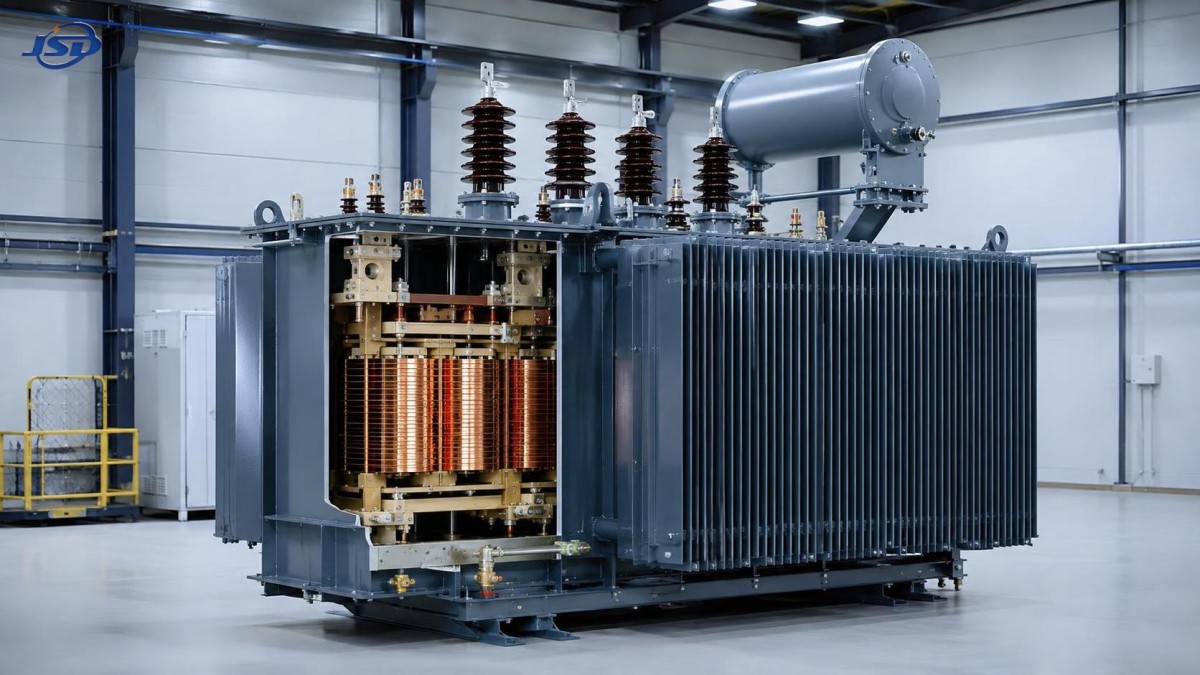
A copper winding’s conductivity and mechanical characteristics can support compact winding arrangements with robust current-carrying capability. In a carefully designed high efficiency copper winding transformer, this may provide useful thermal headroom where load is dense, ambient temperature is high, or future demand is uncertain. Such margin can be particularly relevant in mines, petrochemical plants, data centers, hospitals, and renewable-energy collector systems, where loading patterns may be less forgiving than a steady conventional distribution profile.
That does not mean a copper unit should automatically be operated beyond its rating. Rated capacity, cooling class, oil temperature, hot-spot temperature, local ambient conditions, and applicable loading guidance still control the decision. A supplier’s claimed overload capability should be reviewed alongside monitoring requirements and the project’s protection philosophy. Short-term overload is a managed operating condition, not a permanent capacity upgrade.
Mechanical strength matters during faults and transport
Normal operation is only part of the transformer’s life. Through-faults impose substantial electromagnetic forces on windings. The windings, clamping system, insulation spacers, leads, and connections must withstand these forces without displacement or damage. Copper has greater mechanical strength than aluminum, which can be beneficial in designs exposed to high fault current or frequent system disturbances.
A material comparison should not be confused with a short-circuit withstand assessment. That assessment requires the actual transformer impedance, available fault level, protection-clearing time, winding arrangement, and applicable standard requirements. Still, where fault duty is severe, evaluators often place more value on a winding system with strong mechanical reserve and well-documented short-circuit design verification.
Connections deserve equal scrutiny. Aluminum forms a stable oxide layer rapidly and has a higher coefficient of thermal expansion than copper. These properties do not prevent reliable aluminum connections, but they make material-compatible terminals, correct joining methods, torque control, surface preparation, and inspection discipline more consequential. Copper connections also require proper workmanship, yet mixed-metal interfaces and long-term contact resistance demand particular attention when aluminum is involved.
The real cost comparison is based on duty, not conductor price
A reasonable lifecycle evaluation separates costs that occur once from those that recur over decades. Initial purchase price, civil works, transport, installation footprint, energy losses, outage exposure, inspection effort, spares strategy, and end-of-life value all belong in the discussion. The weighting will vary by project. A rural network upgrade with modest utilization may prioritize capital discipline. A continuous-process factory may treat an unplanned outage as the dominant risk. A solar or wind site may focus on cyclic loading, remote access, and the operational effect of lost generation.
The best comparison also normalizes the quotations. If one proposal includes lower losses, a different vector group, a higher insulation level, different accessories, stricter test requirements, or different enclosure provisions, it is not a like-for-like conductor comparison. Ask bidders to state exclusions and technical deviations plainly. Ambiguity at this stage tends to reappear later as change orders, performance disputes, or operational constraints.
Where aluminum can be a rational choice
Aluminum-winding transformers can be appropriate where loading is predictable, fault levels are moderate, physical size is not restrictive, and the manufacturer has a demonstrated design and quality-control process for the required duty. A well-specified aluminum unit may meet relevant performance requirements and provide an economically sound solution, particularly where capital cost carries greater weight than exceptional overload margin or compactness.
The mistake is treating aluminum as a simple material substitution within an otherwise identical transformer. Reliable performance depends on the complete electromagnetic, thermal, mechanical, and connection design. Evaluators should be cautious when a very low quote is accompanied by broad claims but limited detail on guaranteed losses, conductor dimensions, temperature rise, short-circuit capability, routine tests, or after-sales documentation.
A practical reference point for 35 kV distribution projects
For urban distribution conversion, industrial plants, public facilities, and renewable-energy interconnection, a 35 kV to 0.4 kV oil-immersed design often requires a balance between efficiency, reliability, and site-specific flexibility. One example is the 35kV/0.4kV Oil-Immersed Power Distribution Transformer, available across a 50–5000 kVA range with copper coils, 50 Hz or 60 Hz options, and no-load tap changing. Its stated configuration includes 6.5% short-circuit impedance and efficiency exceeding 99%, while voltage, capacity, frequency, connection group, and loss requirements can be aligned with project needs.
For applications where environmental and fire-risk considerations affect the insulation-fluid decision, FR3 vegetable oil may also be considered where suitable for the project specification. The relevant point is not to select an option because it sounds advanced, but to confirm compatibility with the installation environment, applicable standards, maintenance strategy, and insurer or authority requirements.
Jinshida Electric Power Technology Co., Ltd. approaches this type of selection through power transmission and distribution equipment R&D, manufacturing discipline, and application-oriented engineering. For a technical review, the useful conversation begins with the network and duty data: incoming voltage and taps, expected loading, harmonic content where relevant, fault level, ambient conditions, installation location, required documentation, and target standard. A rigorous quality management process has practical value only when it translates into controlled materials, repeatable manufacturing, meaningful testing, and clear records for the equipment delivered.
Questions worth resolving before issuing a purchase order
Rather than asking only, “Copper or aluminum?”, technical teams should ask whether the proposed transformer is optimized for the real system. The following questions usually reveal whether the offer has been engineered or merely priced:
- Are no-load and load losses guaranteed at defined conditions, and can they be economically evaluated against the site’s loading profile?
- What temperature-rise limits and cooling assumptions apply at the stated ambient temperature and altitude?
- Does the specified impedance coordinate with protection studies, parallel operation, voltage regulation, and available fault current?
- What winding-support and connection details support short-circuit and transport resilience?
- Which routine, type, or special tests are required by the contract, and which standards govern acceptance?
- Can the supplier provide drawings, test records, accessories, and spare-part support that match the site’s maintenance model?
Copper winding is usually the stronger risk-reduction choice when load is high or uncertain, thermal conditions are demanding, fault duty is significant, space is constrained, or power continuity is critical. Aluminum can remain a valid solution when its complete design is transparent and the operating duty is well understood. The material should be the result of engineering evaluation—not a shortcut for estimating quality, and not the only line item used to control cost.
Before final selection, compare matched technical schedules and evaluate losses, thermal performance, fault duty, insulation system, testing, and service support as one package. That process gives a high efficiency copper winding transformer its proper context: not as a premium label, but as a design decision that can preserve operating margin over the life of the asset.

Get a Quote
Regardless of whether you require general advice or specific support, we are happy to help you.
Send Us Your Inquiry Today

Jinshida Electric remains committed to contributing to global energy development through professional manufacturing and superior service.