





Distribution Transformer Purchasing: Questions to Ask Before Comparing Suppliers
It is late in the project schedule, the civil work is progressing, and the electrical room layout has already been reviewed. Then several supplier quotations for a distribution transformer arrive. At first glance, the ratings look similar, the delivery promises are close, and the lowest price appears hard to ignore. This is where many purchasing decisions become risky.
A transformer that matches the headline voltage and kVA rating can still create problems after delivery: an unsuitable tap range, losses that do not fit the operating profile, incomplete test documentation, accessories omitted from the quotation, or a service arrangement that becomes unclear when a fault investigation is needed. The purchase order may look efficient in the short term, while the project team later spends time resolving technical gaps that should have been identified before supplier comparison began.
For a distribution transformer, the most useful starting point is not “Which supplier is cheapest?” but “What exactly must this unit do at this site, under these conditions, for its expected operating life?” Once that question is answered, quotations become easier to compare on a like-for-like basis.
Start with the operating situation, not the supplier list
Before requesting prices, collect the information that describes the real electrical and environmental conditions. A basic rating alone rarely captures the whole requirement. A unit serving a rural feeder, a commercial building, a mine, an industrial park, or a photovoltaic project may face very different load patterns, voltage conditions, maintenance access, and environmental exposure.
Begin by confirming the nominal high-voltage and low-voltage system voltages, frequency, required capacity, vector group, impedance requirement, insulation level, and connection arrangement. If the transformer will operate in parallel with an existing unit, the parameters must be reviewed together rather than selected independently. Differences in voltage ratio, impedance, vector group, or tap position can lead to uneven load sharing and operating difficulties.
It is also important to ask whether the stated capacity reflects continuous demand, expected peak demand, or an allowance for future expansion. A transformer selected only around present demand may become constrained when a new production line, charging load, HVAC expansion, or renewable-energy connection is added. Conversely, excessive oversizing can raise initial cost and may increase no-load energy losses over many years of lightly loaded operation.
Site conditions deserve the same attention. Ambient temperature, altitude, indoor or outdoor installation, ventilation, dust, moisture, corrosive atmosphere, seismic requirements, and transportation restrictions can all change the practical specification. A quotation cannot be fairly evaluated if one supplier has assumed a sheltered installation and another has included enclosure, protection, or corrosion-resistance provisions for a harsher location.
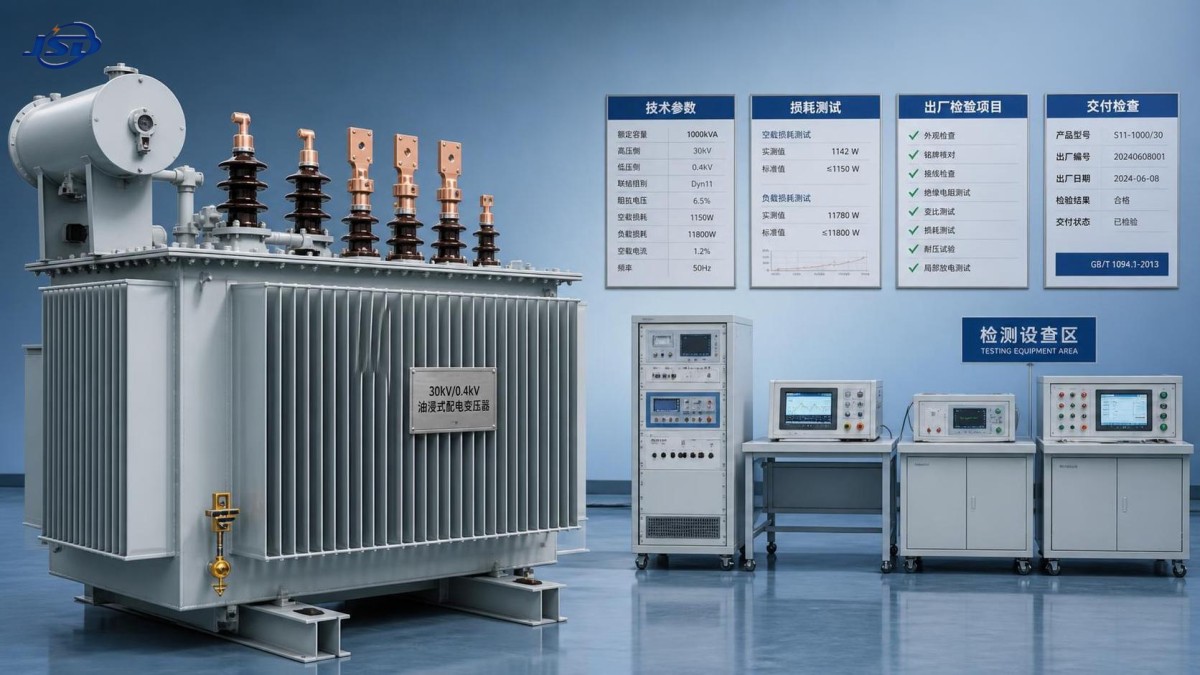
Turn the requirement into a comparison sheet
A common procurement problem is receiving quotations prepared against different assumptions. One supplier may quote the transformer body only. Another may include bushings, monitoring devices, surge arresters, cable boxes, terminal connectors, marshalling equipment, or a more complete testing package. The first quotation looks lower, but the difference may not represent a lower total project cost.
Create a comparison sheet before sending the inquiry. It does not need to be complicated, but it should separate mandatory technical requirements from preferred options and commercial terms. Use the same sheet for every supplier response. This prevents a missing item from being mistaken for an included item.
Useful fields include:
- Rated power, voltage ratio, frequency, vector group, and impedance.
- Applicable standard and the specific edition or project requirement, where defined.
- Cooling method, insulation system, winding material, and allowable temperature rise.
- No-load loss, load loss, and the testing method used to verify them.
- Tap range, tap-changer type, operating position, and adjustment procedure.
- Tank, radiators, bushings, terminals, earthing points, lifting points, and protection accessories.
- Routine tests, type-test evidence where required, factory inspection arrangements, and documents supplied with the unit.
- Packing, transport dimensions, delivery point, warranty scope, spare parts, and field-service availability.
This approach does not make purchasing slower. It reduces the time spent clarifying quotations after bid opening, when commercial pressure often makes technical corrections harder to negotiate.
Questions that reveal whether ratings are genuinely comparable
The kVA figure is necessary, but it is not enough. Ask each supplier to confirm how the transformer is designed to perform at the specified voltage, frequency, ambient condition, and loading profile. If the project has harmonic-producing loads such as variable-speed drives, rectifiers, data equipment, or power-electronic converters, raise that issue at the inquiry stage. Harmonics can affect heating, losses, and design considerations, so they should not be introduced as an afterthought.
Losses should be reviewed in context. A lower purchase price may be offset by higher losses during operation, particularly where the unit is energized continuously. Request guaranteed no-load and load-loss values, along with the reference temperature and applicable standard. Then ask how those values will be confirmed during factory testing. Do not compare an isolated “efficiency” statement without understanding the loading point and conditions behind it.
Tap selection is another frequent source of confusion. Ask whether the required voltage adjustment is off-circuit or on-load, how many tap positions are available, and whether the proposed range matches the utility or site voltage variation. In many projects, an off-circuit tap changer is appropriate, but it requires isolation before adjustment. That operational reality should be understood by the people responsible for commissioning and maintenance.
Short-circuit withstand capability, insulation coordination, and terminal arrangement may feel like engineering details, yet they can affect project acceptance and future reliability. Request clear confirmation of the relevant values rather than accepting broad wording such as “standard design.” If a supplier proposes deviations, ask for them in writing and have the responsible engineering team assess their impact.
Look past the factory brochure
Supplier assessment is more reliable when it follows evidence instead of presentation materials alone. A well-designed quotation should identify the manufacturing scope, applicable standards, test scope, drawings to be submitted, and exceptions to the specification. Vague language can hide uncertainty about what will actually be supplied.
Ask practical manufacturing questions. Is the proposed unit produced by the bidding manufacturer or sourced through another party? Which components are made in-house, and which are purchased? How are incoming materials controlled? What traceability is available for critical components? How are winding, drying, assembly, oil handling, and final testing managed?
These questions are not intended to force disclosure of confidential processes. Their purpose is to understand whether the supplier has a controlled route from approved materials to final test records. For an oil-immersed transformer, the quality of winding work, insulation processing, tank sealing, oil treatment, and test discipline has a direct connection to long-term operation.
Documentation should be treated as part of the deliverable. Ask for the proposed document schedule early. It may include outline drawings, nameplate data, terminal diagrams, test procedures, routine-test reports, installation instructions, operation and maintenance guidance, and packing details. If third-party inspection or factory acceptance testing is required, clarify the notification period, witness points, and handling of nonconformities before the order is placed.
Use standards carefully instead of treating them as a shortcut
Standards provide a common technical language, but a long list of standards is not automatically proof that every project requirement has been met. The more useful question is: which standard governs this supplied unit, and what documentation supports compliance with the requested clauses?
For example, IEC 60076 may be relevant to transformer design and testing, while the project may also impose local grid rules, energy-efficiency requirements, safety provisions, or customer-specific testing requirements. Ask suppliers to state the exact standard basis of their offer and list any deviations. If the project requires particular market approvals or certification documents, specify them in the inquiry and request their validity to be verified during evaluation.
Do not let standards replace a clear specification. A standard can define broad requirements, but it may not settle project choices such as cable connection direction, allowable dimensions, preferred accessories, paint system, noise limits, protection arrangement, or delivery documentation. Those items still need to be written down.
Consider an option in relation to its duty
For projects requiring a 30kV to 0.4kV step-down arrangement, capacity choices often need to cover both current demand and a realistic operating margin. A product such as the 30kV/0.4kV Oil-Immersed Power Distribution Transformer is available in 500kVA, 630kVA, 800kVA, 1000kVA, 1250kVA, and 1600kVA ratings. The right choice depends on the site load study, expected growth, installation constraints, and the operator’s maintenance approach rather than on a preferred rating alone.
When evaluating an oil-immersed option, ask the supplier to explain the cooling arrangement and overload conditions in precise terms. An ONAN self-cooled design may suit many distribution applications, but the accepted loading profile must remain consistent with the manufacturer’s thermal limits and the installation environment. Where a proposal states short-term overload capability, confirm the duration, temperature condition, monitoring requirement, and any restrictions that apply. A stated capability should never be treated as permission for routine overloading.
Material selection also requires context. Copper windings, for example, may be specified for electrical and mechanical design reasons, but the evaluation should still focus on the complete offered design, verified losses, test records, and suitability for duty. If a vegetable-based insulating fluid such as FR3 is proposed, clarify the exact fluid, fire-safety rationale, compatibility requirements, handling procedure, and maintenance expectations rather than assuming all alternative fluids provide identical characteristics.
Compare cost over the purchase cycle
Price comparison is necessary, but the purchase price should be broken into visible elements. Ask whether the quotation includes transport, unloading support, special packing, installation supervision, commissioning assistance, mandatory accessories, testing, and documents. If these are excluded, record them as exclusions rather than leaving them in general notes.
Energy losses deserve a separate line in the evaluation. The financial significance depends on operating hours, local energy cost, load profile, and project life. Procurement does not need to perform a complex financial model for every small purchase, but it should obtain the technical inputs needed for the owner or engineering team to assess operating cost. No-load loss is particularly relevant when the transformer remains energized for long periods, while load loss changes with loading.
Also review maintenance access. Can terminals, gauges, valves, earthing points, and tap settings be reached safely after installation? Are replacement parts identifiable? Is there a clear process for technical support if a test report, transport issue, or site abnormality needs review? A low-cost unit can become expensive if basic service information is difficult to obtain.
Resolve uncertainty before issuing the order
Once the technical and commercial comparison is complete, hold a short clarification stage rather than immediately selecting a supplier based on the initial bid. Send the same unresolved questions to the shortlisted suppliers. Require answers that identify whether the item is included, excluded, optional, or subject to customer confirmation.
Before final approval, verify the approved datasheet against the purchase order, quotation revision, drawings, and promised test scope. Pay particular attention to voltage ratio, tap range, vector group, impedance, losses, accessories, protection rating, and shipment requirements. These are the details most likely to cause disagreement if they are left in informal email exchanges instead of incorporated into the contractual document set.
The strongest purchasing decision is usually not the one with the shortest comparison table. It is the one where technical duty, supplier evidence, commercial scope, and lifecycle considerations point in the same direction. By asking focused questions before comparing suppliers, procurement teams can avoid false price comparisons and choose a distribution transformer that is appropriate for the installation, verifiable at delivery, and manageable throughout its service life.

Get a Quote
Regardless of whether you require general advice or specific support, we are happy to help you.
Send Us Your Inquiry Today

Jinshida Electric remains committed to contributing to global energy development through professional manufacturing and superior service.