





Why industrial rectifier transformer cooling design differs from standard distribution units
For project managers overseeing heavy industrial or high-power conversion systems, understanding why industrial rectifier transformer cooling design differs from standard distribution units isn’t a theoretical exercise—it’s a reliability checkpoint. A mismatched cooling strategy doesn’t just risk overheating; it accelerates insulation aging, triggers unplanned downtime during peak production, and silently degrades voltage regulation over time. The difference isn’t about “more cooling”—it’s about *why* the thermal load profile is fundamentally different, and how that changes every layer of engineering judgment: from winding geometry to oil flow paths, from hotspot placement to monitoring thresholds.
The Core Thermal Disconnect
A standard distribution transformer operates under near-sinusoidal loads with predictable, cyclical demand—typically peaking during business hours and relaxing overnight. Its cooling system (often ONAN or ONAF) is sized for average loading, with conservative margins for ambient temperature swings. An industrial rectifier transformer, by contrast, feeds processes like aluminum smelting, DC traction, or large-scale electrolysis—where current isn’t smooth. It handles non-sinusoidal waveforms rich in 5th, 7th, and 11th harmonics. These harmonics don’t contribute to useful power output, but they *do* generate significant additional losses—especially in windings and structural parts—because harmonic currents increase resistive (I²R) loss disproportionately. For example, a 30% 5th harmonic component can raise copper losses by over 40% beyond fundamental-frequency expectations. That extra heat isn’t evenly distributed: it concentrates in conductor strands and tank walls, creating localized hotspots that standard thermal models often miss.
Why Standard Cooling Assumptions Fail
Three interlocking realities make conventional cooling inadequate:
- Continuous high-current operation: Unlike grid-tied distribution units that see load variation, rectifier transformers often run at >90% rated load, 24/7. There’s no thermal recovery window. Oil and winding temperatures stabilize at much higher baselines—reducing margin for transient surges.
- Harmonic-induced stray losses: Eddy currents induced in tank walls, clamping structures, and even core laminations add 5–15% extra loss not captured in standard IEC 60076-1 load-loss calculations. This energy converts directly to heat *outside* the main winding zones—so radiator sizing based solely on winding loss underestimates total heat rejection needs.
- Asymmetric loading across phases: In 6-pulse or 12-pulse rectifier schemes, phase currents aren’t balanced. One winding leg may carry significantly more harmonic-rich current than another—creating uneven thermal stress that static cooling designs can’t compensate for.
This isn’t a matter of “upgrading” fans or adding radiators. It’s about rethinking thermal management as an integrated system—not just heat removal, but heat *distribution control*. That means designing for lower oil velocity gradients, optimizing duct spacing to avoid local stagnation, using thermally graded insulation (e.g., NOMEX® in hotspot zones), and embedding fiber-optic temperature sensors *within* windings—not just at top-oil points.
Cooling Method Selection: Not Just ONAN vs. ONAF
Many project managers assume upgrading from ONAN (oil-natural, air-natural) to ONAF (oil-natural, air-forced) solves the problem. But that’s only half the story. The real decision hinges on *where* forced cooling is applied—and whether it addresses the actual bottleneck.
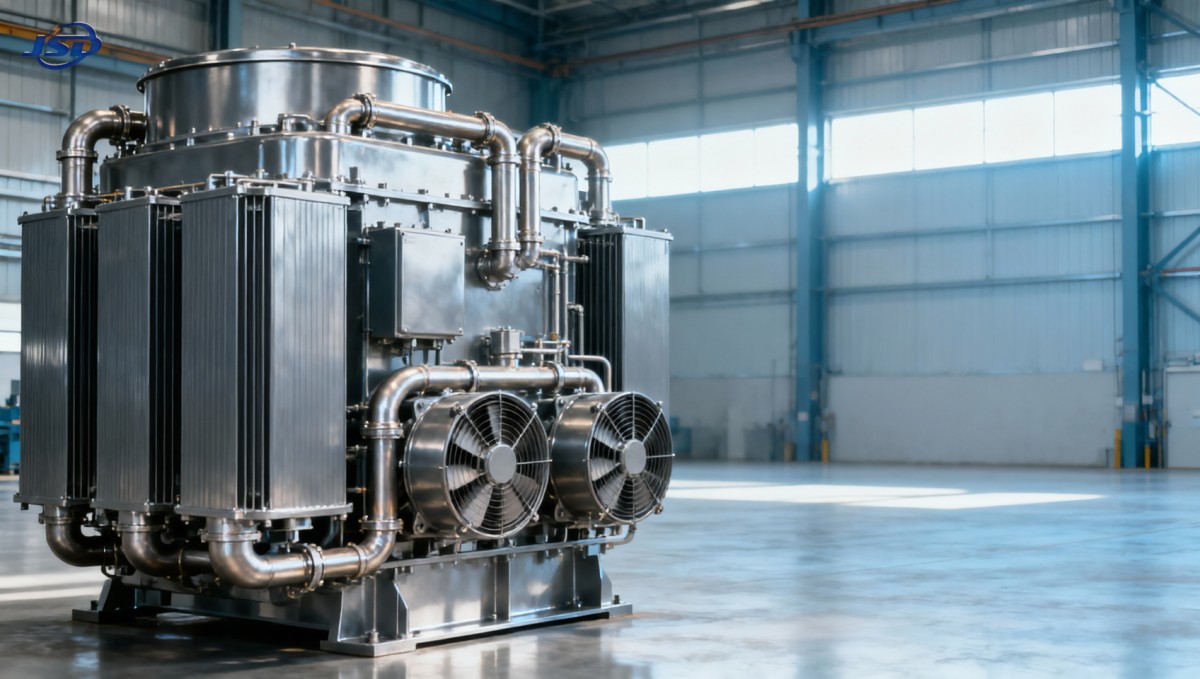
In a typical ONAF unit, fans cool the external radiator surface uniformly. But if the limiting factor is internal oil flow resistance—say, due to narrow cooling ducts between tightly packed rectifier windings—adding fans won’t reduce winding hotspot temperatures meaningfully. What’s needed is often OFAF (oil-forced, air-forced), where pumps circulate oil *through* optimized internal channels, carrying heat directly from conductors to radiators. Even then, pump sizing must account for increased oil viscosity at operating temperature and pressure drop across harmonic-loss-heated structural components.
At Jinshida Electric Power Technology Co., Ltd., our industrial rectifier transformer designs begin with 3D electromagnetic-thermal coupled simulation—not simplified equivalent-circuit models. We map harmonic current density distribution, calculate stray loss in each structural part, and model oil flow dynamics under worst-case continuous load. Only then do we finalize radiator surface area, fan curve selection, and internal baffle layout. This avoids over-engineering (costly) and under-engineering (risky).
Real-World Consequences of Oversimplification
We’ve seen projects where rectifier transformers were specified using standard distribution transformer catalogs—with identical cooling ratings. Within 18 months, partial discharge activity spiked in low-voltage windings. Root cause? Hotspot temperatures exceeded 110°C during sustained operation—degrading paper-oil insulation faster than expected. The fix wasn’t replacement; it was retrofitting directed oil jets to critical zones and recalibrating protection relays for harmonic-influenced temperature rise curves.
Another common misstep: assuming ambient-rated cooling applies equally indoors and outdoors. Rectifier transformers in enclosed substation buildings face trapped harmonic-generated heat—especially when installed near other harmonic sources (VFDs, arc furnaces). Here, ONAN may be insufficient *even at nameplate rating*, because ambient air doesn’t exchange effectively. Forced ventilation of the enclosure—or specifying OFAF with remote radiators—becomes necessary, not optional.
When Distribution-Style Cooling *Is* Acceptable
Not all rectifier applications demand custom thermal engineering. If your load is short-cycle (e.g., intermittent welding, batch electroplating), with duty cycles below 30% and harmonic content under 10%, a well-derated standard distribution unit *may* suffice—provided you verify hotspot rise via manufacturer test reports (not just top-oil readings). But for continuous-process industries—mining, smelting, rail traction, or green hydrogen production—the thermal profile shifts decisively. There, “standard” becomes a liability.
What Project Managers Should Verify—Before Finalizing Specs
Don’t rely on catalog cooling class alone. Ask suppliers for:
- Harmonic loss breakdown per IEC 61000-4-7 (not just total loss)
- Winding hotspot temperature rise *under full harmonic load*, measured per IEC 60076-2 Annex D
- Oil flow velocity maps through cooling ducts at rated flow rate
- Thermal time constant data—how quickly hotspot temperatures respond to load transients
Also confirm whether protection relays are configured for harmonic-influenced heating curves—not just IEEE C57.91 standard curves. A relay calibrated for sinusoidal loads may ignore dangerous slow-rising hotspots caused by persistent 7th harmonics.
For temporary or emergency deployments where rapid commissioning matters—such as construction sites or infrastructure restoration—Jinshida’s Mobile Temporary Compact Substation offers pre-integrated, ONAN-cooled transformer solutions rated up to 1250kVA. While not designed for continuous rectifier duty, its robust thermal design and IP33 outdoor rating make it suitable for auxiliary AC supply in rectifier-fed facilities—providing reliable, fast-deployed power without compromising on thermal safety standards.
The Bottom Line
The cooling distinction between industrial rectifier transformer and standard distribution units isn’t about complexity—it’s about fidelity to physics. Harmonics change where heat is generated, how it moves, and where it accumulates. Ignoring that leads to premature failure masked as “normal wear.” Addressing it requires moving beyond catalog specs to verified thermal modeling, application-specific validation, and protection systems tuned to real-world waveform behavior. For project managers, that means treating cooling not as a box to check—but as a core performance parameter, as critical as voltage regulation or short-circuit withstand.

Get a Quote
Regardless of whether you require general advice or specific support, we are happy to help you.
Send Us Your Inquiry Today

Jinshida Electric remains committed to contributing to global energy development through professional manufacturing and superior service.