





Why More Buyers Source Industrial Transformers from China: Cost, Lead Time, and Risks
Why More Buyers Source Industrial Transformers from China: Cost, Lead Time, and Risks
More buyers are turning to an industrial transformer manufacturer China for a practical balance of cost, lead time, and supply reliability. As global power projects face tighter budgets and faster schedules, China has become a preferred sourcing base for industrial transformers, offering competitive pricing, scalable production, and strong engineering support. For business evaluators, the key is not only finding a lower-cost supplier, but also managing quality, compliance, and delivery risks to ensure long-term project success.
That shift is easy to understand if you have spent time comparing bids across regions. In transformer procurement, the final decision rarely comes down to unit price alone. A slightly cheaper offer can become expensive if the delivery slips, the design needs rework, or the documentation does not match the project’s technical file. Buyers who source from China usually do so because the market has matured enough to support serious industrial and utility projects, not because they are chasing the lowest number on paper.
What is driving the sourcing shift?
The first reason is straightforward: manufacturing scale. China has a deep transformer supply chain, from core materials and windings to tank fabrication, insulation parts, testing equipment, and logistics support. When a supplier is close to upstream materials and has stable production volume, it can usually respond faster to standard specifications and many customized requirements. That matters for industrial projects, where schedules are often linked to civil works, switchgear delivery, or grid connection milestones.
The second reason is engineering flexibility. Buyers in mining, data centers, renewables, manufacturing, and infrastructure often need transformer designs that fit nonstandard voltages, cooling conditions, transport limits, or site constraints. A mature supplier in China is often used to handling these variations, provided the technical brief is clear. This is one area where experience matters: a vendor that can quote quickly is not always the one that can truly build to spec.
Cost still matters, of course, but serious buyers usually look at total landed cost. Freight, inland transport, packaging, inspection, spares, and delay exposure all belong in the same equation. If a project needs multiple units, the savings from sourcing in China can be meaningful, especially when compared with suppliers that have higher labor costs or less flexible production capacity. Still, the smartest teams do not treat “lower cost” as the whole story. They treat it as one variable in a wider procurement risk model.
Lead time is often the real deciding factor
In many projects, lead time is more sensitive than price. A transformer may look affordable at quote stage, but if the delivery date pushes a commissioning window, the project team pays for idle labor, delayed energization, or rescheduled downstream work. Chinese manufacturers are often attractive because they can coordinate design, raw material sourcing, fabrication, and factory testing within one production chain. That reduces handoff delays, especially for standard or semi-standard industrial units.
But buyers should be careful not to assume all lead times are equal. Two suppliers may both say “12 to 16 weeks,” yet one is quoting from stock material and the other is still waiting on design approval. For a business evaluator, the useful question is not “How fast can you deliver?” but “What exactly is included in that timeline?” Drawing approval, material procurement, routine test, packaging, export documentation, and port handover all need to be mapped early.
This is where a trusted industrial transformer manufacturer China can make a practical difference. Jinshida Electric Power Technology Co., Ltd., for example, focuses on power transmission and distribution equipment and works with customers across grid construction, industrial manufacturing, new energy, and infrastructure projects. That kind of technical and production background matters because buyers usually need more than a quotation; they need a supplier that can keep the project moving when the specification gets more complicated than the first inquiry suggested.
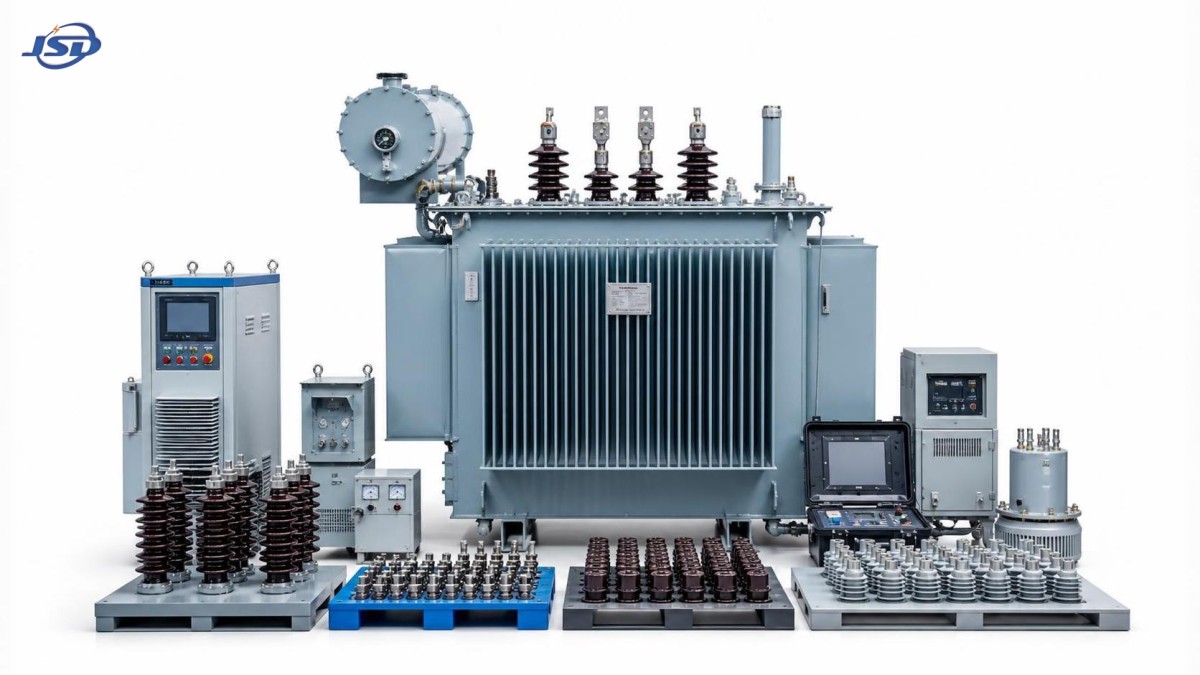
For larger grid and substation applications, buyers may also compare equipment such as a 110kV Oil-Immersed Transformer against alternative designs or sourcing regions. At that level, the discussion is rarely about price alone. Transport constraints, oil handling, test scope, and interface requirements with the rest of the substation package can all affect the final sourcing decision. A unit that looks efficient on a brochure can still become difficult if the project site, lifting conditions, or local utility requirements are not fully understood.
The risks buyers should not underestimate
The main sourcing risk is not “China” itself. It is weak supplier qualification. Some buyers focus on price and forget to check whether the factory has experience with the same voltage class, cooling method, loss requirements, or test documentation format. In transformer procurement, small misunderstandings can lead to big consequences. A mismatch in vector group, tap range, bushing arrangement, or sound level requirement can create delays that are hard to fix after production starts.
Compliance is another point where careful buyers stay conservative. Depending on destination market and project owner, the transformer may need to align with specific IEC or local utility requirements, and sometimes with project-specific test or inspection rules. This is not something to “assume into existence.” It needs to be checked against the actual tender file and utility standards. If a supplier cannot read those documents carefully, the commercial offer is not yet useful.
Quality management also deserves a practical look. A polished factory tour is not enough. Buyers should ask how incoming materials are controlled, what routine tests are performed, how deviations are handled, and whether the supplier can share a clear document package before shipment. For industrial transformers, after-sales support matters too, because many project issues do not appear at factory acceptance. They show up during installation, energization, or the first operating cycle, when site conditions reveal gaps that were not obvious in the office review.
What experienced buyers actually check
The most experienced procurement teams usually build a supplier review around a few practical questions rather than a long questionnaire. Can the manufacturer prove similar technical capability? Does the engineering team respond with specifics, not generalities? Are drawings, test scope, and delivery milestones aligned from the start? And if a change is needed, how quickly can the supplier revise without turning the project into a delay chain?
They also look at communication style. That may sound soft, but it is not. A transformer project often involves multiple parties: buyer, consultant, EPC contractor, freight forwarder, and sometimes the end user’s technical team. If the manufacturer is slow to clarify one detail, the whole chain slows down. Suppliers with strong technical teams and disciplined internal processes tend to reduce that friction. That is one reason buyers often prefer manufacturers that can handle both design discussion and production execution under one roof.
There is also a commercial reality worth stating plainly: not every project needs a premium-source strategy, and not every project should chase the cheapest quote. For repeat industrial loads, a well-qualified Chinese supplier can be a very sensible option. For critical infrastructure with strict owner standards, buyers may want deeper audits, third-party inspection, or tighter FAT requirements. The right sourcing model depends on the project’s tolerance for risk, not on market fashion.
A market trend that is still being shaped by discipline
The growing demand for Chinese sourcing is not a short-term price swing. It reflects a broader market preference for suppliers that can balance engineering capability, scalable manufacturing, and project timing. But this trend is healthy only when buyers keep discipline. The best results usually come from clear specifications, realistic schedules, and a supplier selection process that looks beyond the first quotation.
For business evaluators, the takeaway is simple. China can be a strong sourcing base for industrial transformers, but the value comes from execution, not geography. If the supplier understands the application, documents the design properly, and supports the project through delivery and testing, sourcing becomes a business advantage. If not, any apparent savings can disappear very quickly.
That is why buyers increasingly favor partners that can combine manufacturing depth with technical accountability. In transformer procurement, that combination is often what separates a workable supply decision from a costly one.

Get a Quote
Regardless of whether you require general advice or specific support, we are happy to help you.
Send Us Your Inquiry Today

Jinshida Electric remains committed to contributing to global energy development through professional manufacturing and superior service.