





Custom Power Transformer with CE: What OEM Buyers Should Verify Before Approval
Custom Power Transformer with CE: What OEM Buyers Should Verify Before Approval
When approving a custom power transformer with CE, quality and safety teams must verify more than the nameplate. From design compliance and material traceability to testing records and protection performance, every detail affects reliable operation in grid, industrial, and infrastructure projects. Jinshida Electric Power Technology provides engineered transformer solutions with strict quality control, helping OEM buyers reduce risk and ensure stable, energy-efficient performance before release.
That sounds straightforward, but in practice CE approval is where many projects get slowed down. The issue is not usually one big defect. It is a chain of small mismatches: the customer’s spec says one thing, the drawing reflects another, the insulation system is not documented clearly enough, or the test file does not show how the unit was evaluated under the actual configuration. For a custom transformer, those gaps matter more than a polished sales sheet.
The CE mark is not the final check
OEM buyers sometimes treat CE as a simple acceptance box. In reality, the CE marking only makes sense when the technical file, declared standards, and product configuration all match the delivered unit. If the transformer is custom-built, you need to confirm what exactly is covered by the declaration: the winding arrangement, voltage class, cooling method, enclosure or tank design, accessories, and any special protection devices.
A common mistake is assuming that a CE declaration attached to one model automatically covers a modified order. It does not. If the OEM changes the terminal arrangement, mounting method, tap range, or ambient condition assumptions, the approval team should ask whether the original validation still applies. This is especially true when the transformer is intended for outdoor service, harsh industrial sites, or variable grid conditions.
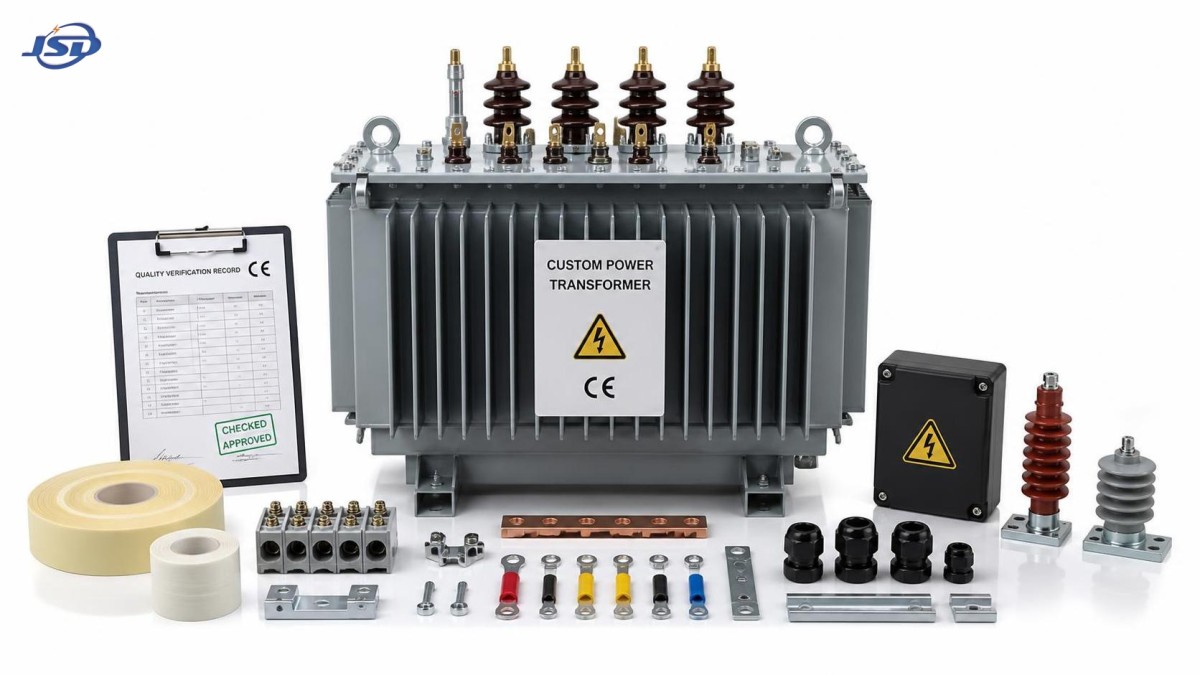
What quality and safety teams should inspect first
Start with the drawings, not the brochure. The approved drawing set should show the exact rated data, insulation levels, connection details, cooling mode, bushing arrangement, and any protection or monitoring accessories. If the transformer is part of a larger package, confirm that the interface points are clearly defined. A lot of project disputes come from unclear responsibility at the boundaries: who provides surge protection, who handles grounding details, and who confirms enclosure clearances.
Next, look at traceability. For a custom power transformer with CE, material records are not just paperwork. Core steel, copper or aluminum conductors, insulating materials, bushings, and tank fabrication records should all be traceable to the production batch. If a supplier cannot explain material substitution or revision control, that is a warning sign. A neat finished unit can still hide a weak process behind it.
Then review the test package in the context of the exact order. Routine test records are useful, but only if they match the actual nameplate data and design revision. For safety teams, the practical question is simple: does this document set prove that the delivered transformer was assessed as built, not as originally quoted?
Why application context changes the approval decision
A transformer for a utility feeder is not judged the same way as one for a factory line or a site power distribution point. Grid projects usually care about long-term stability and insulation durability. Industrial manufacturing often adds concerns around load fluctuation, harmonics, and operating continuity. Infrastructure projects may focus more on installation constraints, outdoor exposure, and maintenance access.
This is where a tailored design should be examined carefully. For example, a pole-mounted unit can be appropriate in some distribution scenarios, but it should still be checked against the site’s mechanical loading, clearance requirements, and maintenance expectations. In the middle of an approval review, it is common to compare options such as Pole-Mounted Oil-Immersed Single-Phase Transformer against a ground-mounted alternative. The right answer depends less on preference and more on service conditions, installation method, and how the project team intends to inspect and maintain the asset over time.
That comparison is not about choosing the “better” product in general. It is about fit. A compact pole-mounted design may solve one layout problem but create another if access for inspection is limited or if the local installation practice is different from the assumptions in the technical file. Buyers who approve quickly without checking the use case often discover the issue only after delivery.
Protection performance is often underchecked
Many review meetings spend too much time on the headline ratings and too little on protection behavior. Yet in field operation, protection is what saves equipment when conditions move outside the normal range. Safety teams should verify how the transformer is protected against overtemperature, overcurrent, moisture ingress, pressure rise, and abnormal loading if those functions are included in the design.
It also helps to ask what happens after a fault event. Is there a clear maintenance instruction? Are replacement parts identified? Are inspection points accessible without unnecessary disassembly? These may sound like service questions, but they directly affect safe operation. A transformer that is difficult to inspect is more likely to be left in service with unresolved issues.
OEM buyers should also be careful with “equivalent” substitutions. A change in gasket material, thermometer type, bushing brand, or sealing method may look minor on paper, but it can affect durability or compatibility with the final system. If the supplier proposes changes late in the process, the approval team should ask for the reason, the impact, and the revised documentation before release.
A practical approval checklist that avoids rework
Before sign-off, most teams benefit from a simple internal check rather than a long theoretical review. The useful questions are usually the ones that expose project risk quickly:
- Does the nameplate match the approved drawing and order specification exactly?
- Are the CE-related documents tied to the delivered configuration, not just a family model?
- Can the supplier show traceability for key electrical and structural materials?
- Do the test records reflect the same revision, ratings, and accessories?
- Are installation, grounding, and maintenance requirements realistic for the actual site?
- Have any late substitutions been reviewed and approved by the responsible team?
If one of these points is unclear, approval should slow down. That is not overcautious; it is normal risk control. In transformer projects, rework after shipment is always more expensive than one more round of document review.
What experienced OEM buyers tend to value
Experienced buyers usually care less about promises and more about process discipline. They want a supplier that can explain the design logic, show a consistent quality system, and respond clearly when the specification changes. That is where a manufacturer like Jinshida Electric Power Technology is expected to stand out: not through broad claims, but through controlled engineering, repeatable production, and documentation that stays aligned with the order from start to finish.
For quality and safety teams, that kind of cooperation matters because it reduces ambiguity. A custom transformer should not feel custom only at quotation stage and standard at delivery stage. The approval file should make the final product understandable enough that the buyer can defend the decision internally and maintain the asset confidently after installation.
A CE mark is useful, but it is not a substitute for technical discipline. If the documents, test evidence, and site assumptions all line up, approval is usually straightforward. If they do not, the safer move is to pause, ask for revision, and close the gaps before release. In transformer work, that caution is usually the difference between a clean handover and a costly field problem later.

Get a Quote
Regardless of whether you require general advice or specific support, we are happy to help you.
Send Us Your Inquiry Today

Jinshida Electric remains committed to contributing to global energy development through professional manufacturing and superior service.