





When does an industrial open type generator suit continuous-duty sites?
When Does an Industrial Open Type Generator Suit Continuous-Duty Sites?
For a project manager, generator selection is rarely a simple choice between “enclosed” and “open.” The real question is whether the generating set can provide dependable power through the site’s actual operating pattern, while remaining accessible, safe, serviceable, and practical to install. An industrial open type generator can be a strong fit for continuous-duty operations, but only when its installation environment and supporting electrical system are designed around it.
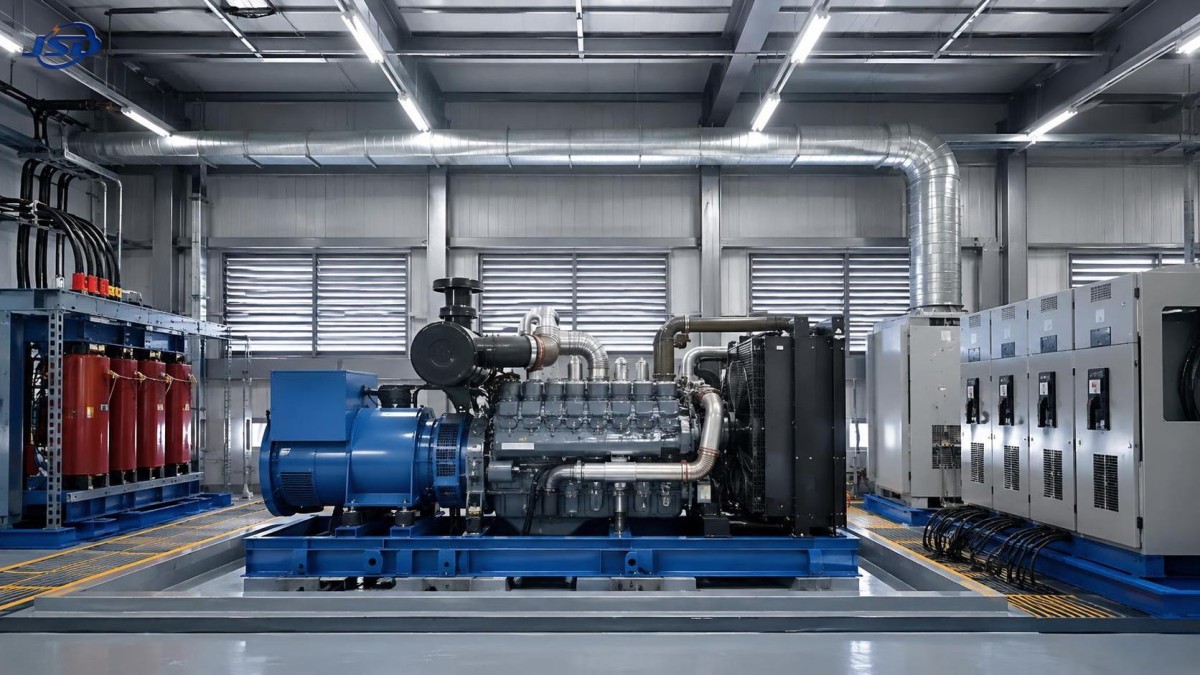
Open type generators are typically supplied without a weatherproof or acoustic canopy. The engine, alternator, control panel, cooling system, and base frame remain exposed for direct access. That configuration is not automatically “less industrial” than an enclosed set. In many factories, mining facilities, process plants, temporary utility compounds, and indoor generator rooms, it is the more logical arrangement because it simplifies maintenance and allows the project team to build ventilation, noise control, fire protection, and access routes into the site itself.
For continuous-duty sites, however, the decision should never rest on purchase price alone. A generator that runs for long periods becomes part of the facility’s power architecture. Its fuel system, transformer arrangement, distribution boards, protection settings, harmonic performance, and maintenance plan all influence whether the operation remains stable under real conditions.
The operating environment is the first filter
An industrial open type generator generally suits a continuous-duty site when it will operate inside a purpose-designed room, protected power house, containerized plant space, or another controlled installation area. These environments can provide the features that a canopy would otherwise attempt to supply: protection from rain and dust, engineered intake and exhaust airflow, drainage, controlled access, fire separation, and an acceptable noise boundary.
A manufacturing facility may place the set in a dedicated utility room near the main low-voltage switchboard. A mine may install it in a serviceable power station with filtered ventilation. A large infrastructure project may use a temporary but properly constructed generator enclosure with fuel containment and cable routing. In each case, the open frame makes inspections easier, particularly where technicians need regular access to filters, belts, cooling connections, batteries, terminals, and control equipment.
The arrangement is much less suitable when the generator must stand outdoors with little site protection, close to occupied offices, residential boundaries, public roads, or locations exposed to driving rain, salt-laden air, windblown sand, flood risk, or severe temperature variation. An open frame does not solve those environmental challenges by itself. Adding a poorly ventilated shed after commissioning is not a substitute for an engineered installation; it can create overheating, exhaust recirculation, and unsafe maintenance conditions.
Continuous duty begins with the load profile, not the nameplate
A generator may be selected for standby use, prime power use, or a duty pattern closer to continuous operation. These categories are not interchangeable. Project teams need to confirm the manufacturer’s stated rating basis, the expected annual operating hours, the permitted average load, and any limits on overload capability. A set that is adequate for occasional utility outages may not be appropriate as the normal power source for a process line operating day and night.
The most useful starting point is a load study. Record the expected base load, peak demand, motor starting requirements, planned expansion, and the sequence in which major loads are connected. Pumps, compressors, crushers, conveyors, HVAC equipment, welding equipment, variable-frequency drives, rectifiers, and UPS systems can create very different demands on the generator. Looking only at total installed kW often leads to oversights.
A continuous site also has a load-quality question. Non-linear loads may introduce harmonic currents, while large motors may cause voltage dip during starting. Sensitive control systems may require tighter voltage and frequency performance than general lighting or resistive heating. The alternator, automatic voltage regulator, governor, switchgear, cable system, and transformer must be considered as one system. If the electrical design is fragmented across suppliers, responsibility for performance during load steps can become unclear.
- Establish the normal running load and realistic maximum demand rather than relying on connected load alone.
- Identify the largest motor starts and determine whether sequencing, soft starters, or variable-speed drives change the starting profile.
- Review power factor and harmonic-producing equipment before finalizing alternator and transformer ratings.
- Allow for maintenance outages, future loads, and the practical consequences of running a single set near its limit for extended periods.
Where uptime is critical, parallel generator sets may offer a more resilient approach than one large unit. They can follow changing demand more effectively, permit maintenance on one set while others remain online, and reduce the operational impact of a single failure. That said, paralleling introduces additional control, protection, synchronization, and commissioning requirements. It should be chosen because the operating strategy justifies it, not because it appears more sophisticated on a drawing.
Why the transformer is part of the generator decision
At many industrial sites, generation is only the first stage of power delivery. The generator output must then feed low-voltage distribution, step-up equipment for a medium-voltage network, or a transformer serving separate production zones. The transformer selection affects voltage regulation, fault levels, energy losses, protection coordination, and the generator’s ability to support transient loads.
For example, a site receiving or distributing power at medium voltage may need a 33 kV-to-0.4 kV arrangement for industrial loads. In indoor locations where fire performance, low maintenance needs, and the absence of oil-leakage risk are relevant, a cast-resin dry-type transformer can be worth evaluating. The 33kV Cast Resin Dry-Type Distribution Transformer is designed for 33 kV input and 0.4 kV output applications, with rated capacities stated from 30 kVA to 2500 kVA. Its SCB10-12 configuration is relevant to industrial plants, commercial buildings, hospitals, data centers, mining operations, and renewable-energy systems where the transformer installation must be assessed alongside the generation and distribution design.
The provided transformer data also indicates 6% short-circuit impedance, lightning impulse capability of 175 kV, and operation at 120% rated load under forced-air cooling conditions. These values should not be treated as isolated selection points. The engineering team still needs to check protection coordination, actual fault-duty conditions, ambient temperature, ventilation, cable lengths, earthing arrangement, and the operating mode of the generator. A transformer that is well suited to the building can still be poorly matched to the rest of the power system if those interfaces are not reviewed.
Maintenance access is a practical advantage—if the site uses it
One of the strongest reasons to choose an industrial open type generator is maintenance visibility. Technicians can inspect fluid levels, hoses, clamps, wiring, insulation condition, and abnormal vibration without removing canopy panels or working through restricted service doors. On a set that operates continuously, this access can shorten routine inspections and make early warning signs easier to identify.
But accessibility only creates value when the generator room has usable clearances, safe lighting, lifting access, a clean floor, drainage, and documented maintenance procedures. It is common for a set to be specified with sufficient service access and then installed too close to a wall, cable trench, fuel tank, or exhaust duct. The result is a generator that is technically maintainable but operationally inconvenient. Over time, inconvenient maintenance often becomes deferred maintenance.
Continuous-duty planning should cover consumables, fuel filtration, oil analysis where appropriate, coolant management, battery checks, alternator insulation testing, control-panel diagnostics, and a clear spare-parts strategy. It should also define who has authority to isolate equipment and what power remains available during scheduled service. For process sites, that plan is often more valuable than an optimistic claim about generator reliability.
Noise, heat, fuel, and safety cannot be left to later stages
An open generator transfers more responsibility to the project design. Acoustic treatment may be built into walls, doors, silencers, intake louvers, and exhaust routing. This can work very well, especially in permanent industrial buildings, but it requires an acoustic assessment based on the site boundary and nearby work areas. If noise limits are strict or the installation is near people, an enclosed generator may be the more straightforward option.
Heat management deserves the same attention. The room must remove radiator heat and combustion air without allowing hot exhaust air to circulate back to the engine intake. Ventilation sizing must reflect the selected engine and local ambient conditions. Dust control matters as well: aggressive filtration may be needed in cement, quarrying, mining, or construction environments, but restrictive filters can affect airflow if maintenance intervals are ignored.
Fuel autonomy should be calculated from actual consumption at expected loading, not from a nominal tank size. The fuel system may involve daily tanks, bulk storage, transfer pumps, filtration, leak detection, bunding, and fuel-quality controls, subject to local requirements. Long continuous runs make contaminated fuel, water ingress, and inadequate transfer arrangements more consequential than they are in an emergency-only installation.
Safety design also extends beyond the generator set. Emergency stops, guarding around moving components, hot-surface protection, exhaust insulation, fire detection, earthing, cable protection, and lockout procedures need to work together. The precise requirements depend on the project location, applicable codes, insurer expectations, and client standards. These items should be reviewed before procurement, since late modifications can affect space, cost, and commissioning schedules.
A useful decision test for project teams
An industrial open type generator is usually a sensible continuous-duty solution when the site has a protected, engineered installation space; the duty rating matches the planned operating regime; the load study includes starting and power-quality behaviour; noise and ventilation are addressed at building level; and maintenance access is genuinely preserved. It is particularly compelling where technicians are present, service response matters, and the generator room forms part of a larger electrical plant rather than a stand-alone outdoor installation.
It is less convincing when the project needs fast outdoor deployment, has limited control over weather and dust, cannot provide acoustic treatment, or lacks a maintenance team capable of supporting long operating hours. In those cases, a canopy-equipped package, a containerized solution, or a revised utility connection strategy may reduce overall project risk.
The best decision is made before equipment is ordered: align the generator rating, transformer parameters, switchgear, protection philosophy, fuel arrangement, room layout, and operating responsibilities on one coordinated design basis. Jinshida Electric Power Technology Co., Ltd. approaches power equipment through that wider system perspective, combining transmission and distribution equipment expertise with manufacturing processes and quality management intended to support stable power for industrial, grid, new-energy, and infrastructure projects. For a continuous-duty site, the final specification should be tested against the actual load, environment, and maintenance reality—not merely against a catalogue rating.

Get a Quote
Regardless of whether you require general advice or specific support, we are happy to help you.
Send Us Your Inquiry Today

Jinshida Electric remains committed to contributing to global energy development through professional manufacturing and superior service.