





When Does a Solar Inverter Transformer OEM Partnership Make Sense for PV Projects?
For PV project decision-makers, choosing the right solar inverter transformer OEM partner can directly impact system efficiency, long-term reliability, and project ROI. Jinshida Electric Power Technology Co., Ltd. supports global energy and infrastructure projects with high-performance power equipment, advanced manufacturing, and strict quality control. If your solar project demands stable power conversion, customized solutions, and dependable delivery, a trusted solar inverter transformer OEM partnership may be the strategic advantage you need.
When OEM becomes a strategic choice, not just a sourcing option
In utility-scale and commercial PV projects, the transformer is rarely the headline item, but it often becomes one of the most consequential. When an inverter-transformer interface is poorly matched, losses increase, harmonics become harder to manage, and commissioning issues can delay grid connection. That is why a solar inverter transformer OEM partnership makes sense only when the project has enough scale, technical complexity, or delivery risk to justify a more integrated approach.
For small distributed projects, standard catalog products may be enough. But once a project involves higher voltage levels, harsh site conditions, grid-code compliance, or repeated rollout across multiple sites, OEM cooperation starts to matter. The value is not simply custom branding. It is about aligning transformer design, inverter output characteristics, insulation performance, thermal behavior, and logistics planning with the actual project architecture.
This is especially relevant in markets where grid requirements vary from one region to another. A transformer that works well in one country may not meet another market’s losses, temperature rise, or protection coordination expectations. In those situations, buying a standard unit can look efficient on paper and expensive in execution.
The decision usually depends on four practical questions
Decision-makers often ask whether OEM is “better” than buying from a distributor or selecting a generic manufacturer. That is the wrong question. The more useful question is whether the project needs design responsibility, supply control, and performance consistency beyond what off-the-shelf sourcing can provide.
The first question is project scale. If the order volume is small and the site design is fixed, the cost of customization may outweigh the benefit. If the project is part of a pipeline of repeated installations, OEM partnership can reduce unit-level friction and improve standardization over time.
The second question is electrical compatibility. Solar transformers must work smoothly with inverter characteristics, partial-load operation, and dynamic output changes. Projects with advanced grid-support functions, frequent ramping, or mixed equipment vendors often benefit from tighter OEM coordination.
The third question is lifecycle risk. Delayed delivery, poor thermal margin, or weak fault tolerance can create expenses that are far greater than the initial purchase price. In many PV cases, the cheapest transformer is not the least expensive solution once downtime and corrective work are included.
The fourth question is service continuity. If the project spans multiple phases, the ability to reproduce the same specifications, test records, and installation logic matters more than most buyers expect. This is where an OEM partner can provide practical value.
Where inverter-transformer integration creates real project value
Solar projects increasingly operate under tighter grid expectations and higher scrutiny on power quality. That has pushed many developers to rethink the inverter-transformer interface as a system-level issue rather than a component-level purchase. A well-matched OEM arrangement can improve voltage regulation, reduce integration risk, and simplify site engineering.
For example, when storage is added to a PV plant, the electrical profile becomes more complex. Charging, discharging, and grid interaction all affect the transformer’s loading pattern. In these cases, the project may benefit from a more coordinated solution such as a 1MW/2MWh Liquid Cooling Container Energy Storage System, especially when storage is being deployed to stabilize output, support peak shifting, or improve curtailment response. The key point is not the product category itself, but the need for equipment that fits the broader power conversion strategy rather than operating as an isolated purchase.
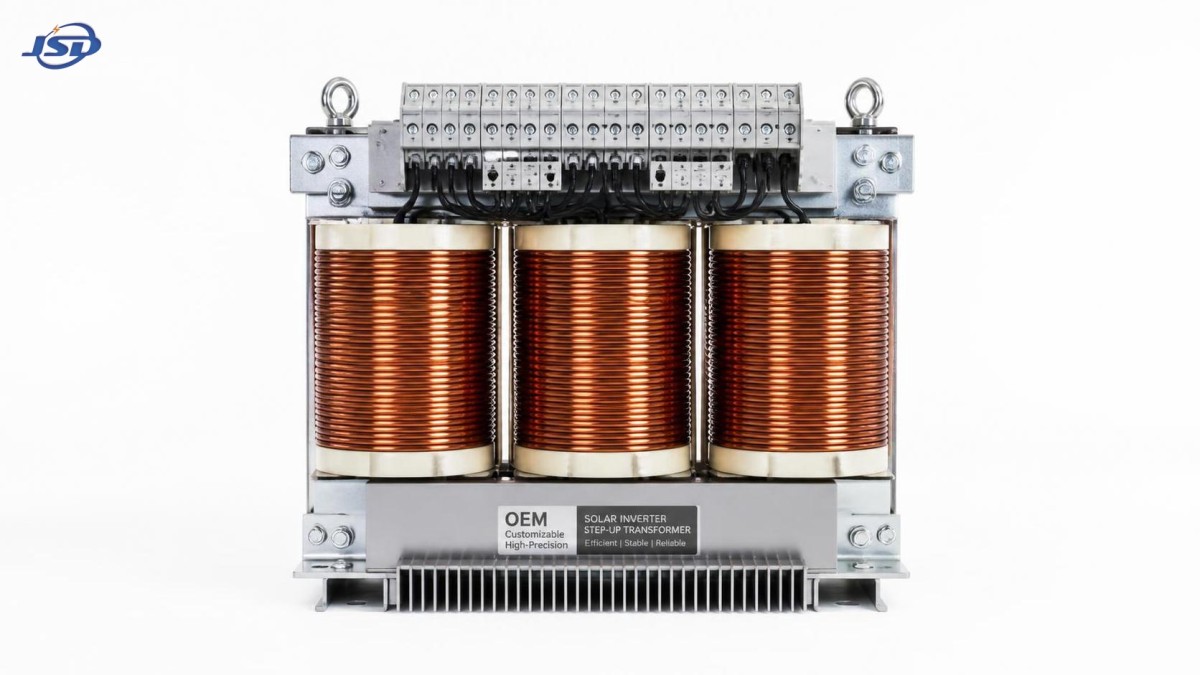
That same logic applies to transformers. If the transformer is being selected after inverter procurement, then the buyer may be forced into compromise. If it is selected with OEM input early in the project, the design can better reflect site temperature, altitude, ventilation, harmonic content, and expected overload behavior. Those details influence performance more than marketing claims do.
What a serious OEM partner should be able to prove
In this market, “OEM capable” is easy to say and harder to verify. Decision-makers should look for evidence in engineering and manufacturing, not in presentation language. A credible solar inverter transformer OEM partner should be able to demonstrate design flexibility, traceable quality control, test capability, and stable production management.
Key checks usually include whether the supplier can support custom voltage ratios, impedance targets, cooling methods, and enclosure requirements. It also matters whether they can provide routine test reports, insulation verification, and documentation suitable for project approval. If the project is being financed or insured, document quality can matter as much as equipment performance.
Delivery reliability is another common weak point. A supplier may have technical capability but still create project risk if material sourcing, production scheduling, or export packaging is inconsistent. For international projects, the best OEM partner is often the one that can combine technical adaptation with disciplined delivery control.
Quality systems should also be viewed in operational terms. A project owner does not benefit from a “high-quality factory” in abstract terms; it benefits from repeatable control over winding, drying, assembly, testing, and final inspection. For transformers used in PV projects, small process deviations can become field issues later.
Where OEM partnerships fail in practice
Most failures do not come from the transformer concept itself. They come from mismatched expectations. A buyer may expect OEM customization, but the supplier is only modifying labels. Or the supplier may offer engineering changes without enough validation, which can create hidden reliability risk.
Another common mistake is treating price as the primary selection factor before confirming grid code, insulation class, environmental conditions, and installation constraints. In solar projects, these factors often define whether the transformer will operate safely and efficiently. A low bid that ignores them can increase commissioning time or lead to derating later.
There is also a commercial risk in over-customization. Some projects request a highly tailored design for issues that do not materially affect performance. That can increase lead time and complicate spare parts planning. The best OEM arrangement is usually a disciplined one: custom where it matters, standardized where it does not.
How to judge whether the partnership makes sense for your PV project
A solar inverter transformer OEM partnership is usually worth pursuing when at least one of these conditions is true: the project is large enough that downtime is expensive; the site conditions are difficult; the grid requirements are strict; multiple project phases need product consistency; or the developer wants tighter control over lifecycle cost.
It is less compelling when the project is small, the electrical design is straightforward, and market-standard products already meet requirements with acceptable risk. In that case, the added engineering and procurement effort may not generate enough return.
The real decision is not “OEM or not.” It is whether the transformer is a commodity item in your project, or a system-critical component that affects integration, compliance, and long-term operating cost. For many PV developers, EPCs, and asset owners, that line is becoming harder to ignore.
As solar portfolios expand and grid expectations become more demanding, the companies that benefit most from OEM cooperation are usually the ones that treat equipment selection as part of project strategy, not just procurement. That is where transformer partnerships can move from optional to operationally important.

Get a Quote
Regardless of whether you require general advice or specific support, we are happy to help you.
Send Us Your Inquiry Today

Jinshida Electric remains committed to contributing to global energy development through professional manufacturing and superior service.