





What to check before buying a BESS energy storage system
Procurement teams searching for a BESS energy storage system are usually trying to answer a practical question: will this project reduce operating cost and improve power reliability, or will it introduce new technical and commercial risk? That is the right starting point. In real projects, battery storage is rarely purchased as a standalone box. It sits inside a broader power architecture that may include transformers, switchgear, PCS, EMS, protection devices, fire safety systems, and grid connection requirements. A low initial quotation can look attractive, but if the system is poorly matched to the site, the total cost of ownership rises quickly through derating, retrofit work, downtime, or compliance issues.
For buyers in industrial, infrastructure, and energy projects, the smarter approach is to check whether the proposed system fits the actual duty cycle, site conditions, electrical design, and long-term service model. Price matters, but it should come after technical fit, safety, and lifecycle assumptions have been tested.
Start with the business case, not the battery container
Many purchasing mistakes happen before technical comparison even starts. A BESS energy storage system can serve very different purposes: peak shaving, time-of-use arbitrage, backup support, renewable smoothing, demand charge control, microgrid support, frequency response, or power quality improvement. These use cases may sound similar in a sales deck, but they place different demands on power rating, discharge duration, cycling frequency, response speed, and control logic.
If your site needs short bursts of power to reduce peak demand, a two-hour configuration may be enough. If the goal is to support production continuity during unstable grid conditions, runtime, transfer strategy, and integration with backup generation become more important. If the system will operate alongside solar or wind, dispatch logic and charging behavior need closer review. In other words, the “right” system is defined by how it will be used, not by its nominal capacity alone.
Before requesting final bids, buyers should be clear on a few internal questions:
- What commercial problem is the system expected to solve?
- How many cycles per day or per year are realistically expected?
- Is the priority savings, resilience, grid compliance, or production continuity?
- What is the acceptable payback range for the investment?
- Which part of the electrical system will the BESS connect to?
If these points remain vague, suppliers will fill the gap with assumptions, and quotations will become hard to compare in a meaningful way.
Check the electrical integration path early
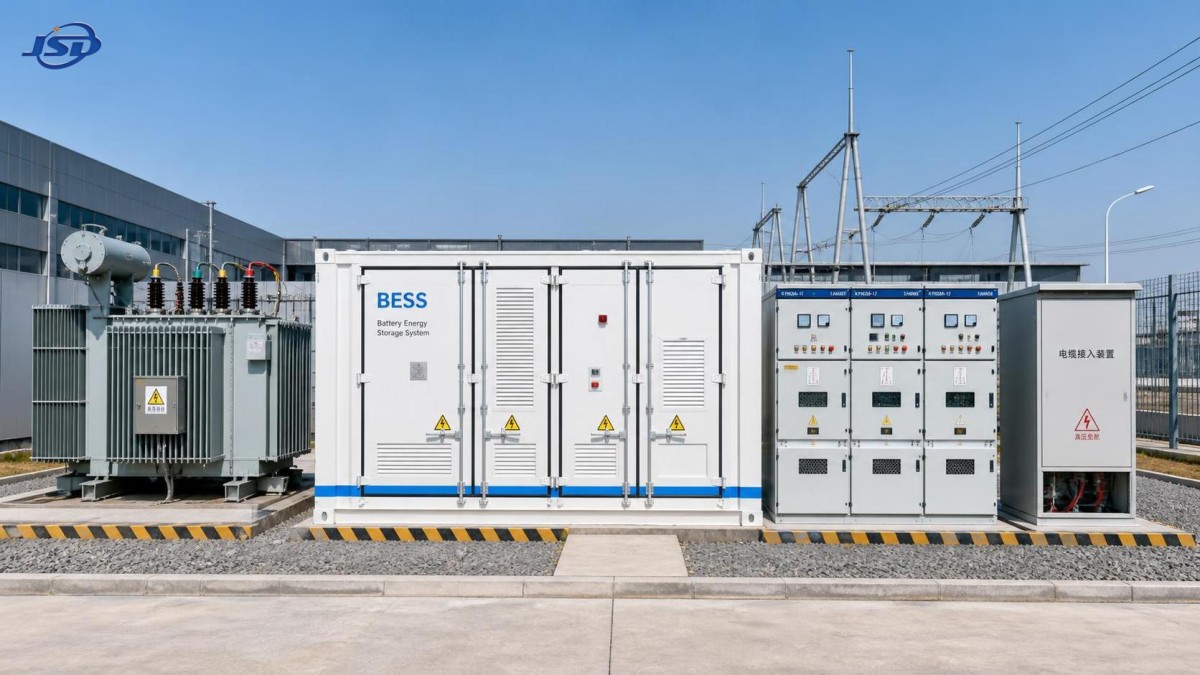
In the transformer and power distribution context, one of the most important procurement checks is how the storage system will connect into the existing network. This is where many projects become more complex than expected. The battery itself is only one part of the installation. The full solution may require transformer capacity review, medium- or low-voltage interface design, short-circuit coordination, relay protection settings, harmonic assessment, cable routing, ventilation planning, and SCADA or EMS integration.
Buyers should ask a direct question: what upstream and downstream equipment must be modified for this system to operate safely and legally? If the answer is vague, the bid is incomplete.
Where a site already has aging distribution assets, adding storage can expose limitations that were previously manageable. Transformer loading margins, ambient temperature, protection selectivity, and fault level constraints all deserve review. In some industrial sites, the storage project also overlaps with hazardous-area power equipment decisions. In those environments, buyers often compare broader power-system components, including solutions such as Mining Flameproof Transformer, because storage procurement is not isolated from the site’s overall electrical safety philosophy.
Do not compare proposals by rated capacity alone
A common procurement shortcut is to compare systems mainly by MWh and MW numbers. That is understandable, but it misses the variables that determine actual usable value. Buyers should examine at least five technical dimensions behind the headline specification.
1. Usable energy versus nominal energy
Nominal capacity does not always equal the energy available in day-to-day operation. State-of-charge limits, reserve requirements, thermal conditions, and warranty operating windows may reduce usable output. Ask suppliers to state usable capacity under the intended operating conditions, not just nameplate capacity.
2. Duration and dispatch profile
A four-hour system and a two-hour system can produce very different economics depending on tariff structure and load shape. The lower-cost option on paper may underperform if the discharge window does not match the site’s actual demand peaks.
3. Degradation assumptions
Battery performance changes over time. Procurement teams should request the assumed degradation curve, end-of-life definition, augmentation assumptions, and the operating profile used to model them. A proposal that looks cheaper may simply be using optimistic assumptions.
4. Round-trip efficiency at system level
Ask whether the efficiency figure refers to the battery cell, battery rack, DC block, or full AC system. Commercial results depend on system-level efficiency, including conversion and auxiliary loads.
5. Response and control capability
If the site needs fast response for power quality or grid support, the control architecture matters as much as battery chemistry. Review PCS performance, EMS logic, and communication compatibility with the existing plant system.
Safety is not a brochure section, it is a procurement filter
Battery safety cannot be treated as a generic checklist item. Buyers should understand how the system addresses thermal runaway detection, gas management, fire suppression, cell monitoring, enclosure design, emergency shutdown, and fault isolation. It is also worth checking what safety strategy applies at cell, module, rack, and container levels, because a single feature is not enough on its own.
Do not accept broad claims such as “international safety design” without specifics. Ask for the exact standards, test reports, and certification scope. Some documents may cover components rather than the assembled system. That distinction matters. Certification requirements also vary by market and application, so any compliance statement should be verified against project location and utility or authority requirements【待核实】.
For sites with demanding environmental or industrial risk conditions, the enclosure and auxiliary design deserve the same scrutiny as the battery chemistry. Dust, humidity, corrosive atmosphere, altitude, and high ambient temperature can materially affect safety and reliability.
The supplier’s delivery boundary needs to be explicit
In BESS procurement, cost overruns often come from unclear scope rather than equipment price. Buyers should require a clean definition of what the supplier includes and excludes. Does the quotation cover transformer matching, switchgear, civil foundation inputs, commissioning, grid studies, EMS integration, fire system interfaces, training, spare parts, remote monitoring, and warranty response? If not, who is responsible?
This is especially important when comparing integrated suppliers with battery-only suppliers or trading companies. Two bids can look close in price while offering very different delivery boundaries. A lower quotation may leave the buyer exposed to design coordination work, interface risk, and delayed energization.
Useful procurement questions include:
- Who takes responsibility for system integration at site level?
- Is the supplier providing a turnkey package or only major equipment?
- What assumptions were used for grid connection and protection design?
- What site data does the supplier still need before freezing the design?
- Which performance values are guaranteed, and under what conditions?
Look at lifecycle cost, not just capex
For procurement teams under budget pressure, the temptation is to treat BESS purchasing as a capex comparison. That usually leads to weak decisions. The more useful metric is lifecycle cost against the intended business outcome. This includes not only equipment price, but also efficiency losses, auxiliary power consumption, degradation, maintenance, replacement strategy, software support, downtime exposure, and possible augmentation later in the project life.
A disciplined commercial review should ask whether the payback model is based on realistic electricity tariffs, dispatch assumptions, and operating windows. If a supplier’s savings estimate depends on perfect cycling behavior every day of the year, it deserves challenge. Local dispatch restrictions, utility rules, and production variability often reduce the theoretical revenue or savings available in practice【待核实】.
Warranty language deserves close reading
In many storage projects, the warranty is where commercial expectations and technical reality diverge. Buyers should check whether the warranty is tied to throughput, years, retained capacity, availability, operating temperature, cycle count, or a combination of these. It is also important to understand what actions void or limit coverage, including changes to operating profile, environmental conditions, charging behavior, or third-party integration.
Ask for plain answers to these questions: what is guaranteed, how is it measured, who measures it, and what remedy applies if the guarantee is missed? A warranty that offers only limited parts replacement without performance restoration may leave the buyer carrying most of the financial risk.
After-sales capability is part of product quality
In power equipment procurement, strong manufacturing is important, but support capability is what protects performance after handover. Buyers should assess whether the supplier can actually support commissioning, troubleshooting, spare parts, firmware updates, and technical response in the target market. This is particularly relevant for systems expected to operate as part of critical power infrastructure.
Ask where service engineers are located, what remote monitoring tools are available, how fault escalation works, and what the expected response times are. If the supplier is positioning itself as a long-term power equipment partner, its quality management system, engineering depth, and experience across transmission and distribution applications should be visible in the way it handles these questions, not just in company-profile language.
Reference projects matter, but only if they are comparable
Suppliers often present project references as proof of capability. Those references are useful only when they resemble your operating context. A utility-scale renewable storage project does not automatically validate a behind-the-meter industrial application. A mild-climate installation does not prove performance in high-temperature or high-dust conditions. A pilot project does not equal repeatable delivery capability.
Buyers should ask for reference cases with similar duty cycle, voltage level, integration scope, and service expectations. If the site includes specialized underground or hazardous operations, adjacent power-system references can also be relevant. In that context, seeing how a supplier approaches equipment such as Mining Flameproof Transformer may help procurement teams judge whether the company understands harsh operating environments rather than only standard commercial installations.
Questions that usually improve the final decision
By the time procurement reaches final negotiation, the best buyers have moved the discussion from “What is your best price?” to “What exactly are we buying, under which operating assumptions, and who carries which risks?” That shift tends to expose weak proposals quickly.
- Provide the expected AC usable energy over time under our actual operating profile.
- List all certifications and specify whether they apply to components or the complete system.
- State the required site conditions for warranty validity.
- Clarify all owner-supplied items and integration responsibilities.
- Explain the augmentation or replacement strategy after capacity fade.
- Define commissioning support, training scope, and post-handover service terms.
For most procurement teams, the practical conclusion is simple: a BESS energy storage system should be evaluated as a long-life power asset, not a commodity purchase. The strongest buying decisions usually come from combining electrical integration review, safety verification, lifecycle cost analysis, and supplier capability screening before price negotiation becomes the center of the conversation.
That extra work at the front end is usually cheaper than discovering, after award, that the battery was the easiest part of the project.

Get a Quote
Regardless of whether you require general advice or specific support, we are happy to help you.
Send Us Your Inquiry Today

Jinshida Electric remains committed to contributing to global energy development through professional manufacturing and superior service.