





How a BESS battery energy storage system supports solar projects
Solar projects rarely fail because panels cannot produce energy. More often, performance suffers because generation does not match demand, grid conditions shift, or project operators have limited flexibility once the sun moves behind clouds. For project managers responsible for timelines, performance targets, and long-term asset value, a bess battery energy storage system is no longer just an add-on. It is increasingly the element that turns intermittent solar generation into a controllable, dispatchable, and more bankable power asset.
In utility-scale, industrial, and infrastructure applications, storage helps reduce curtailment, smooth output, and support more stable grid interaction. It also gives operators room to respond to real operating conditions rather than relying on ideal forecasts. Backed by power equipment expertise, Jinshida Electric supports solar projects with dependable transmission and distribution solutions that make the broader energy system more reliable, practical, and easier to manage over time.
Why solar projects reach a point where storage becomes necessary
Many solar projects begin with a straightforward goal: generate clean electricity and deliver as much of it as possible. But once a project enters detailed design or actual operation, a more complicated picture emerges. Peak solar production may not line up with peak load. Grid operators may impose export limits. Sensitive industrial facilities may not tolerate voltage fluctuation. In remote or infrastructure settings, maintaining continuity of power can be just as important as producing renewable energy.
This is where a bess battery energy storage system changes the design logic. Instead of treating solar as an energy source that must be accepted whenever it appears, the project gains a buffer between generation and delivery. That buffer can absorb excess energy, release it later, and help shape how the plant behaves electrically.
For project leaders, that matters because many real project risks sit in this gap between production and usable power. If storage is considered early, it can improve system economics and reduce downstream redesign. If it is added too late, the team may face avoidable constraints in civil layout, transformer sizing, switchgear selection, protection coordination, and control strategy.
What a BESS actually does in a solar application
At a practical level, battery energy storage does far more than “save extra power for later.” In a well-designed solar project, BESS can serve several operational roles at once:
- Energy shifting: storing midday excess solar and discharging during evening demand or tariff peaks.
- Ramp-rate control: smoothing sudden changes caused by passing clouds or plant dispatch adjustments.
- Curtailment reduction: capturing energy that would otherwise be limited by grid export caps.
- Voltage and frequency support: helping the site or connected network maintain power quality.
- Backup or resilience support: improving continuity for critical loads in industrial or infrastructure environments.
- Capacity firming: making solar output more predictable and easier for the grid or facility to plan around.
Not every project needs all of these functions. The point is that storage should be selected based on the project’s real operational bottlenecks, not just on battery capacity alone. A system built mainly for time shifting may be configured differently from one intended for grid support or microgrid resilience.
Where project managers see the biggest value
From a project management perspective, the strongest argument for integrating BESS is often not theoretical energy efficiency. It is operational control.
When a solar plant has no storage, managers are forced to accept more uncertainty in delivery schedules, grid interaction, and power stability. When storage is integrated correctly, teams can plan with more confidence. Procurement becomes more targeted. Commissioning tests become more meaningful. Long-term operation and maintenance decisions become less reactive.
That value shows up in several ways.
Better use of generated solar energy
If a site regularly produces more power than it can immediately consume or export, unused energy becomes a quiet but important loss. A battery system helps recover that value by shifting output to more useful times. For commercial and industrial projects, this may support peak shaving. For utility-connected sites, it may reduce curtailment and improve delivery flexibility.
More stable site performance
Solar output can change quickly. Facilities with motor loads, process equipment, or sensitive electronics often care less about annual generation totals and more about minute-by-minute stability. Storage can absorb those short-term swings and support more consistent power behavior.
Stronger grid compatibility
As grid codes evolve, solar projects are increasingly expected to do more than inject energy. They may need to support voltage control, respond to dispatch signals, or operate within stricter ramping limits. BESS helps solar plants behave more like managed power assets rather than passive generators.
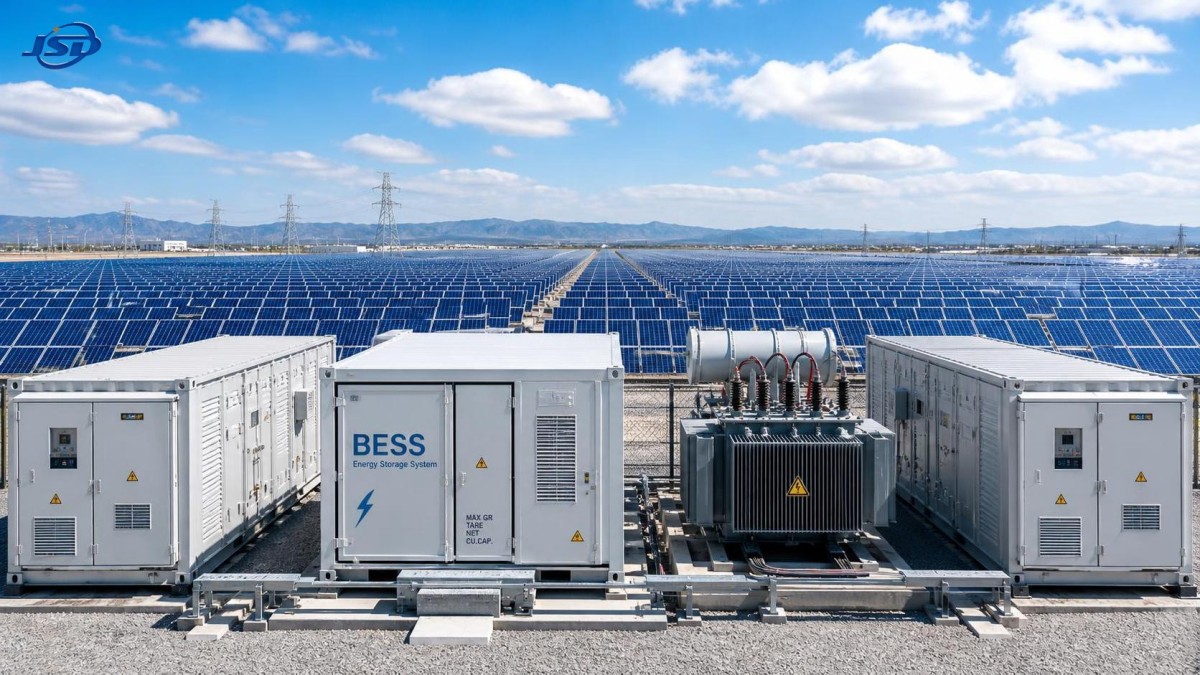
System design is not only about the battery container
One common mistake in early planning is to focus almost entirely on battery cells, duration, and PCS ratings while underestimating the surrounding electrical infrastructure. In reality, the success of a BESS-supported solar project depends heavily on how storage connects with transformers, switchgear, protection systems, and site distribution architecture.
This is especially important in medium-voltage collection and distribution environments. The charging and discharging behavior of the battery introduces dynamic load and export conditions that need to be matched with appropriate power equipment. Transformer selection, thermal performance, insulation reliability, and installation environment all affect long-term stability.
In some project configurations, a dry-type transformer is preferred for safety, fire performance, and ease of installation in enclosed or sensitive environments. For example, when integrating MV-side distribution in solar and storage applications, an option such as the 20kV Three-Phase Cast Resin Dry-Type Distribution Transformer may be relevant where design priorities include insulation reliability, reduced maintenance concerns, and suitability for demanding installation conditions. This is not the centerpiece of the storage strategy, but it is part of the electrical backbone that allows the strategy to work safely and consistently.
Questions worth answering before specifying a BESS battery energy storage system
Project managers often get pushed toward sizing discussions too quickly. Before deciding on power and energy ratings, it is worth clarifying a few operational questions:
- Is the main objective curtailment recovery, backup support, tariff optimization, or grid compliance?
- How often will the battery cycle, and at what depth of discharge?
- Will the system operate behind the meter, in front of the meter, or in a hybrid mode?
- What is the expected relationship between solar generation profile and actual site load?
- Are there medium-voltage interconnection requirements that influence transformer and switchgear design?
- How important are fire safety, indoor installation constraints, or environmental conditions such as humidity and dust?
- What control hierarchy will govern the solar inverter, battery PCS, EMS, and protection systems?
These questions matter because a battery sized for one business case may disappoint in another. A project designed only for energy shifting might not respond effectively to rapid ramp control. A system intended for resilience may need different reserve logic than one optimized for market arbitrage.
How BESS supports different solar project types
Utility-scale solar plants
In large plants, storage often improves dispatchability and grid friendliness. It can reduce clipping losses, support scheduled delivery, and help meet interconnection requirements. Project managers in this segment usually care about how storage affects export profiles, substation design, and operational predictability over many years.
Industrial solar installations
For factories and production campuses, the strongest driver may be less about selling power and more about protecting operations. Storage can reduce demand spikes, support voltage stability, and improve power continuity during disturbances. Here, the right design should reflect process sensitivity, shift patterns, and critical load priorities.
Infrastructure and remote projects
In transportation, utilities, campuses, or off-grid support applications, storage helps bridge the gap between renewable generation and essential service reliability. The project team may need the system to maintain service quality despite variable weather, weak grids, or limited fuel alternatives.
Integration challenges that should not be ignored
Storage brings value, but it also introduces complexity. The most successful projects are usually the ones that address this complexity early rather than treating it as a commissioning issue.
Controls integration is one major area. Solar inverters, battery PCS, EMS platforms, and site protection systems must respond in a coordinated way. If controls are poorly aligned, the system may oscillate, underperform, or fail to meet dispatch expectations.
Thermal and environmental planning is another. Battery systems, transformers, and MV equipment all have environmental limits. Heat, dust, moisture, and ventilation conditions can affect reliability more than many teams expect during concept design.
Protection coordination also deserves close attention. Once a site includes storage, fault currents, load flow direction, and operating states become more complex. Protection settings that looked sufficient in a simple solar plant may need to be re-evaluated.
Lifecycle thinking matters as well. Project managers should not only ask whether the system works on day one, but whether it remains maintainable, safe, and economically useful under real operating patterns. That includes attention to equipment quality, service access, replacement planning, and compatibility across core electrical components.
What to look for in an electrical equipment partner
Even when the battery technology itself comes from a specialist supplier, the broader project still depends on strong electrical infrastructure. This is where an experienced power equipment manufacturer can add practical value. For solar-plus-storage projects, project teams benefit from partners who understand how transmission and distribution equipment performs in new energy environments, not just in conventional installations.
Jinshida Electric focuses on the R&D, manufacturing, and application of power transmission and distribution equipment, supporting customers with power products designed for stable and reliable operation. For project managers, that kind of support matters when storage integration affects medium-voltage distribution, equipment coordination, and installation quality across the whole system.
Whether the application calls for dry-type transformers in safety-sensitive areas or robust distribution equipment for demanding project conditions, the right supporting components help ensure that the BESS strategy translates into dependable field performance. In some layouts, the 20kV Three-Phase Cast Resin Dry-Type Distribution Transformer can fit naturally into that supporting role where medium-voltage distribution, insulation reliability, and installation practicality are key concerns.
Making the solar project more controllable, not just more complex
The best reason to deploy a bess battery energy storage system is not that storage is trendy or widely discussed. It is that solar projects increasingly need control, flexibility, and resilience that panels alone cannot provide. For project managers balancing technical demands with commercial expectations, storage offers a way to reduce wasted generation, improve grid interaction, and make the project behave more predictably under real-world conditions.
That outcome depends on more than battery capacity. It requires clear operating goals, realistic integration planning, and reliable electrical equipment surrounding the system. When those elements come together, solar-plus-storage becomes more than a renewable concept. It becomes a practical power solution that is easier to operate, easier to trust, and better aligned with the long-term needs of modern energy projects.

Get a Quote
Regardless of whether you require general advice or specific support, we are happy to help you.
Send Us Your Inquiry Today

Jinshida Electric remains committed to contributing to global energy development through professional manufacturing and superior service.