





What makes a dry type transformer manufacturer reliable
Reliability starts long before delivery
When people evaluate a dry type transformer manufacturer, they often begin with the obvious questions: price, lead time, rated capacity, voltage class. Those matter, but they do not tell you whether the supplier will still look reliable after commissioning, under fluctuating loads, in a dusty plant room, or during a hot summer when ventilation is less forgiving than the design sheet suggested.
A reliable manufacturer is not simply one that can produce a transformer. It is one that can translate project conditions into a workable design, build it consistently, document it clearly, and support it when the job moves from procurement to installation and operation. In practice, that means buyers should look beyond catalog language and ask how the manufacturer thinks.
A supplier that understands application risk is usually the safer choice
Dry type transformers are often selected because they reduce fire risk, fit indoor environments well, and simplify maintenance compared with some oil-filled alternatives. But “dry type” is not a complete answer. A transformer used in a commercial building, a metallurgy workshop, a data-heavy industrial facility, and a renewable energy project may face very different thermal, harmonic, altitude, humidity, and overload conditions.
A dependable dry type transformer manufacturer usually asks about these conditions early. If a supplier jumps straight to quotation without discussing installation environment, load profile, cooling method, insulation class, protection degree, or local grid characteristics, that is worth noticing. It does not automatically mean poor quality, but it often suggests a transactional approach rather than an engineering one.
Business evaluators tend to focus on measurable procurement criteria, and that is reasonable. Still, one practical test is simple: does the manufacturer ask questions that reduce project uncertainty? The stronger suppliers usually do.
R&D capability matters because standard products do not solve every project
One of the more overlooked signs of reliability is whether the manufacturer has real design and development capability, not just assembly capacity. In this industry, many failures are not dramatic factory defects. They come from design mismatches: insufficient thermal margin, coil structure not suited to site conditions, enclosure selection that ignores ventilation, or inadequate adaptation to harmonic-rich loads.
A manufacturer with a professional technical team can usually explain why a particular insulation system, winding arrangement, or cooling design is appropriate for a given application. That does not require exaggerated claims. In fact, the more reliable companies are often the ones that speak carefully, define assumptions, and distinguish between standard configurations and custom engineering.
This is where companies focused on transmission and distribution equipment tend to stand out. Jinshida Electric Power Technology Co., Ltd., for example, positions itself around R&D, manufacturing, and application of power transmission and distribution products rather than treating manufacturing as a standalone activity. For buyers, that kind of orientation is relevant because it usually means the factory is thinking about field performance, not only output volume.
Quality control is not a slogan; it shows up in repeatability
Many procurement teams hear the phrase “strict quality management system” from almost every vendor. The more useful question is what that discipline looks like in daily production. Reliable manufacturers tend to have tighter control over raw material consistency, winding process, resin treatment where applicable, core assembly, dimensional tolerance, and routine testing before shipment.
You do not need to turn a supplier audit into a forensic exercise, but you should expect evidence of process control. Ask how incoming materials are checked. Ask whether production records are traceable by batch or serial number. Ask how routine test results are documented and whether drawings, nameplate data, and final configuration are aligned before dispatch. These questions are not administrative. They are directly tied to whether a transformer arriving six months later is the same transformer you thought you ordered.
Consistency is especially important for buyers handling multi-unit projects. One good unit proves less than many people think. Repeatability across units and across batches is the real signal.
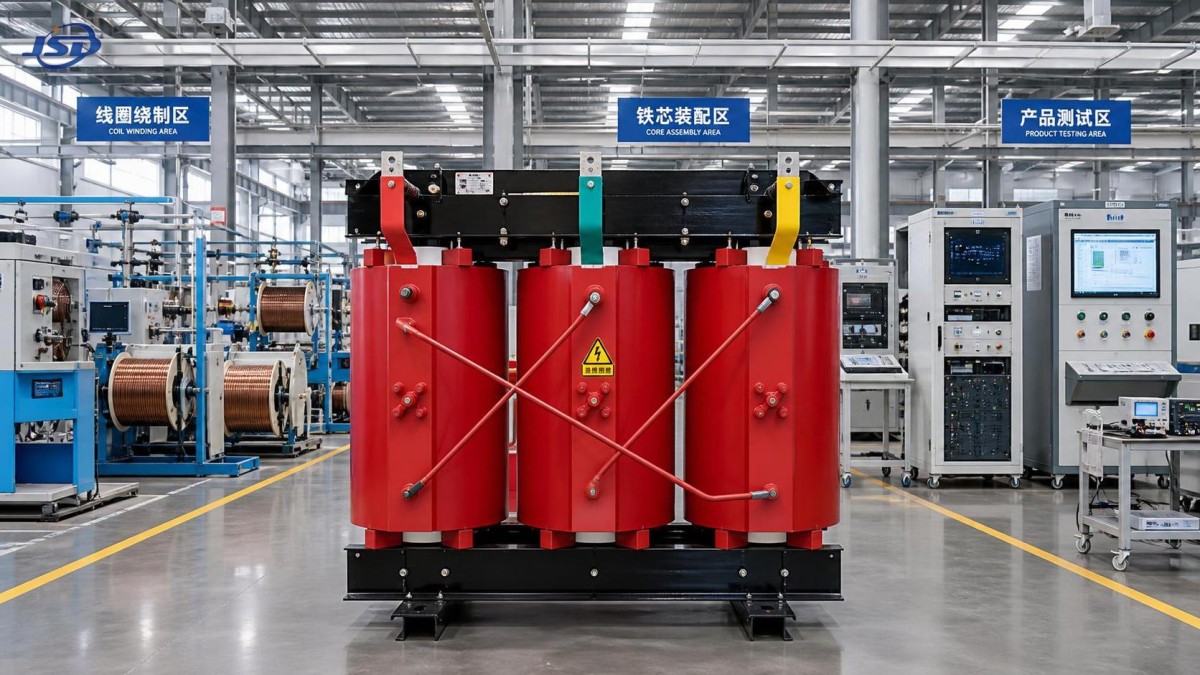
Manufacturing capability should match the complexity of the project
There is a practical difference between a factory that can produce a basic dry type transformer and one that can support industrial, infrastructure, or new energy applications with stable quality. Advanced production processes are not only about automation. They also involve process discipline, tooling accuracy, insulation handling, and the ability to maintain quality when specifications vary.
This matters because many procurement issues show up at the interface between design and manufacturing. A technically acceptable drawing can still become a problem if the production line cannot execute it reliably. Lead time pressure makes this worse. Some suppliers quote aggressively, then substitute details or compress inspection steps to keep schedule. A reliable manufacturer is usually more transparent about what can be delivered as quoted and what requires adjustment.
For projects connected to solar generation or substation upgrades, this becomes even more obvious. A company that also understands adjacent equipment and system application is often better positioned to avoid coordination errors. In that context, products such as Step-Up Transformer for Photovoltaic Power Stations are relevant not as a sales talking point, but as an indicator that the manufacturer has exposure to power conversion scenarios beyond a single standard indoor transformer order.
Documentation quality says a lot about future service quality
One detail experienced buyers rarely ignore is the quality of technical documentation. Reliable manufacturers typically provide clearer drawings, specification sheets, wiring information, testing records, and installation guidance. That sounds mundane until a contractor is on site trying to verify cable interface, enclosure dimensions, or protection requirements against civil works already underway.
Poor documentation creates hidden cost. It delays approvals, increases clarification cycles, and raises the risk of installation errors. In some projects, the direct transformer price difference between vendors is smaller than the cost of one schedule disruption caused by unclear data. For business evaluators, this is one of the easiest areas to test before placing an order: review the quotation package and technical response carefully. If it is vague at bid stage, post-order communication is unlikely to improve.
Experience in real operating environments matters more than broad claims
Not every manufacturer needs to claim expertise in every segment. In fact, broad claims without application depth can be a warning sign. A more credible indicator is relevant experience across grid construction, industrial manufacturing, infrastructure, and new energy projects, because these sectors expose equipment to different operational stresses and compliance expectations.
What buyers should listen for is not polished marketing language, but practical awareness: how the supplier discusses ventilation constraints in compact electrical rooms, transport limitations for site access, harmonic distortion concerns near variable-frequency drives, or coordination with switchgear and protection schemes. These are the kinds of details that experienced manufacturers tend to mention naturally.
That is also why long-term positioning matters. A company committed to becoming a trusted global partner in power equipment usually has stronger incentives to maintain service standards, improve product quality over time, and protect reputation in export and project-based markets. Those goals are only credible when backed by technical support and manufacturing discipline, but they are still relevant in supplier evaluation.
After-sales support should be judged before the sale
A transformer may operate for years with little attention, which makes support easy to underestimate. Yet the critical support moments often happen early: submittal approval, installation questions, site acceptance, startup checks, and fault investigation if something behaves unexpectedly.
Reliable manufacturers are usually responsive before the order because they have enough technical depth to answer specifics. If simple pre-sales questions about temperature rise, tapping arrangement, enclosure option, or accessory compatibility take too long or receive generic answers, that tends to predict future frustration. Strong service is not just about being polite. It is about having the engineering and production teams aligned enough to give accurate answers without repeated internal confusion.
How to compare suppliers without getting trapped by low headline price
For procurement decisions, a useful comparison framework is to weigh at least five things together: technical fit, manufacturing consistency, documentation quality, delivery realism, and service responsiveness. Price belongs in that group, but it should not dominate it.
A lower quotation can become expensive if it omits accessories, reduces enclosure protection, assumes easier ambient conditions, or leaves testing and acceptance details ambiguous. This is common enough that buyers should normalize quotations before comparing them. Make sure voltage ratio, impedance assumptions, cooling method, protection degree, terminal arrangement, and test scope are being compared on the same basis. Otherwise, you may be evaluating two very different products under one line item.
It also helps to assess whether the manufacturer is comfortable discussing limits. Good suppliers do not say yes to everything. They will usually point out where project conditions may require design review, schedule adjustment, or parameter confirmation under local standards. That restraint is often a stronger sign of reliability than a fast promise.
What reliability looks like in a manufacturer shortlist
If you are narrowing a shortlist, the most reliable dry type transformer manufacturer is rarely the one with the most impressive brochure. It is more often the one that combines engineering judgment, disciplined production, clear technical communication, and enough project experience to spot problems before they become change orders or operating issues.
For buyers evaluating suppliers in the transformer sector, that usually means looking for a company with a serious technical team, advanced and controlled manufacturing processes, a rigorous approach to quality, and familiarity with the demands of industrial, grid, infrastructure, and renewable power applications. Those are the factors that reduce long-term risk.
Before making the final decision, ask one more question: if site conditions change slightly, or if the project team needs technical clarification quickly, which manufacturer is most likely to respond with a workable answer instead of a delayed excuse? In this market, that answer often tells you more than the quotation total.

Get a Quote
Regardless of whether you require general advice or specific support, we are happy to help you.
Send Us Your Inquiry Today

Jinshida Electric remains committed to contributing to global energy development through professional manufacturing and superior service.