





How to evaluate dry type transformer manufacturers for quality
Quality evaluation starts with whether a manufacturer can translate a project requirement into a stable dry type transformer, not whether the quotation looks tidy. When comparing dry type transformer manufacturers, the useful questions are practical: which core material is being used, how the windings are insulated, how temperature rise is controlled, how routine testing is documented, and whether the factory can keep the same build standard from one batch to the next. A supplier may present a polished drawing set, but if the production discipline behind it is weak, the transformer can still arrive with inconsistent losses, noise, partial discharge behavior, or mechanical finishing.
The first filter is technical fit. Dry type transformers are selected for specific indoor environments, fire-safety expectations, ventilation conditions, and load profiles. A manufacturer should be able to discuss rated capacity, primary and secondary voltage, frequency, vector group, impedance, insulation class, cooling method, and enclosure arrangement without turning every answer into a generic brochure statement. If the discussion stays vague around overload behavior, harmonic conditions, altitude correction, or space restrictions inside the electrical room, the evaluation is already exposing risk. Good dry type transformer manufacturers usually ask detailed follow-up questions because the product cannot be judged correctly in isolation from the installation site.
Look closely at core and winding choices
Core material and winding construction are often where product quality becomes visible. Grain-oriented silicon steel, cutting precision, burr control, step-lap assembly, and clamping stability affect no-load loss, noise, and long-term mechanical reliability. If a manufacturer cannot explain how the core is processed and assembled, it becomes difficult to verify whether the stated electrical performance is repeatable in actual production.
Winding design deserves the same attention. For dry type transformers, copper or aluminum conductors may both be used depending on the design target, but the real issue is whether conductor sizing, insulation spacing, thermal path, and short-circuit strength are engineered properly. In cast resin units, resin formulation, vacuum casting discipline, curing control, and crack resistance matter. In vacuum pressure impregnated designs, the impregnation quality, resin penetration, and coil compactness matter just as much. A drawing may list the same rated power from two different suppliers, yet the manufacturing margin against hot spots and mechanical stress can be very different.
Ask for a clear explanation of conductor joints, tap arrangement, lead support, and how the windings are braced against electrodynamic forces. A transformer may perform acceptably during routine factory tests and still develop problems later if the winding block is not rigid enough. Loose supports, poor resin penetration, or weak lead exits tend to reveal themselves only after transport, repeated load cycling, or a network fault.
Test reports are only useful when they are specific
Many evaluations stall because a test report is treated as a formality. It should be read as evidence of manufacturing discipline. Routine tests should match the offered rating and configuration exactly, including voltage ratio, polarity or vector group, winding resistance, no-load current, no-load loss, load loss, impedance voltage, and insulation tests where applicable. A serious manufacturer can usually explain why one measured value is close to the design estimate and why another shows some deviation within tolerance.
Watch for reports that look overly generic, especially when the document style appears standardized but the technical fields are thin, inconsistent, or copied across models. The safest reading is line by line: transformer rating, tapping range, connection symbol, temperature limits, and serial traceability should align with the offered unit. When dry type transformer manufacturers handle many custom orders, documentation control becomes part of product quality. If serial numbers, drawings, bills of material, and test sheets are loosely linked, mistakes become easier during production and shipment.
For projects with sensitive loads, it is reasonable to probe further into temperature rise behavior, partial discharge control where relevant, and noise performance under real installation conditions. Some factories can discuss these points with engineering depth, including coil geometry, cooling duct arrangement, and enclosure impact. Others only restate catalog values. The difference matters because dry type transformers often operate inside buildings where ventilation, harmonics, and ambient temperature can shift actual performance.
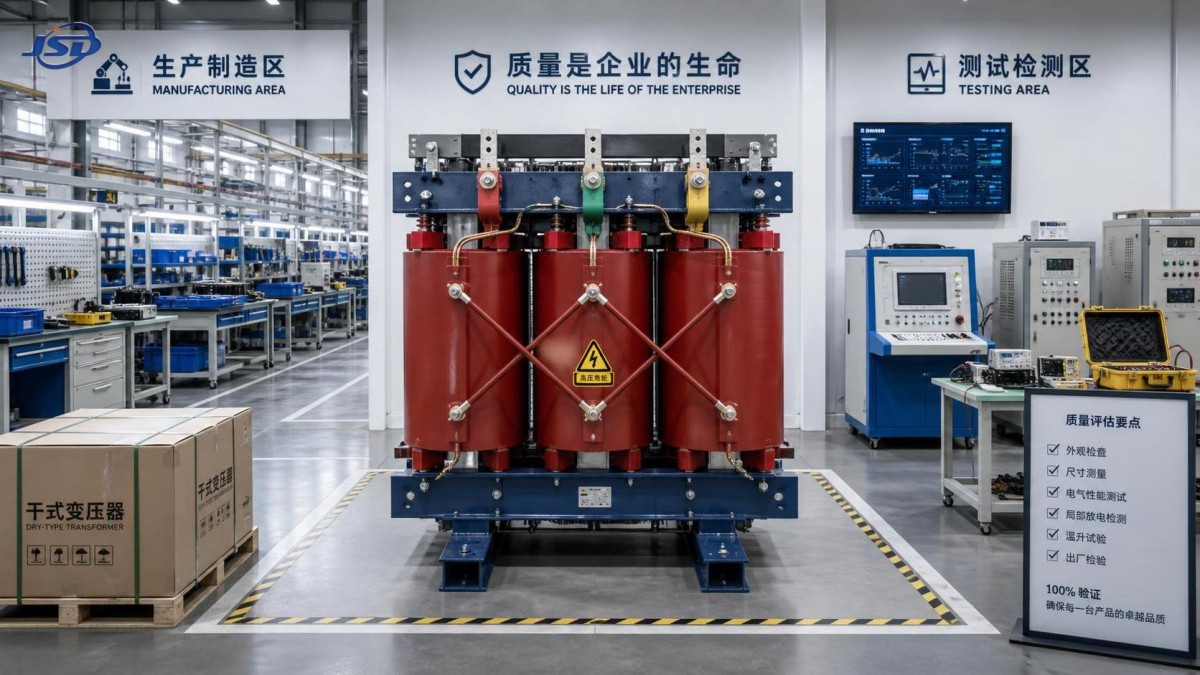
Manufacturing consistency matters more than a single sample
A factory visit, whether physical or by well-structured remote review, should focus less on appearance and more on process control. Clean work areas are useful, but they are not enough. The stronger signals are material identification at each station, process sheets linked to product types, in-process inspection points, coil drying or curing control, calibrated measuring tools, and separation between qualified and nonconforming parts. A manufacturer producing dry type transformers at stable quality usually has a visible workflow from incoming material to final assembly and test.
Ask how core laminations are stored, how conductors are verified before winding, how resin or insulation materials are controlled, and what happens when a measured parameter falls outside internal limits. If the answer is only that the unit will be rechecked, that says little. Better answers describe rework boundaries, engineering review, cause analysis, and whether the deviation can trigger hold status for the batch. This is where factory discipline becomes visible.
Lead time also reveals quality risk. Very short production promises can sound attractive, but dry type transformers need time for winding, insulation processing, curing or impregnation, assembly, testing, and packing. If the timeline appears compressed without a clear production plan, quality may be sacrificed in the invisible stages. That does not automatically mean the supplier is weak, but it does justify closer verification of process capacity and scheduling control.
Engineering support should be concrete, not promotional
The evaluation should include how the manufacturer handles technical clarification before order release. Transformer quality is shaped during this stage because errors in specification handover can produce a perfectly built unit that is wrong for the site. A competent supplier usually confirms cable entry direction, terminal arrangement, enclosure protection level, forced ventilation options if any, installation clearances, transport limits, and local environmental conditions such as dust, humidity, or corrosive atmosphere. When these details are skipped, later site modifications become more likely.
This matters especially when a dry type transformer is part of a broader power system with low-voltage equipment, energy storage, or renewable integration. For example, if the transformer is serving a room that also houses battery equipment such as 51.2V Wall-mounted LiFePO4 Energy Storage Battery, layout constraints, heat sources, cable routing, and maintenance access should be reviewed together rather than treated as separate procurement lines. The point is not product bundling; it is interface control. Good manufacturers understand that transformer reliability can be affected by the surrounding electrical environment.
Pay attention to thermal design and site conditions
Dry type transformers are often chosen for indoor safety and reduced maintenance concerns, but they are not insensitive to the installation environment. Poor room ventilation, blocked air passages, elevated ambient temperature, or high harmonic distortion can push operating temperature higher than expected. When evaluating dry type transformer manufacturers, ask how they account for derating, enclosure effects, and actual airflow assumptions. If the quoted transformer only works under ideal ambient conditions that the site may never achieve, the quality risk is embedded before installation.
Manufacturers with real application experience tend to ask whether the load is continuous or cyclical, whether there are large motor starts, rectifier loads, variable frequency drives, or rooftop placement near heat sources. These are not small details. Harmonics can increase additional losses in windings and structural parts, while poor ventilation can narrow thermal margin even if the transformer passed factory temperature tests. The right evaluation looks at whether the manufacturer is designing for service conditions or merely supplying a nameplate.
Transport and packaging are part of the quality judgment
A well-built transformer can still arrive in compromised condition if packaging and handling are weak. Dry type units are sensitive to impact, moisture exposure during transit or storage, and improper lifting. Review how the manufacturer protects coil surfaces, terminals, sensors, and enclosures. Packing should reflect route length, transfer frequency, and whether the unit will be stored before energization. If the supplier cannot specify lifting points, shock protection, and storage recommendations clearly, the quality chain is incomplete.
It is also worth asking what inspections are expected on arrival. This may include checking for cracks, shifted supports, loose fasteners, insulation contamination, or transport damage at the cable box and tap changer area. A manufacturer that provides practical receiving guidance is often more familiar with real field risks than one that stops responsibility at factory dispatch.
Service capability should be measured by technical response quality
After-sales support is often discussed too loosely. The meaningful question is whether the manufacturer can interpret a fault symptom with technical precision. If a unit shows unusual odor, local heating, increased noise, insulation alarm, or imbalance in monitored temperature points, can the supplier guide troubleshooting based on transformer construction? Can it advise whether the issue points to ventilation, loose connections, overloading, harmonic stress, contamination, or internal winding concerns? A vague promise of support does not have much value without engineering depth behind it.
Spare parts availability is another practical point. Temperature sensors, cooling fans where fitted, terminal hardware, and enclosure accessories are easier to support than internal winding repairs, so the supplier should be honest about what is field-replaceable and what requires factory involvement. Clear boundaries are a sign of reliability, not weakness.
Common mistakes that distort supplier comparison
- Comparing only rated kVA and voltage while ignoring impedance, insulation system, and enclosure conditions. Two offers can look equivalent on the first page and behave differently in service.
- Treating lower loss values as automatically better without asking how they were achieved. A design optimized heavily for one parameter may introduce tradeoffs in size, temperature rise, or mechanical margin.
- Assuming every dry type transformer manufacturer follows the same internal standards for resin processing, winding compression, and inspection records.
- Overlooking installation interfaces such as terminal orientation, floor loading, access space, and maintenance clearance until after the order is placed.
- Accepting broad statements about quality control without matching them to actual process evidence and product-specific test documents.
A strong evaluation usually ends with a technical clarification matrix rather than a marketing comparison sheet. That matrix should align the offered transformer against the project conditions, the exact electrical parameters, the manufacturing approach, the tests to be witnessed or submitted, packing expectations, and the limits of site service. Once those points are visible, it becomes much easier to distinguish dry type transformer manufacturers that can build a dependable unit from those that mainly compete on quotation speed.

Get a Quote
Regardless of whether you require general advice or specific support, we are happy to help you.
Send Us Your Inquiry Today

Jinshida Electric remains committed to contributing to global energy development through professional manufacturing and superior service.