





What drives the installed cost of a high voltage power transformer
Installed cost is never just the transformer price
When a high voltage power transformer appears in a capital budget, the first number most people see is the factory quotation. It is also the most misleading number if it is treated as the full investment. In real projects, the installed cost is shaped by a chain of technical and site-specific decisions: rating, voltage class, cooling method, loss requirements, transport limits, civil works, grid compliance, testing scope, and how difficult it is to put the unit into service without delay.
For finance teams, the practical question is not simply “How much does the transformer cost?” but “What are we really buying, what will it take to install, and which choices reduce long-term exposure?” That distinction matters because two transformers with similar MVA ratings can land at very different installed costs once engineering, logistics, and commissioning are included.
In transmission and distribution equipment, this is where disciplined manufacturers tend to make a difference. Companies such as Jinshida Electric Power Technology, which focus on R&D, manufacturing process control, and project-oriented technical support, are not only supplying hardware. They are often helping customers avoid preventable cost growth caused by mismatched specifications, incomplete site assumptions, or late design changes.
The technical specification sets the cost floor
The biggest cost driver is usually the transformer’s core specification. Capacity in MVA, primary and secondary voltage, frequency, impedance, insulation level, and cooling arrangement all affect active material consumption, tank design, accessory selection, and test requirements. A higher voltage class does not just mean “more insulation.” It can require different bushings, larger clearances, a more robust internal structure, and sometimes a different manufacturing approach altogether.
This is why early budgeting based only on MVA can go wrong. A 40 MVA unit for a straightforward utility substation and a 40 MVA unit for a heavy industrial site with unusual load characteristics or strict fault-level constraints are not the same purchasing problem. One may need standard accessories and routine tests; the other may call for additional monitoring, special tap changer arrangements, or tighter temperature-rise and sound limits.
Loss capitalization also changes procurement economics. Some buyers prioritize the lowest purchase price, while others evaluate no-load loss and load loss as part of lifecycle cost. That decision can shift the design toward better core materials or more conductor material, raising initial cost but lowering operating expense over decades. For finance reviewers, this is one of the most important trade-offs to make explicit, because a “cheaper” transformer can become the more expensive asset once energy losses are priced over its service life.
Site conditions are where budgets often start to move
Installed cost is heavily influenced by where the transformer will actually operate. Altitude, ambient temperature, seismic conditions, pollution level, and available substation footprint all have design consequences. A unit intended for a coastal, high-pollution environment may need different external insulation considerations than one going into a dry inland area. A site with space constraints may force changes in radiator arrangement, cable routing, or fire separation distances.
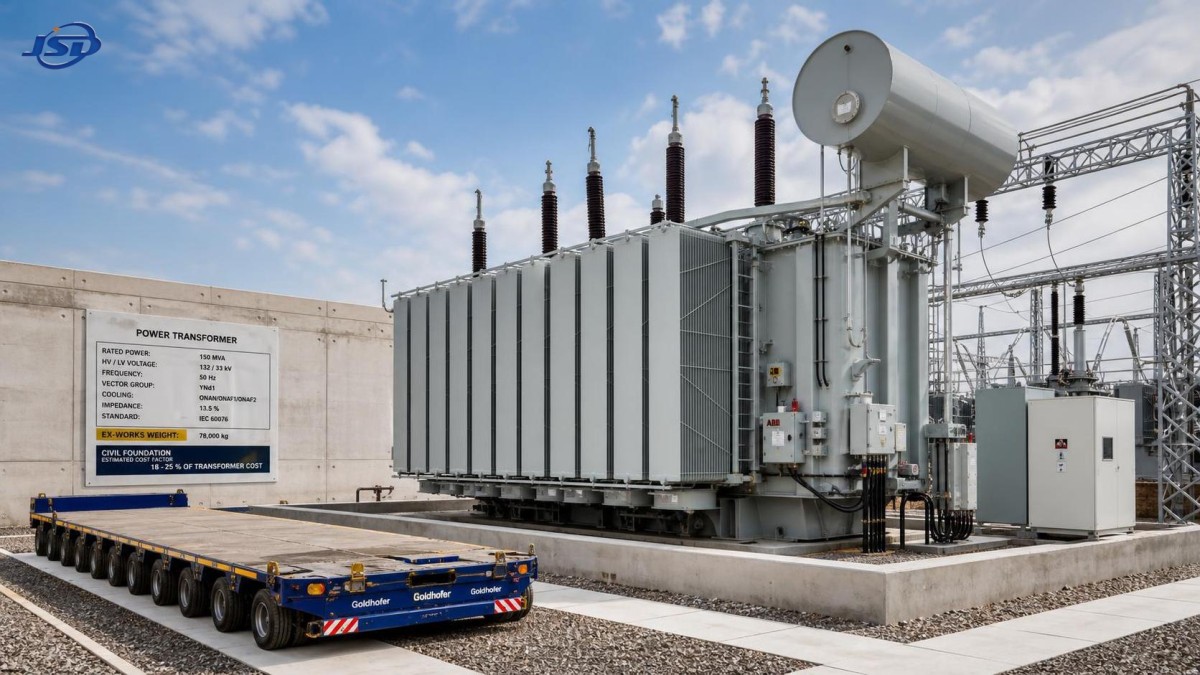
Foundations and oil containment are another frequent blind spot. A high voltage power transformer is not a plug-and-play asset. Civil works can become a large share of installed cost, especially when the unit weight is high or the site requires reinforced plinths, bund walls, drainage systems, blast protection, or revised access roads for transport and positioning.
This is where experienced project teams usually ask a simple question early: does the selected transformer fit the site, or will the site have to be modified to fit the transformer? That sounds obvious, but it is often answered too late.
Transportation can add more than buyers expect
Large transformers are expensive to move, and not only because of distance. Road limits, bridge restrictions, port handling capability, customs procedures, and the decision to ship fully assembled or partially dismantled all affect cost and schedule. In some projects, transport planning forces a redesign because the original weight or dimensions cannot pass along the intended route.
If the transformer must be shipped with detachable radiators, conservator components, or bushings packed separately, installation labor rises at site. So does commissioning risk, because there are more assembly and oil-handling steps to control. That does not mean partial shipment is a bad choice; sometimes it is the only practical one. But it should be reflected honestly in the installed cost model rather than hidden inside a generic logistics line.
For imported equipment, the same principle applies to lead time. A lower manufacturing price can lose its appeal quickly if the delivery window creates knock-on costs in civil readiness, contractor standby, or grid connection delays.
Installation complexity depends on the full package, not just the main unit
A transformer arrives with an ecosystem of components: cooling equipment, tap changer controls, protection devices, marshalling kiosks, cable interfaces, oil treatment needs, and monitoring systems. The more customized the package, the more careful the installation and integration work tends to be.
On paper, accessories can look like a manageable add-on. In practice, each one can touch wiring, protection logic, SCADA integration, spare parts planning, and operator training. Online dissolved gas monitoring, fiber optic winding temperature sensing, or advanced control interfaces may be worthwhile for critical assets, but they should be evaluated as part of the installed system cost, not as isolated equipment upgrades.
A common procurement mistake is to compare one bid with a fuller accessory and test scope against another with a bare minimum configuration, then assume the cheaper number represents equivalent value. It usually does not. A fair comparison requires a normalized technical and commercial matrix.
Standards, testing, and compliance have real cost impact
Buyers often underestimate how much standards alignment affects final cost. Whether the project follows IEC, IEEE/ANSI, utility-specific requirements, or local grid authority rules can change design details, documentation, witness testing, and acceptance procedures. Routine tests are expected, but some projects also call for type test evidence, special tests, or third-party inspection arrangements. Each requirement has a cost, either directly or through longer production scheduling.
The same is true for documentation. Detailed drawings, quality plans, factory acceptance protocols, transport method statements, and commissioning support are not glamorous line items, yet they often determine whether installation proceeds smoothly. Manufacturers with mature quality systems usually price this discipline into the job. That may make the quote look less aggressive at first glance, but it can reduce rework and clarification delays later.
For global projects, it is worth checking early whether local authorities require specific formatting, language, nameplate details, or approval steps. These are not large technical changes, but late compliance corrections can be surprisingly expensive.
Total cost of ownership belongs in the approval process
A finance-led procurement review is strongest when it separates three layers of cost: acquisition, installation, and operating life. Acquisition includes the transformer and specified accessories. Installation covers logistics, civil interface, assembly, oil processing, testing, energization, and site coordination. Operating life includes losses, maintenance, outage risk, and expected service support.
This is where a technically stronger manufacturer can justify a higher initial number. Better design control, stable production processes, and rigorous inspection do not guarantee a perfect project, but they usually improve predictability. In transformer procurement, predictability has financial value. It lowers the chance of site disputes, missed energization dates, and avoidable maintenance interventions after handover.
For applications such as grid construction, industrial manufacturing, renewable energy integration, and infrastructure projects, reliability is not an abstract benefit. A transformer outage can stop production, delay revenue, or strain network stability. That is why the installed cost discussion should include expected service conditions and support capability, not only the invoice amount.
Questions worth asking before approving the budget
Where cost savings are real, and where they are risky
There are sensible ways to control installed cost. Standardizing specifications across multiple projects can reduce engineering variation. Confirming transport and site constraints before final design can avoid expensive changes. Matching monitoring features to actual asset criticality is another practical lever; not every transformer needs the most sophisticated diagnostic package.
The risky savings are different. Cutting documentation, witness testing, or installation support may reduce the order value while increasing project uncertainty. Choosing a design solely on lowest initial purchase price can also backfire if the asset has higher losses or weaker service support over time. In transformer projects, cheap can be expensive in a very quiet way, through delays, rework, and operating cost that do not appear in the original bid comparison.
A well-managed procurement process usually treats the factory price as only one part of the decision. The better question is whether the chosen package will arrive, fit, comply, energize, and operate as expected with a reasonable whole-life cost profile.
A more useful way to read a transformer quotation
When reviewing offers for a high voltage power transformer, it helps to read the quotation backwards from project risk. Start with exclusions, transport assumptions, test scope, assembly responsibilities, and efficiency values. Then look at the core technical rating. That sequence often reveals which quote is genuinely economical and which one is merely incomplete.
For budget approval, the installed cost should be treated as an engineered number, not a catalog number. If the specification is clear, the site conditions are known, and the supplier has the technical depth and manufacturing discipline to support the job properly, the result is usually not the lowest visible price. It is the most controllable investment.

Get a Quote
Regardless of whether you require general advice or specific support, we are happy to help you.
Send Us Your Inquiry Today

Jinshida Electric remains committed to contributing to global energy development through professional manufacturing and superior service.