





What Is Industrial Energy Storage and Where Does It Deliver the Best ROI?
Industrial energy storage refers to battery-based or hybrid electrical storage systems installed at factories, logistics facilities, processing plants, data-intensive sites, and other power-sensitive operations to store electricity and release it when the load profile, grid condition, or production schedule makes that power more valuable. In practical terms, it is a controllable asset placed between the utility supply, on-site generation, and industrial loads. Its value does not come from the battery alone. Return depends on how well the storage system is matched with transformers, converters, switchgear, protection settings, and the actual shape of the site load.
When people discuss ROI, the first mistake is often to treat industrial energy storage as a generic container of cheap electricity. That view misses the engineering constraints that decide whether a project performs well or drifts into underused capacity. A storage system may charge at night and discharge during daytime peaks, but that simple cycle only captures one part of the value. In many transformer-linked projects, the stronger economic case appears when storage also reduces demand spikes, supports unstable feeder conditions, smooths renewable output, or postpones capacity upgrades on upstream distribution equipment.
Where industrial energy storage usually earns its value
The best ROI tends to appear where electricity costs are uneven across the day, where demand charges are sensitive to short peaks, or where process interruptions carry a real operational cost. A site with flat consumption and stable low tariffs may still install storage for resilience, but the financial return is often slower. By contrast, facilities with large motor starts, intermittent furnace loads, electrochemical processes, fast-ramping production lines, or high evening peaks can create a more favorable operating window.
Grid-limited sites are another strong candidate. If a facility needs more production capacity but the incoming transformer, feeder agreement, or substation connection cannot be expanded quickly, energy storage may act as a buffer. It can cover short high-load intervals without forcing the utility connection to be resized immediately. In those cases, the avoided cost is not only an electrical bill item. It may include delayed civil work, less downtime during upgrade scheduling, and reduced disruption to existing busbar and protection layouts.
Projects coupled with solar PV often rank high as well, but only under the right load shape. If daytime generation already overlaps well with consumption, storage may add limited incremental value. If solar production exceeds midday use and the excess would otherwise be curtailed or exported at an unattractive rate, storage becomes more interesting. The battery then converts a timing mismatch into usable internal energy, especially where late-shift loads, cooling systems, or batch processes continue after solar output falls.
Why transformer integration changes the economics
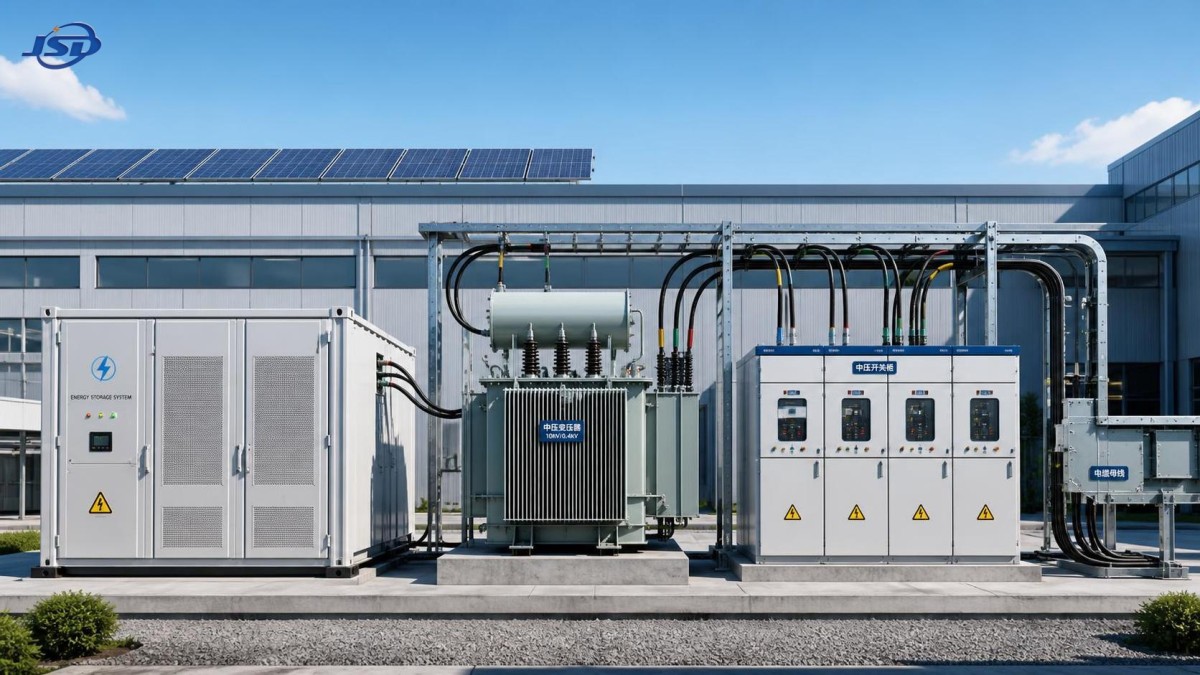
In industrial environments, storage does not operate in isolation from the power system. The transformer arrangement influences charging current, harmonic exposure, voltage stability, and thermal margins. A storage project connected at low voltage may be easier to install, but it can also create heavier current flow on existing cables and busbars. A medium-voltage connection may reduce current and improve system balance, yet it introduces stricter requirements for insulation coordination, relay protection, metering, and installation sequencing.
Transformer loading matters because many storage projects are justified by reducing overload risk or shaving coincident peaks. If the transformer is already running close to its thermal limit during certain shifts, a properly dispatched battery can reduce hotspot stress and create operational headroom. However, if the charging schedule is poorly designed, the battery may simply move the stress to another part of the day. ROI calculations should therefore use interval load data rather than monthly energy totals. A battery that looks attractive on paper can disappoint if it charges during periods that already strain the transformer.
Power quality is another overlooked element. Some industrial loads, especially rectification systems, variable-speed drives, welding lines, and heavy DC applications, can introduce harmonics and waveform distortion. In those settings, storage equipment must be coordinated with conversion stages, filters, and the transformer type. Where rectifier-heavy processes are involved, interface equipment such as an Isolation and Rectifier Special Transformer may be relevant within the broader electrical architecture because isolation, voltage adaptation, and rectification behavior affect how stable and usable the power path remains.
Applications that often outperform simple peak shaving
Peak shaving is the most familiar use case, but it is not always the strongest one. In some facilities, the highest return comes from combining several functions in one dispatch strategy. A battery may reduce the monthly peak, support ride-through for short disturbances, absorb fast renewable fluctuations, and lower the cycling stress on backup generators. The combined value can be materially better than a system that only reacts to tariff windows.
Short-duration support for process continuity deserves attention. Certain lines do not need hours of backup to protect output. They need seconds or minutes to bridge a voltage sag, transfer supply, or avoid an uncontrolled shutdown. When the cost of restarting equipment, reheating material, recalibrating instruments, or scrapping in-process product is high, a relatively small storage system can create disproportionate economic value. These projects often look modest in energy terms but strong in operational protection.
Another strong scenario is temporary capacity support during phased expansion. A plant adding new equipment may face a gap between production deadlines and utility upgrade timing. Installing storage to cover transitional peaks can preserve schedule flexibility. The return here depends on project sequencing: delivery time of transformers, switchgear modification windows, commissioning constraints, and whether the temporary storage asset can later be redeployed to another feeder or operating mode.
What weakens ROI even when the concept looks attractive
Oversizing is common. A larger battery may appear safer because it promises more discharge time, but excess capacity can sit idle if the site only experiences short, infrequent peaks. That leads to poor asset utilization and a longer payback period. The opposite problem also occurs: undersized power capability. Some projects have enough energy in kilowatt-hours but insufficient inverter power in kilowatts to cut the actual demand spike. The result is a system that works electrically yet misses the commercial target.
Another weak point is poor data resolution. Fifteen-minute billing data may hide sub-minute spikes that trigger process issues or demand charges, depending on the local metering method. Storage design should be based on real interval behavior: transformer loading curves, startup sequences, simultaneous motor operation, ambient temperature effects, and charging restrictions. If these details are ignored, the dispatch model can become too optimistic.
Round-trip efficiency also needs realistic treatment. Losses do not occur only in the battery cells. They appear in inverters, transformers, HVAC, auxiliary control systems, and cable runs. A long-distance installation between battery container and point of common coupling may add meaningful conductor losses and installation cost. That is why site layout, cable routing, and available indoor or outdoor placement are not secondary details. They change both CAPEX and usable performance.
Technical items that should be examined early
Several engineering details have a direct effect on financial outcome:
- Battery chemistry and thermal control. Different chemistries tolerate cycling, ambient variation, and charge rates differently. The right choice depends on whether the project is driven by daily arbitrage, frequent shallow cycling, or standby reserve.
- Transformer compatibility. Existing transformer impedance, tap setting range, overload history, and insulation age influence how comfortably the new charging and discharging profile can be absorbed.
- Protection coordination. Storage adds bidirectional power flow, which may require relay setting revisions, fault current review, and anti-islanding logic.
- Installation path. Transport access, crane positioning, foundation requirements, fire separation distance, and cable trench availability can change the project budget more than expected.
- Control hierarchy. A battery controlled only by tariff timing may miss opportunities that a plant-level EMS could capture through load forecasting and transformer-aware dispatch.
Maintenance planning also affects ROI. Industrial energy storage is often described as low-maintenance, but that can be misleading. The battery may need limited routine intervention, yet the full system still depends on cooling equipment, contactors, sensors, communication links, protection devices, and periodic firmware management. In dusty, corrosive, or high-temperature environments, enclosure sealing and HVAC reliability become important lifecycle issues. A battery that is unavailable during the site’s most expensive peak window delivers little value, even if its nameplate condition looks acceptable.
Procurement and delivery risks that alter project value
The commercial picture can change during procurement. Long lead items may include transformers, power conversion systems, medium-voltage switchgear, and protection panels rather than the battery modules themselves. If delivery sequencing is not aligned, the site may receive containers before the interconnection path is ready, creating storage and handling complications. Transport route limits, local lifting constraints, and customs documentation for electrical equipment can also affect project timing.
Specification gaps are another source of ROI erosion. A purchase document that states only total energy capacity and discharge duration is incomplete for industrial use. It should also define power rating at the operating temperature range, permissible cycling pattern, response time, harmonic limits, communication protocol, transformer interface voltage, enclosure ingress considerations, and fault handling logic. Without that detail, two technically compliant offers may perform very differently once installed.
Factory acceptance and site acceptance stages should focus on the intended use case, not just basic energization. For example, if the system is meant to reduce short-duration transformer overload, the test sequence should simulate the expected ramp and dispatch timing. If the project depends on renewable smoothing, the control logic should be observed under fluctuating input conditions. Commissioning that only proves the battery can charge and discharge leaves the most important economic question unanswered.
Where the strongest returns usually do not appear
Industrial energy storage is less compelling where load is already steady, utility tariffs are simple, grid reliability is strong, and there is no near-term capacity pressure. It may also struggle in sites with little control visibility, where actual load data is fragmented across departments and operating schedules change without notice. Storage can still be justified for resilience or strategic flexibility, but the investment case should then be framed around those functions rather than forced into a weak energy-cost narrative.
It also tends to underperform when the surrounding electrical system needs correction first. If the site has chronic power quality problems, undersized conductors, aging protection, or poorly documented transformer loading, adding storage may mask symptoms rather than solve the limiting issue. In such cases, the better sequence may be system cleanup first, then storage integration after the baseline network is understood.
A sound view of ROI in industrial energy storage comes from matching the storage profile to real operating friction: unstable peaks, transformer bottlenecks, renewable mismatch, or interruption-sensitive processes. When those conditions are present and the electrical integration is handled with discipline, the project has a clearer path to economic value. When they are absent, the same equipment can remain technically impressive but commercially ordinary.

Get a Quote
Regardless of whether you require general advice or specific support, we are happy to help you.
Send Us Your Inquiry Today

Jinshida Electric remains committed to contributing to global energy development through professional manufacturing and superior service.