





Commercial Battery Storage Systems for Retail, Offices, and Mixed-Use Buildings
Commercial Battery Storage Systems for Retail, Offices, and Mixed-Use Buildings
For project teams working on commercial buildings, battery storage has moved from a “future-ready” add-on to a practical design consideration. Retail centers want to avoid costly peak demand charges. Office buildings need steadier backup for critical loads, especially where digital systems, elevators, access control, and tenant expectations leave little room for outages. Mixed-use developments add another layer of complexity because their load profile changes by hour, by tenant, and often by season.
That is where commercial battery storage systems start to make sense. Not as a universal answer to every energy problem, but as a tool that can reshape how a building buys, stores, and uses electricity. The value is usually found in the details: load pattern, transformer capacity, backup strategy, tariff structure, fire and space constraints, and how the storage system interacts with the rest of the power distribution network.
For project managers, the real question is rarely “Should we add storage?” It is more often “What problem are we solving, and how do we integrate the solution without creating new operational risks?”
Why these buildings are different from industrial sites
Commercial buildings typically do not behave like factories. Their loads are more variable, and the most expensive part of the electricity bill may come from short demand spikes rather than constant consumption. A supermarket refrigeration cycle, a lunchtime HVAC surge in an office tower, or simultaneous EV charging and lift usage in a mixed-use property can all create brief but expensive peaks.
Battery storage is often evaluated here for three practical reasons. The first is peak shaving: discharging during high-demand intervals to reduce demand charges where local tariffs make that worthwhile. The second is resilience: keeping selected systems online during short outages or transfer events. The third is operational flexibility: supporting solar self-consumption, scheduled load shifting, or future electrification without immediately rebuilding the entire incoming power architecture.
In many projects, these objectives overlap, and that overlap is exactly what complicates system sizing. A battery designed only for peak shaving may look very different from one expected to support life safety interfaces, essential tenant services, or sensitive building controls.
The first design decision is not battery size
One common mistake in early planning is jumping straight to kilowatt-hours. In commercial projects, the starting point should be the building’s electrical behavior and distribution layout. Before specifying storage capacity, teams usually need to understand:
- whether the main issue is energy cost, power quality, continuity, or deferred infrastructure upgrades;
- how much of the load is critical, controllable, or shiftable;
- where the storage system connects in relation to switchgear, transformers, metering, and protection devices;
- whether onsite solar, diesel backup, or EV charging is already planned;
- what local fire, ventilation, acoustic, and access rules apply to the battery room or enclosure.
These questions are not paperwork. They directly affect whether the system will be useful in daily operation. A battery that looks attractive in a financial model can underperform in practice if the control strategy is weak or if the building management system cannot coordinate major loads.
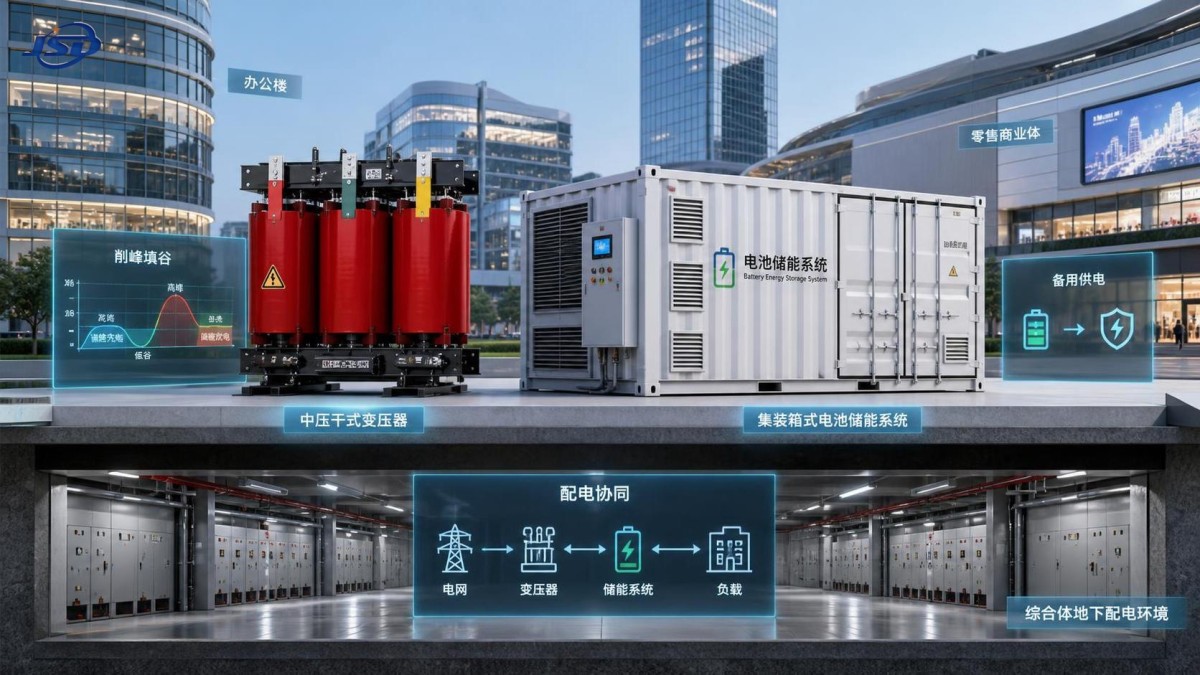
Where transformers enter the picture
Battery storage discussions often focus on cells, inverters, and software, but the distribution side matters just as much. In retail parks, office campuses, and mixed-use towers, the system has to work with existing medium- and low-voltage infrastructure. That includes transformer loading, harmonic behavior, fault coordination, and thermal performance in enclosed electrical rooms.
If a project is already close to transformer limits during peak hours, storage may reduce the effective stress on upstream equipment. In some cases, that helps delay costly upgrades. In other cases, especially when storage is paired with solar or future EV demand, the transformer still needs reassessment because bidirectional power flow and new switching conditions change the operating profile.
That is one reason experienced power equipment manufacturers tend to look beyond the battery container itself. Jinshida Electric Power Technology focuses on transmission and distribution equipment as well as application-side integration, which is often more relevant to commercial projects than broad marketing claims about storage performance. A technically sound solution depends on how the battery, transformer, switchgear, and protection logic behave as one system.
For buildings that need robust indoor distribution equipment, especially where fire safety, maintenance access, and environmental performance matter, components such as the 20kV Three-Phase Cast Resin Dry-Type Distribution Transformer can be part of the wider discussion. Not because every battery project needs a new transformer, but because many commercial upgrades succeed or fail at the interface between storage and distribution.
Typical application logic by building type
Retail buildings often benefit from predictable daily cycles. Cooling, lighting, signage, and tenant operations produce recurring peaks, which can make storage easier to schedule. If the site also has rooftop solar, batteries can help absorb excess daytime generation and use it later during higher-tariff periods. The caution here is diversity: anchor tenants and smaller shops may not peak at the same time, so interval load data matters more than rough monthly averages.
Office projects usually care about continuity as much as cost. Short outages may not damage machinery, but they can interrupt digital infrastructure, security systems, lifts, ventilation controls, or tenant operations. In these buildings, commercial battery storage systems are often evaluated as part of a resilience package, bridging outages or supporting selective loads while backup generation starts or grid conditions stabilize.
Mixed-use buildings are more demanding because they combine residential, retail, parking, amenities, and office functions behind one electrical strategy. Evening peaks may come from different zones than daytime peaks. Common-area systems and tenant systems may be metered differently. The battery control logic has to be more selective, otherwise the operator ends up paying for capacity that is not dispatching at the right times.
What project managers should verify before approval
A workable solution is usually defined less by headline capacity and more by boundaries. Before moving from concept to procurement, it helps to pressure-test a few points.
Another issue that deserves more attention is maintainability. Commercial properties are long-life assets. A system that fits the capex target but is difficult to inspect, isolate, or expand may become a headache after handover. That is especially true in mixed-use properties where shutdown windows are limited and tenant disruption is expensive.
The hidden value of good distribution engineering
In practice, many energy storage projects are constrained less by battery technology than by the surrounding electrical ecosystem. Indoor substations, transformer rooms, cable routes, panel space, and load segregation often determine what is realistic. If the upstream design is weak, the battery may never deliver the expected operating pattern safely or consistently.
This is where a manufacturer with deep experience in power transmission and distribution can add substance to the conversation. Jinshida Electric’s background in R&D, manufacturing, and application of power equipment is relevant because commercial buildings need stable, efficient, and coordinated power architecture, not just isolated products. Advanced manufacturing and rigorous quality management matter, but for project delivery the more useful question is whether the supplier understands how equipment behaves in real grids, real buildings, and real handover conditions.
Where medium-voltage distribution upgrades are part of the plan, equipment such as the 20kV Three-Phase Cast Resin Dry-Type Distribution Transformer may support a cleaner integration path for indoor commercial environments. That still needs project-specific verification, especially around rating, ventilation, insulation class, and local installation standards.
Common mistakes that weaken results
The most frequent planning error is treating battery storage as a simple bolt-on. It rarely is. If the tariff model is misunderstood, the savings case can disappear. If critical loads are not clearly defined, the resilience case becomes vague. If transformer and switchgear constraints are ignored, the project can face redesign late in the schedule.
Another mistake is overvaluing nameplate capacity while undervaluing controls. In commercial buildings, timing is everything. A smaller system with better dispatch logic may outperform a larger system that charges and discharges at the wrong intervals. That is why interval metering, seasonal review, and realistic operating assumptions deserve attention during front-end design.
There is also a tendency to frame storage only as a sustainability feature. For many developers and operators, the stronger case is operational: demand management, limited backup, power stability, and infrastructure flexibility. Environmental benefits may still matter, but they should not replace a clear technical brief.
A sensible next step
For retail, office, and mixed-use developments, commercial battery storage systems can be highly effective when they are tied to a specific building problem and integrated properly with the power distribution system. The battery itself is only one part of the answer. The rest sits in load data, control logic, protection coordination, transformer capacity, room conditions, and the operating priorities of the property.
Before committing to a solution, it is worth confirming the load profile, intended operating mode, backup boundaries, transformer interface, and local compliance requirements. Those checks usually tell you more than a generic storage proposal ever will. If the project includes medium-voltage distribution changes, that discussion should happen early rather than after the battery scope is fixed.
Done well, storage can make a commercial building more predictable to operate. Done casually, it becomes another complicated asset connected to an already complicated electrical system. The difference is nearly always in the engineering choices made upstream.

Get a Quote
Regardless of whether you require general advice or specific support, we are happy to help you.
Send Us Your Inquiry Today

Jinshida Electric remains committed to contributing to global energy development through professional manufacturing and superior service.