





Three-Phase High-Voltage Transformer RFQs: Data Suppliers Need to Quote
A usable transformer quotation needs a defined electrical duty, installation envelope, and supply scope. Without these, the lowest price may exclude required cooling equipment, assume a different insulation level, or leave site assembly outside the contract. An RFQ should establish a common technical basis and require every departure from it to be stated and priced separately.
When comparing a three phase high voltage transformer supplier with alternative sources, distinguish a budget estimate from a firm offer. A preliminary quote can proceed with declared assumptions. A firm offer needs enough confirmed data to settle the design, testing obligations, delivery configuration, and contractual guarantees.
Start with the network duty, not just the voltage label
“High-voltage transformer” does not define a design. The RFQ needs the rated voltage of every winding, system frequency, highest system voltage, and intended direction of power flow. A single-line diagram should identify the transformer connections, neutral grounding arrangement, connected equipment, and any existing units intended for parallel operation.
Rated voltage and insulation requirements are separate inputs. The nominal network voltage alone does not establish the required withstand levels. Specify the applicable insulation coordination requirements, including lightning impulse and power-frequency withstand levels, and switching impulse requirements where applicable. Identify neutral-terminal insulation separately where it differs from line-terminal insulation.
Capacity also needs a defined basis. State the required continuous MVA rating at each cooling stage, together with ambient conditions and temperature-rise limits. A rating that relies on fans is not equivalent to the same rating available with natural cooling. Include the expected load profile, recurring overloads, and emergency loading requirements so the quotation reflects the actual thermal duty.
For renewable generation or converter-connected installations, add available harmonic-current data, operating cycles, and reactive-power requirements. Energy storage duty may involve repeated changes in power direction and loading. These conditions affect loss assessment and thermal design even when the nameplate MVA matches a conventional substation transformer.
Resolve winding connections, taps, and impedance together
Specify the winding arrangement and vector group, including whether the design requires two windings, three windings, or an autotransformer connection. For a three-winding unit, give each winding’s voltage and capacity, the anticipated simultaneous loading, and the required pairwise impedances. A tertiary winding needs a defined purpose and rating; its presence alone does not establish how much load it must carry.
The tap specification should identify the tapped winding, adjustment range, number of positions, step size, and whether adjustment is required while energized. An on-load tap changer adds equipment, controls, maintenance requirements, and testing scope. A de-energized tap changer cannot provide the same operating function.
Include the target voltage-control behavior where automatic regulation is required. Relevant details include the controlled bus, measurement inputs, remote interfaces, and coordination with other voltage-control equipment. The required MVA at extreme tap positions also needs confirmation because tap range and available capacity are related design inputs.
Short-circuit impedance affects both fault current and voltage regulation. Request a specified value or permitted range, its reference MVA, reference tap, and applicable tolerance. A lower impedance increases prospective fault current; a higher value increases voltage drop under load. For parallel operation, matching voltage ratios, vector groups, tap behavior, and impedance characteristics requires explicit review.
The network fault duty should state the prospective short-circuit current and required withstand duration, with grounding information relevant to earth faults. These inputs establish the mechanical and thermal short-circuit duty. An impedance percentage by itself does not prove that the transformer meets the installation’s fault requirements.
Site conditions change the quoted design
Provide the installation location, altitude, ambient-temperature limits, indoor or outdoor arrangement, and cooling restrictions. Elevated altitude affects external insulation and cooling performance. Restricted airflow, enclosed transformer bays, or nearby heat sources require more detail than a regional weather description.
Pollution severity and the surrounding environment influence bushing selection, creepage requirements, coatings, and corrosion protection. Coastal exposure, conductive dust, and industrial contamination should be identified directly. Where seismic qualification is required, include the project criteria and the evidence expected with the offer.
For a substation or renewable-energy step-up application considering a 110kV Oil-Immersed Transformer, the RFQ still needs the actual winding voltages, MVA duty, cooling stages, and connection arrangement. The product voltage class cannot settle those project-specific requirements. If an ester insulating liquid is proposed, confirm the liquid specification, temperature-rise basis, material compatibility, and site handling requirements in the technical offer.
Noise limits need a measurement basis. State the required sound quantity, operating condition, cooling equipment status, and test method. A value measured with fans stopped cannot be compared directly with a requirement covering operation at full forced cooling.
Show the physical interfaces before pricing is finalized
A general arrangement drawing or site interface sketch should define the available footprint, terminal orientation, phase identification, cable or busbar connections, and access for installation. Existing foundations and buswork can constrain the design more strongly than a preferred overall dimension.
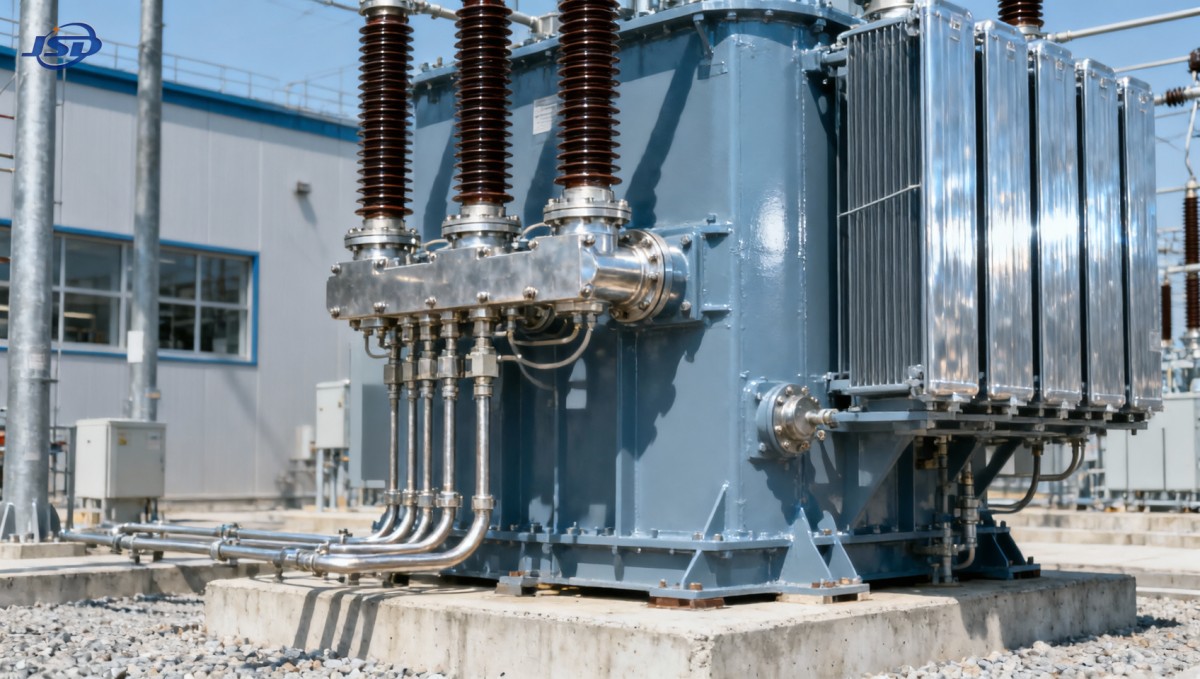
Include the required bushing arrangement, neutral connection, surge-arrester mounting provisions, marshalling cabinet location, and auxiliary supply details. Cable boxes, air terminals, and interfaces to gas-insulated equipment create different supply boundaries. Each terminal connection should have an identified scope, especially when mating parts belong to another equipment package.
The transport envelope must distinguish the assembled transformer from its shipping configuration. Request overall shipping dimensions, maximum indivisible transport mass, lifting provisions, center-of-gravity information, and the list of components shipped separately. Road access, bridge limits, unloading space, and crane capacity can make a technically acceptable transformer impractical to deliver.
If shipment requires partial disassembly or removal of insulating liquid, allocate responsibility for storage, reassembly, vacuum treatment, filling, and site tests. Price the necessary supervision and equipment explicitly. These activities create real project costs that are easily omitted from an equipment-only offer.
Turn efficiency claims into comparable loss guarantees
A headline efficiency percentage is a weak comparison unless its operating basis is defined. Transformer efficiency varies with load, power factor, temperature, and auxiliary consumption. Request guaranteed no-load loss and load loss, with the reference temperature and measurement basis stated. Cooling-system power should be reported separately and treated consistently in the evaluation.
No-load loss continues while the transformer is energized, including periods of light loading. Load loss increases approximately with the square of load current. A lightly loaded standby unit and a heavily loaded industrial transformer therefore justify different loss valuations, even if their purchase prices are similar.
Where lifetime energy cost forms part of the award decision, issue common loss-capitalization factors or a common calculation method with the RFQ. A simple comparison can use evaluated cost equal to the quoted equipment price plus the assigned values of guaranteed no-load loss, load loss, and auxiliary consumption. All offers need the same currency, energy assumptions, and operating profile.
Define acceptance tolerances and the contractual treatment of measured losses exceeding guaranteed values. A guarantee has limited commercial value if the contract leaves the consequences unresolved. Loss penalties, rejection thresholds, and any correction mechanism should be agreed before manufacture.
Make the testing scope specific enough to price
Identify the governing transformer standards, applicable editions, and project-specific requirements. Listing several standards without an order of precedence creates uncertainty where requirements differ. Certification marks and quality-system certificates do not replace the transformer’s required design evidence and acceptance tests.
The test schedule should separate routine factory tests from additional type, special, and site tests. Depending on the specified design, the schedule may include winding resistance, ratio and phase-displacement checks, losses and impedance measurements, dielectric tests, and leak testing. Temperature-rise testing, sound measurement, and other additional tests need explicit scope and acceptance criteria.
Short-circuit withstand evidence deserves particular attention. State whether the project accepts design calculations, relevant prior test evidence, or requires a specified test. Evidence from a different transformer design needs a technical basis for applicability. Leaving this decision until order placement can change both price and schedule.
Define witness and hold points, notice periods, report language, and document approval requirements. If factory attendance is required, clarify whether travel costs are included. Site acceptance should also distinguish installation checks, commissioning measurements, and the conditions for energization.
Require a quotation structure that exposes exclusions
A single total price makes technical normalization difficult. The quotation schedule should identify the base transformer scope and separately priced additions. The following distinctions reveal whether an apparent saving comes from a different design or an omitted obligation.
Commercial terms should state the quotation currency, price validity, payment milestones, delivery term and named place, taxes and duties, and warranty conditions. The warranty start point matters when delivery and energization occur months apart. Storage obligations should be defined wherever delayed installation is anticipated.
Lead time needs an identified starting event. An offer based on receipt of an advance payment is different from one based on final drawing approval. Request a schedule showing the drawing submission, approval, manufacturing, testing, and shipment milestones, including dependencies on project information.
Close open assumptions before converting the offer into an order
Issue the RFQ with a document register and revision identifiers covering the datasheet, single-line diagram, site interfaces, test requirements, and commercial schedule. Require a consolidated deviation list. Exceptions scattered through brochures and drawings are difficult to evaluate and easy to lose during contract preparation.
Where a parameter remains unresolved, identify it as an assumption and request the effect of changing it. For example, a quotation based on natural cooling should state the additional price and design implications of a required forced-cooling rating. Unknown terminal details should have a defined confirmation deadline.
Before award, incorporate accepted clarifications into the contractual datasheet and scope. The final price should correspond to a traceable configuration, with outstanding interfaces, approval dates, and responsibility for each remaining input recorded.

Get a Quote
Regardless of whether you require general advice or specific support, we are happy to help you.
Send Us Your Inquiry Today

Jinshida Electric remains committed to contributing to global energy development through professional manufacturing and superior service.