





Buying Oil-Filled High-Voltage Transformers: Shipping and Storage Terms
A transformer quotation is only comparable when it makes clear who pays for transport, when shipment risk transfers, and how the equipment will be preserved before installation. A low factory price can become an expensive purchase if it excludes suitable packing, destination handling, unloading, or storage maintenance.
When choosing an oil filled high voltage transformer supplier, ask for a shipping and storage schedule alongside the technical offer. It should describe the transformer’s condition at dispatch, the delivery point, handling requirements, insurance scope, and permitted storage conditions. These details determine how much work and cost remain between factory release and energization.
Compare the cost of reaching installation-ready condition
“Freight included” does not mean every delivery expense is covered. A quotation may include the main sea journey while leaving terminal handling, customs clearance, inland transport, and crane services outside the price. Another offer may cover delivery to your site but leave unloading entirely to you.
Build the comparison around the same endpoint: the transformer received, inspected, preserved, and ready for the agreed installation work. Keep commissioning separate if it is outside the purchase scope, but identify any preparation that transport or storage will make necessary.
Separate fixed prices from allowances and exclusions. If a freight allowance can change, the contract should state what triggers an adjustment and how it is calculated. Also allocate waiting time, failed delivery attempts, and charges caused by a site that cannot receive the equipment.
The delivery term must name an exact place
An Incoterms rule helps allocate transport obligations, costs, and shipment risk. It does not, by itself, settle ownership, payment, technical acceptance, warranty, or compensation for project delays. Those subjects need their own contract provisions.
The named place matters as much as the three-letter abbreviation. “DAP project site” leaves room for disagreement if the site has several entrances or the delivery vehicle cannot reach the unloading area. Specify the address, receiving point, and access conditions.
Common terms create different practical responsibilities:
- FCA: The seller delivers to the nominated carrier at the agreed place. Loading responsibilities depend on that place, so distinguish factory collection from delivery to another location.
- CIP: The seller arranges carriage and insurance to the named destination, but shipment risk generally transfers when the equipment is handed to the carrier. Paying for transport does not mean retaining risk throughout the journey.
- DAP: The seller delivers at the named destination, ready for unloading. Unloading and import clearance generally remain with the buyer.
- DPU: Delivery includes unloading at the named destination. The unloading method and site readiness still need agreement.
FOB and CIF apply to sea or inland waterway transport. Under these terms, risk transfers when the goods are on board at the shipment port, even though CIF includes freight and insurance to the destination port. For containerized movements handed to a carrier before vessel loading, FCA or CIP may better match the actual handover.
Choose a term that fits your logistics capability. Controlling freight can be useful when you have an established forwarder and suitable cargo cover. Supplier-arranged delivery can simplify coordination where specialist transport is needed, provided the scope and destination charges are explicit.
Agree on the transformer’s shipping condition before booking transport
Oil-immersed transformers do not all travel in the same condition. Some are dispatched filled with insulating liquid and substantially assembled. Larger units may require removed bushings, radiators, or other components to meet transport restrictions. Certain designs may travel under a manufacturer-specified dry-gas preservation arrangement.
These choices affect more than freight dimensions. A partly dismantled transformer can require specialist assembly, oil treatment, and additional testing at site. A smaller shipping envelope may therefore reduce transport costs while increasing preparation costs.
Request a dispatch configuration drawing and packing list that identify:
- The main unit’s shipping dimensions, gross weight, and center of gravity
- Approved lifting points, support points, and transport orientation
- Whether oil is inside the tank, shipped separately, or requires site supply
- Removed accessories, their package numbers, and their preservation requirements
- Any impact recorder, tilt indicator, or pressure-monitoring device included
- The work needed to restore the unit to its operating configuration
Specify protection for bushings, valves, gauges, and exposed connections. Restraints must use approved locations; convenient-looking brackets or fittings may not be designed to carry transport loads. Impact indicators can help document an event, but their readings require interpretation against the manufacturer’s criteria.
For rural or suburban distribution projects, Jinshida Electric Power Technology Co., Ltd.’s Pole-Mounted Oil-Immersed Single-Phase Transformer illustrates a different handling situation from a large substation unit. Its compact pole-mounted configuration can suit distributed installation locations. Even so, the ordered unit’s packed weight, lifting instructions, and mounting details must govern transport and installation planning. A pole-mounting bracket should not be assumed to be a lifting point.
Insurance should cover the actual journey and any storage gap
Ask for the cargo insurance scope before dispatch. Identify the insured parties, covered route, insured value, deductible, exclusions, and claims procedure. Check whether loading, unloading, intermediate handling, and temporary storage fall within the cover.
This matters when responsibility changes during the journey. A transformer may pass through a port, a logistics warehouse, and a project storage yard before installation. If transit cover ends at delivery, equipment waiting at site may need separate storage or project insurance.
Agree who will arrange a survey, notify the insurer, preserve damaged packaging, and authorize remedial work. The party receiving the equipment needs access to the relevant documents and contact details, even when the supplier purchased the policy.
Cargo insurance and warranty address different problems. Transit damage may fall under cargo cover, while a manufacturing defect may fall under warranty. Neither should be assumed to pay for crane cancellation, temporary power, or delayed energization. Allocate those commercial consequences separately where they matter to the project.
Make unloading and receipt inspection part of the delivery plan
Before dispatch, check the access route and unloading area against the shipment drawing. Gate width, turning space, overhead obstructions, ground bearing capacity, and crane setup space can determine whether the planned delivery is feasible. A lifting contractor needs the actual load and lifting arrangement, rather than an estimated weight from a general brochure.
Schedule delivery only when the receiving crew, handling equipment, and storage position are available. Otherwise, a straightforward shipment can generate vehicle waiting charges, additional handling, or an unplanned transfer to temporary storage.
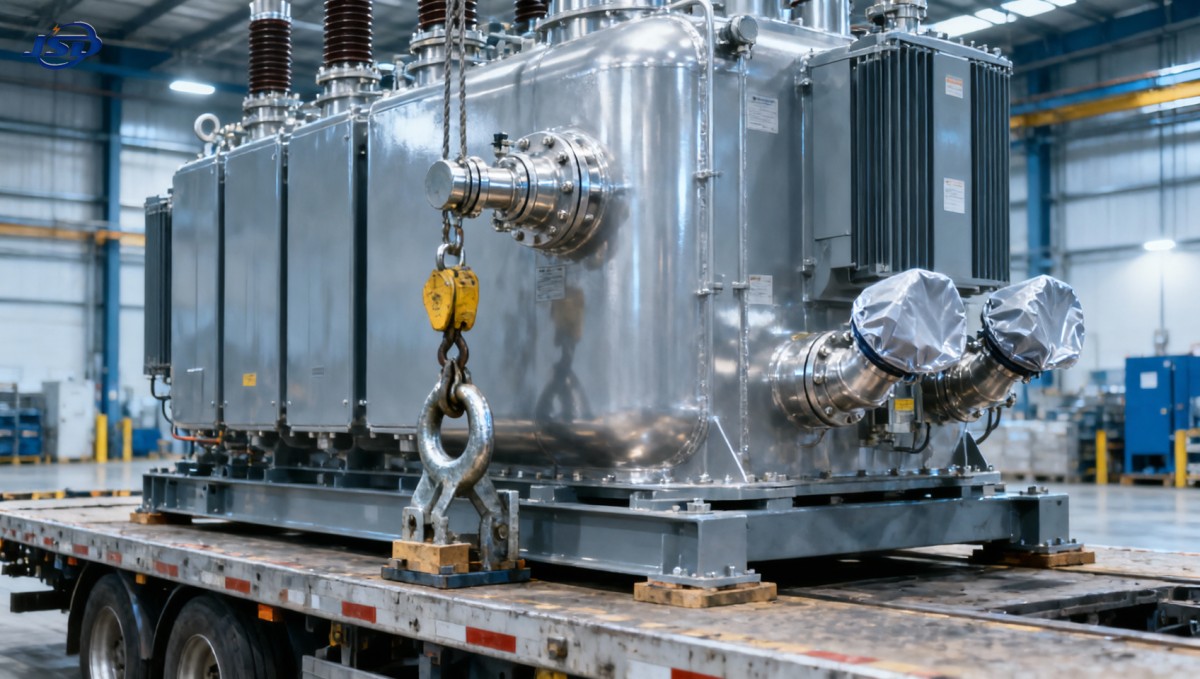
At receipt, photograph the load before removing restraints or packaging. Check package counts, serial numbers, visible tank damage, leaks, bushings, protective covers, and fitted indicators. For units transported under a preservation system, inspect the relevant gauges or seals using the manufacturer’s receiving procedure.
Record visible exceptions on the delivery document and send notice within the contractual and insurance reporting periods. Where the paperwork allows, distinguish acknowledgment of receipt from technical acceptance. Internal damage may not be apparent during a visual check, so define the later inspection and testing stage as well.
If damage, leakage, or an abnormal indicator reading is found, pause further handling or energization as appropriate and obtain the manufacturer’s assessment. Unnecessary opening or dismantling can introduce moisture and complicate both diagnosis and a claim.
Storage terms must match the tank design and expected delay
Outdoor operating capability does not automatically mean a transformer can be left outdoors in its shipping condition without attention. Protective packing may retain moisture, detached accessories may need indoor storage, and transport closures may differ from the final operating arrangement.
The preservation plan must suit the design. A sealed oil-filled unit, a conservator-equipped transformer, and a unit shipped under dry gas have different monitoring needs. Avoid applying one generic storage checklist to all three.
Obtain written instructions covering support, orientation, weather protection, inspection intervals, and allowable storage duration before additional preservation or testing is required. Store the main unit on a stable surface, protect it from accidental impact, and keep access available for inspection.
The routine may include checking for leaks and corrosion, inspecting seals and gauges, monitoring the specified preservation system, and maintaining breathers or desiccant where fitted. Oil level and pressure observations must be interpreted using the manufacturer’s instructions and ambient conditions. Do not open a sealed tank or add oil simply because a reading looks unfamiliar.
Store removed bushings, control cabinets, instruments, and other accessories according to their own instructions. Keep package identification tied to the main unit so that parts remain traceable when installation begins.
Factory storage can be a practical option when civil works are uncertain. Compare its charges with site storage, extra handling, insurance, and preservation labor. The agreement should state whether the transformer remains reserved for your order, who maintains it, what dispatch notice is needed, and whether checks must be repeated before release.
Set warranty and release milestones around the real schedule
A delayed installation can consume warranty time before the transformer is energized. Define whether warranty begins at dispatch, delivery, installation, or commissioning, and whether an outer time limit applies. Include the storage conditions and records required to preserve warranty rights.
If commissioning depends on unfinished infrastructure, consider a planned storage period or an agreed warranty extension when comparing offers. The better commercial choice depends on the likely delay and the cost of preserving the equipment, rather than the warranty headline alone.
Payment milestones also need clear evidence. A dispatch payment can be tied to agreed factory test records, packing documents, and release inspection. Any delivery or acceptance milestone should identify the documents or checks that establish completion, including treatment of missing accessories and transport damage.
When requesting an offer from Jinshida Electric or another manufacturer, provide the destination, access restrictions, expected installation date, and likely storage period with the electrical specification. Ask for one coordinated schedule covering transport preparation, delivery responsibilities, preservation, and site preparation. Before signing, make sure each stage has a named responsible party and a defined cost basis. That gives you a usable purchase agreement and a realistic budget for bringing the transformer into service.

Get a Quote
Regardless of whether you require general advice or specific support, we are happy to help you.
Send Us Your Inquiry Today

Jinshida Electric remains committed to contributing to global energy development through professional manufacturing and superior service.