





Lifecycle Cost Factors for High-Capacity Substation Power Transformers
For financial decision-makers, evaluating a high capacity substation power transformer requires more than comparing purchase prices. Total lifecycle cost depends on energy efficiency, load performance, maintenance requirements, reliability, installation, and expected service life.
Understanding these factors helps utilities, industrial operators, and infrastructure investors make capital decisions that reduce long-term operating expenses while ensuring dependable power for critical projects.
The central financial question is straightforward: which transformer option delivers the lowest risk-adjusted cost of delivered electricity throughout its operating life?
Why the Lowest Purchase Price Rarely Produces the Lowest Lifecycle Cost
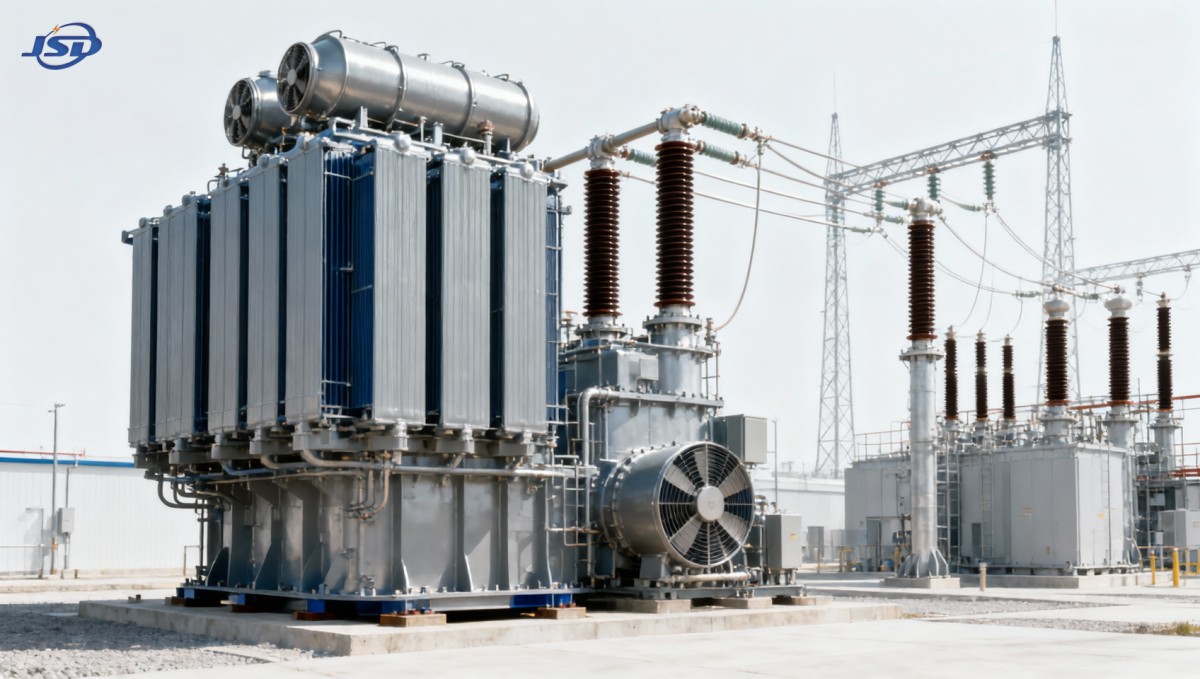
A high capacity substation power transformer is a long-lived infrastructure asset, often expected to operate reliably for several decades under demanding electrical and environmental conditions.
Its initial acquisition price is visible during procurement, but it represents only one portion of the total financial commitment made by the project owner.
Capital budgeting should include engineering, transportation, foundations, installation, protection systems, commissioning, losses, maintenance, insurance, outage exposure, and eventual replacement or disposal costs.
A lower-priced unit may appear attractive in a tender comparison while carrying higher no-load losses, higher load losses, shorter maintenance intervals, or greater failure exposure.
Conversely, a transformer with a higher initial price can create better lifetime value when its design reduces continuous energy waste and improves service availability.
Financial approval should therefore compare alternatives using a consistent lifecycle-cost model rather than relying on equipment price, supplier discount, or nominal capacity alone.
Calculate the Cost of No-Load and Load Losses
Energy losses are commonly the largest lifetime operating cost for a continuously energized power transformer, especially where electricity prices or carbon-related charges are significant.
No-load loss occurs whenever the transformer is energized, regardless of whether it serves a major load. It is primarily associated with the magnetic core.
Because no-load loss continues throughout the year, even a modest difference in watts can create a substantial discounted cost over twenty-five or thirty years.
Load loss increases with current and is mainly generated in windings, leads, connections, and other components affected by electrical resistance and stray flux.
Financial teams should request guaranteed no-load loss and load loss figures at stated reference temperatures, rather than accepting broad efficiency claims without measurable commitments.
The calculation should multiply annual energy losses by expected operating hours, projected load profiles, local energy tariffs, escalation assumptions, and the organization’s discount rate.
Load forecasting matters because a transformer operating near capacity experiences markedly different loss economics from one serving a consistently moderate or seasonal demand profile.
For projects with variable utilization, model several cases: conservative demand, expected demand, high-growth demand, and curtailed or reduced-load operation.
Suppliers should clarify whether quoted loss values are guaranteed, tested, subject to penalties, and aligned with applicable standards such as IEC 60076.
Match Capacity to the Actual Load Profile
Oversizing can improve thermal margin and support future growth, but it can also increase purchase cost and no-load losses without producing proportional operational value.
Undersizing creates a different financial risk: excessive loading accelerates insulation aging, increases cooling demand, reduces efficiency, and may force earlier replacement.
Approvers should examine hourly, seasonal, and contingency load forecasts instead of relying solely on maximum connected load or nameplate assumptions.
Grid substations may require overload capability during emergencies, while industrial facilities may need resilience against process peaks, motor starts, or expansion plans.
The financial evaluation should identify the value of reserve capacity separately from the value of normal operating capacity. These are related but different investment decisions.
Parallel transformer arrangements can sometimes lower system risk, improve maintenance flexibility, and support phased expansion more economically than one oversized unit.
However, parallel operation also adds switchgear, protection, space, and coordination costs. The preferred architecture depends on outage consequences and load growth certainty.
A credible business case states the expected utilization rate, allowable overload duration, cooling assumptions, and the cost consequences of each capacity option.
Reliability Has a Measurable Financial Value
Transformer failure is not merely a maintenance event. For many sites, it can interrupt revenue, trigger contractual penalties, damage production schedules, or affect public-service continuity.
The financial impact may include emergency replacement procurement, expedited freight, temporary generation, lost output, repair labor, environmental response, and reputational damage.
For critical substations, the expected cost of unavailability can exceed the price difference between basic and higher-reliability transformer designs.
Decision-makers should ask suppliers about design margins, insulation systems, short-circuit withstand capability, proven manufacturing controls, and factory test coverage.
They should also review the availability of technical support, spare parts, repair capability, field service, and lead times for a replacement transformer.
Reliability analysis should consider probability as well as consequence. A low-probability event can still justify investment when outage costs are exceptionally high.
Useful metrics include expected annual outage cost, mean time to repair, forced outage rate, critical-load exposure, and business interruption insurance requirements.
Rather than treating reliability as an abstract quality attribute, include it as a quantified risk line within the project’s lifecycle-cost comparison.
Installation, Civil Works, and Grid Integration Costs
Large transformer investments often encounter cost increases after purchase order placement because site requirements were not fully addressed during commercial evaluation.
Transportation route limitations can influence dimensions, weight, delivery method, escort requirements, lifting equipment, and the feasibility of factory-assembled accessories.
Foundation design must account for total mass, seismic conditions, drainage, oil containment, fire separation, cable routing, and access for inspection or replacement.
Cooling equipment, radiators, fans, pumps, control cabinets, bushings, surge arresters, and monitoring systems can change both installed cost and maintenance obligations.
Grid integration may require protection coordination studies, relay upgrades, harmonic assessment, voltage control provisions, and compliance with utility interconnection rules.
Financial teams should request a clear battery-limit schedule that distinguishes transformer supply from installation services, owner-furnished equipment, and civil responsibilities.
Comparing delivered equipment prices without these scope boundaries can produce misleading savings that later reappear as change orders or schedule delays.
A practical evaluation includes a contingency allowance for logistics and site-interface risks, especially for remote, coastal, offshore, or constrained industrial locations.
Maintenance Costs Depend on Design and Operating Conditions
Routine maintenance is normally predictable, but lifecycle cost changes significantly when a transformer requires frequent inspections, oil treatment, component replacement, or unplanned corrective work.
Maintenance planning should cover oil testing, dissolved gas analysis, bushing checks, cooling-system inspection, tap-changer servicing, thermographic surveys, and protection-device testing.
On-load tap changers deserve particular attention because their maintenance cycle, duty level, and operational importance can materially affect whole-life cost.
Condition-monitoring systems require additional initial investment, but they can help identify developing defects before they become outages or major asset losses.
The value of monitoring is highest where access is difficult, load is critical, transformer replacement lead times are long, or outages have significant commercial consequences.
Maintenance estimates should reflect local labor availability, travel requirements, safety procedures, spare-part inventory, and environmental handling costs for insulating fluids.
Ask whether the supplier provides recommended maintenance intervals based on design, operating load, ambient temperature, and expected environmental contamination levels.
A credible lifecycle model distinguishes scheduled maintenance expenses from low-frequency, high-impact corrective events that can disrupt operations and capital plans.
Environmental Conditions Can Change the Financial Case
Ambient temperature, altitude, humidity, salt exposure, dust, vibration, and seismic activity influence transformer cooling performance, insulation aging, corrosion risk, and maintenance frequency.
Equipment designed for mild indoor conditions may create avoidable expense when deployed in harsh outdoor, coastal, desert, or high-altitude operating environments.
Wind power projects illustrate this challenge because transformers can face variable output, weather exposure, remote access constraints, and demanding grid-connection requirements.
For renewable-energy applications, a suitably specified Transformer for Wind Power Generation can support stable operation while reducing losses and maintenance exposure.
Its suitability should be evaluated through verified capacity, voltage ratio, cooling method, winding material, protection arrangement, and site-specific environmental design requirements.
For example, a three-phase outdoor transformer using 100% copper windings and IEC 60076-aligned specifications may support long-term reliability in suitable wind applications.
Financial approval should confirm that the technical specification addresses actual site conditions instead of assuming standard catalog performance will be adequate.
Service Life, Depreciation, and Residual Value
A high capacity substation power transformer is generally evaluated as a multi-decade asset, making service life assumptions central to investment return and depreciation planning.
Longer life can reduce annualized capital cost, but only when the asset retains adequate performance, regulatory compliance, and practical maintainability throughout operation.
Thermal aging of insulation is especially important because it affects the transformer’s remaining life and its ability to withstand future load and fault conditions.
Financial models should test how results change when expected service life shifts due to higher ambient temperature, loading, maintenance quality, or unusual duty cycles.
Residual value may be limited by technology changes, site-specific voltage requirements, transport constraints, and the condition of oil, insulation, and accessories.
Disposal obligations also deserve consideration. Environmental regulations may affect the treatment of insulating oil, contaminated materials, and decommissioned equipment components.
Depreciation rules, tax treatment, financing structure, and asset capitalization policies vary by jurisdiction, but they should be incorporated before final approval.
Build a Defensible Financial Comparison
A useful procurement decision compares each option through net present value, annualized cost, and risk-adjusted sensitivity analysis rather than a single headline number.
Start with installed capital cost, including transformer supply, transportation, insurance, civil works, erection, commissioning, testing, and associated protection or monitoring equipment.
Add projected loss costs using realistic operating hours, load profiles, tariff assumptions, inflation, expected energy-price escalation, and an agreed discount rate.
Then include scheduled maintenance, expected corrective maintenance, replacement parts, condition monitoring, insurance, outage risk, and decommissioning costs where applicable.
Sensitivity analysis should focus on the variables most likely to change the decision: electricity cost, load growth, utilization, outage cost, discount rate, and replacement lead time.
Request transparent supplier data and document the calculation assumptions. This creates an audit trail for approval committees and reduces disagreement after procurement begins.
The strongest proposal is not necessarily the one with the most features. It is the one with a well-supported economic case for the project’s actual risk profile.
Questions Financial Approvers Should Ask Before Approval
What are the guaranteed no-load and load losses, and how were they valued over the expected operating life of the transformer?
Does the proposed rating reflect normal demand, contingency operation, future expansion, and realistic seasonal loading rather than only a theoretical maximum?
Which reliability features are included, what failure modes do they address, and what is the quantified cost of downtime at this location?
What installation, transport, civil, protection, and commissioning costs remain outside the supplier’s quoted scope?
How do environmental conditions affect cooling, corrosion protection, maintenance frequency, insulation life, and warranty coverage?
What factory testing, quality controls, standards compliance, service support, and replacement lead-time commitments are available from the manufacturer?
Finally, which assumptions have the greatest effect on net present value, and has management reviewed optimistic and adverse operating scenarios?
Conclusion
The most effective transformer investment decision treats purchase price as the starting point, not the conclusion. Losses, reliability, load fit, installation, and maintenance determine long-term value.
For financial decision-makers, the priority is to select a high capacity substation power transformer that minimizes total risk-adjusted cost while protecting operational continuity.
A disciplined lifecycle-cost model turns technical specifications into clear business evidence, enabling utilities, industrial operators, and infrastructure investors to approve capital with greater confidence.

Get a Quote
Regardless of whether you require general advice or specific support, we are happy to help you.
Send Us Your Inquiry Today

Jinshida Electric remains committed to contributing to global energy development through professional manufacturing and superior service.