





Is a generator 22kva enough to start common site equipment
Wondering whether a generator 22kva is enough to start and run common site equipment? The short answer is: sometimes yes, often no, and the real answer depends less on the label “22kVA” than on what kind of equipment is connected, how motors start, and how disciplined the load plan is on site.
That distinction matters because many users buy a generator based on running watts alone, then find that a mixer, compressor, pump, or saw trips the unit the moment it starts. On small construction sites, farm jobs, temporary infrastructure works, and emergency field operations, startup behavior is usually the deciding factor—not just steady consumption.
If you are trying to judge whether a 22kVA unit is a practical fit, the useful question is not “How many tools can it power?” but “What is the largest starting load, and what else is already running when it starts?”
A 22kVA diesel generator is commonly understood as a unit with an apparent power rating of 22 kilovolt-amperes. In practical terms, assuming a typical power factor of 0.8, that translates to around 17.6kW of usable real power under standard conditions. But even that figure should not be treated as fully available all the time. Altitude, ambient temperature, cable losses, poor maintenance, and uneven load profiles can all reduce practical site capacity.
For light temporary power needs, this size can be a sensible middle ground. It is often large enough for site lighting, battery chargers, small hand tools, office cabins, and some single motor-driven machines. It becomes more questionable when several inductive loads are combined, especially when one or more starts under load.
Why starting current changes the answer
Most confusion around generator sizing comes from the difference between running load and starting load. Resistive loads such as heaters and incandescent lighting are relatively straightforward. Their startup demand is close to their operating demand. Motor-driven equipment is different. When a motor starts, it may draw several times its normal running current for a brief period.
That inrush can be modest or severe depending on the machine design. Small grinders and drills may be manageable. Air compressors, submersible pumps, mixers, and larger saws are much less forgiving. If the generator cannot support the inrush, voltage drops sharply, the engine lugs, the breaker trips, or the equipment fails to start properly. Repeated failed starts also stress both generator and connected machines.
This is why a generator that seems comfortably sized on paper can still perform badly in the field.
What a 22kVA unit can usually handle
In many real-world cases, a 22kVA unit is adequate for:
- temporary site lighting strings or LED towers;
- portable power tools with low to moderate startup demand;
- battery charging stations;
- small office or welfare cabin loads;
- small water pumps, if started one at a time and not heavily loaded at startup;
- limited welding or cutting support, depending on the machine type and duty cycle.
It may also support a mixed load if site discipline is good—for example, lights, chargers, and one motor load started sequentially rather than all at once.
Where users run into trouble is assuming the same generator can also absorb frequent starts from a loaded compressor, a larger concrete mixer, or multiple pumps cycling unpredictably. That is where theoretical adequacy and operational adequacy diverge.
Common site equipment that can challenge a 22kVA generator
Several categories regularly push this size of generator beyond its comfortable operating range:
- Air compressors: especially piston compressors with direct-on-line motor starts.
- Concrete mixers: startup torque can be high, particularly if material is already in the drum.
- Deep-well or submersible pumps: long cable runs and motor characteristics can worsen voltage drop.
- Large circular saws or bench saws: startup spikes can be sharp.
- Welding equipment: some welders have unstable or high transient demand profiles.
- Multiple cabins with air conditioning: compressor-based cooling can create coincident surges.
Any one of these loads might still run on a generator 22kva if the machine is small enough and the setup is favorable. The issue is that “common site equipment” varies enormously by motor size, duty cycle, and startup method. A small pump and a large pump are not interchangeable loads just because both are called pumps.
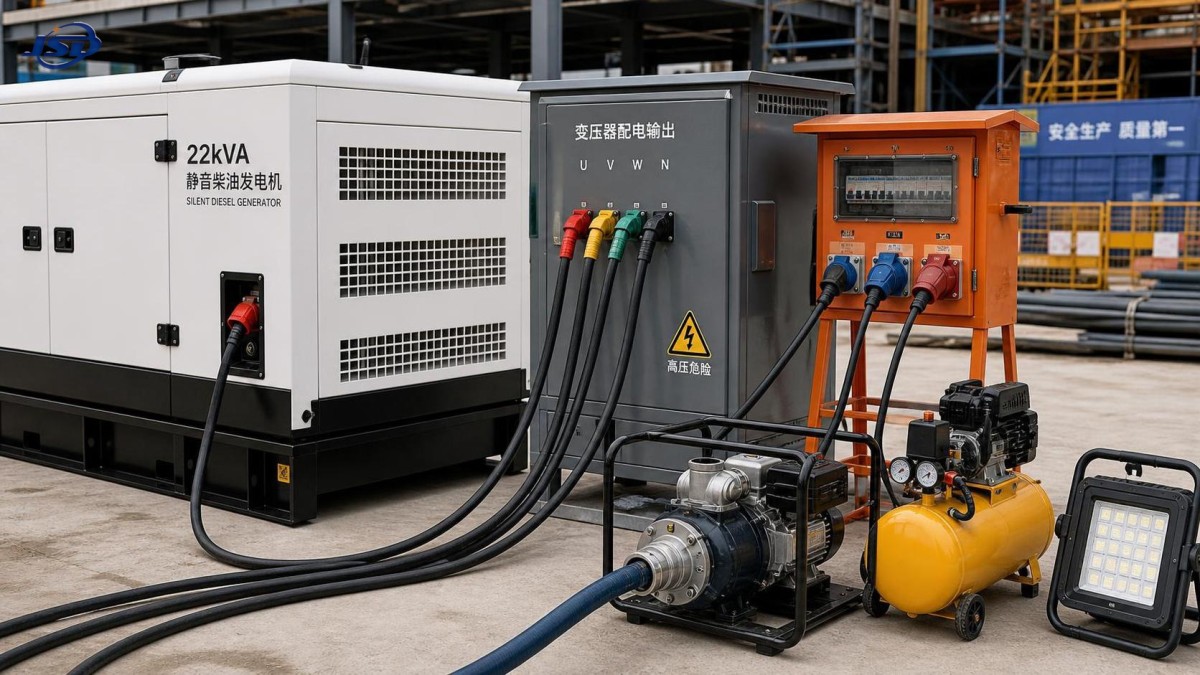
A practical way to decide
Instead of working from equipment names, work from the electrical data plate of each item. The minimum details worth collecting are:
- rated voltage and phase;
- running current or running kW;
- motor horsepower or kW;
- starting method, if known;
- whether the motor starts unloaded or under load;
- how many machines may start at the same time.
Once that information is available, the decision becomes clearer.
If your total steady load is only 30% to 50% of generator capacity, and the largest motor starts one at a time, a 22kVA unit may be entirely reasonable. If your steady load is already above 60% to 70% and you expect heavy motor starts, you are entering a risk zone. In that case, the problem is not only whether the generator can eventually run the equipment, but whether it can maintain voltage and frequency stability while the site operates normally.
Why oversimplified sizing rules often mislead buyers
Online advice often suggests multiplying running load by a fixed factor. That can be directionally useful, but it is not reliable enough for field decisions. Motor starting characteristics differ widely. So do generator alternator performance, engine transient response, and site conditions.
Two generators with the same kVA rating may not behave identically under impact loads. Build quality, governor response, alternator design, and voltage regulation matter. This is one reason contractors who have used low-cost sets on demanding motor loads often become more conservative in sizing later.
Noise, enclosure type, and environmental suitability also affect the decision. On urban or residential-adjacent sites, users often prefer enclosed units such as a Silent Canopy Diesel Generator Set, not because the canopy changes fundamental capacity, but because site access, local noise expectations, and weather protection can be just as important as raw output.
Single-phase vs three-phase matters more than many end users expect
A frequent mistake is to focus on total kVA and ignore output configuration. Many site motors and pumps require three-phase supply. A generator may have enough nameplate capacity overall but still be unsuitable if the load balance is poor or if a large single-phase load is placed on one leg of a three-phase machine.
With three-phase sets, uneven distribution can create overheating, voltage imbalance, and poor motor performance. For small users, this usually shows up as “the generator should be big enough, but the machine still struggles.” In reality, the issue is often load arrangement rather than total size alone.
Before buying or renting, confirm:
- whether each machine is single-phase or three-phase;
- whether the generator output matches that requirement;
- how loads will be distributed in actual use.
When a 22kVA generator is a good fit
This size tends to make sense when the site has moderate and predictable demand. Typical examples include:
- small building or maintenance projects with lighting, hand tools, and one intermittent motor load;
- temporary backup for small facilities without major HVAC or process motors;
- remote service operations where transportability and fuel economy matter;
- short-duration field jobs where loads can be controlled manually.
In these scenarios, a 22kVA unit can offer a practical balance of cost, footprint, and fuel use. Running a much larger generator at very low load for long periods is not always ideal either, particularly for diesel sets, where underloading may contribute to poor combustion behavior over time.
When it is probably too small
If your site relies on several motor-driven machines, especially machines that start automatically or unpredictably, a 22kVA generator is often too close for comfort. Warning signs include:
- compressors and pumps cycling while other equipment is already running;
- large startup loads that cannot be sequenced manually;
- frequent nuisance tripping on previous jobs;
- sensitive electronics on the same temporary power network;
- future load growth likely during the project.
In these cases, the cheapest-looking option at purchase can become the most expensive in downtime, callouts, productivity loss, and operator frustration.
The hidden cost of getting it wrong
Undersizing is not just an inconvenience. It can affect safety and equipment life. Excessive voltage dip may cause motors to overheat during hard starts. Repeated overload events can damage breakers, shorten alternator life, and increase engine wear. Productivity suffers too: crews wait, tools stall, pumps fail to restart, and troubleshooting consumes paid time.
For end users, this is often the most important conclusion: the correct generator size is not the smallest model that can theoretically run the load. It is the smallest model that can run the load reliably under normal site behavior.
What to ask before you choose
Before deciding on a generator 22kva, ask these practical questions:
- What is the single largest motor I need to start?
- Does it start unloaded or already carrying material, pressure, or head?
- Will multiple operators use equipment at the same time?
- Do I need reserve capacity for added tools later?
- Is the site hot, high, dusty, or otherwise derating-prone?
- Do I need stable power for sensitive control panels, chargers, or electronics?
If the answers suggest uncertainty, it is usually worth stepping up in size or getting the load list reviewed properly. That is especially true where lost site hours cost more than the generator price difference.
A realistic conclusion
A 22kVA generator is enough for many common site duties, but not for all “common site equipment” in the way that phrase is often used. It is generally suitable for lighter mixed loads, tools, lighting, and carefully managed motor applications. It is much less reliable as an all-purpose answer for compressors, larger pumps, heavy mixers, or several concurrent motor starts.
The safest decision is to size from actual startup conditions, not from equipment labels or optimistic assumptions. If your site loads are simple and controlled, 22kVA may be a cost-effective choice. If the project includes hard-start motors, variable usage patterns, or any chance of load growth, moving up a size is often the more economical decision over the life of the job.
In generator selection, the biggest mistake is not buying too large. It is buying too small and discovering the problem only after the site goes live.

Get a Quote
Regardless of whether you require general advice or specific support, we are happy to help you.
Send Us Your Inquiry Today

Jinshida Electric remains committed to contributing to global energy development through professional manufacturing and superior service.