





What fuel use to expect from a generator 400 kva at partial load
When evaluating a generator 400 kva for real-world operations, fuel consumption at partial load is usually where the financial picture becomes clearer—or more misleading. Many budget approvals are based on a headline fuel figure taken from a brochure, yet generators rarely run at full rated output for long periods. In factories, construction sites, commercial buildings, and backup power installations, the normal pattern is often 30% to 70% loading, with frequent fluctuations. That matters because diesel consumption does not decline in a straight line as load drops. A lightly loaded generator can look acceptable in capex terms while becoming unnecessarily expensive in operating cost.
For finance teams, the practical question is not simply “How many liters per hour does a 400 kVA generator consume?” The more useful question is “What fuel cost should we expect under our actual load profile, and how sensitive is that cost to poor sizing, low load operation, and maintenance quality?” Those are different questions, and they lead to better approval decisions.
What fuel use is typical for a 400 kVA generator at partial load?
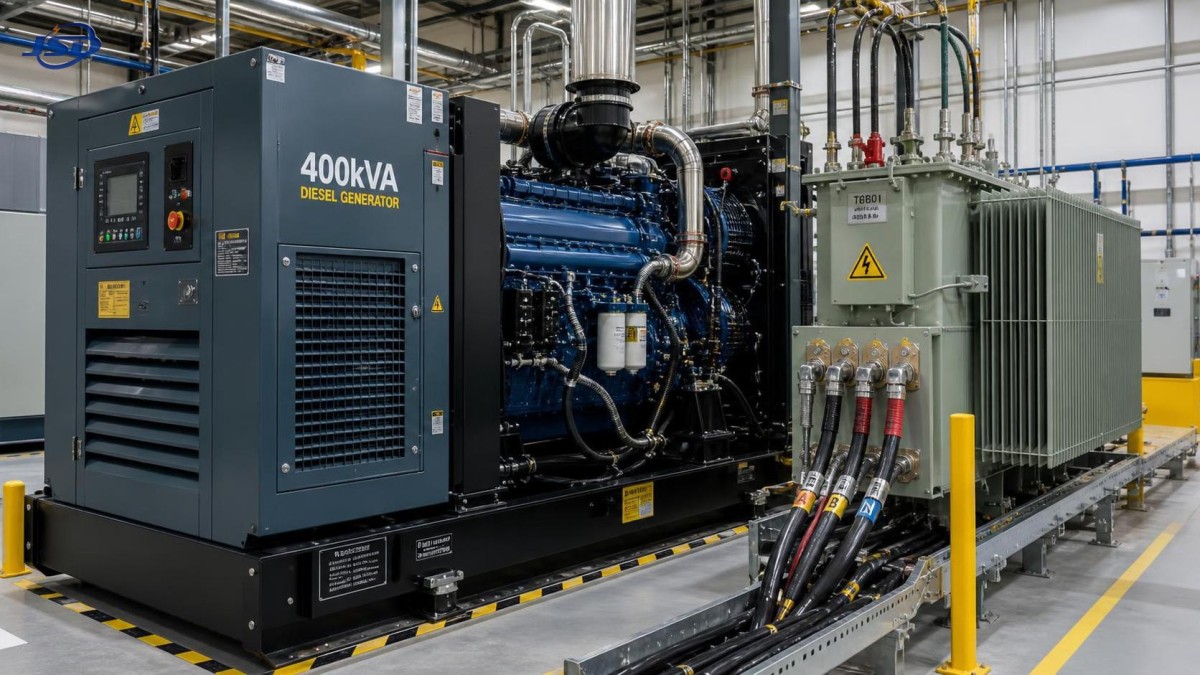
A 400 kVA diesel generator is commonly associated with a power factor of 0.8, which means a rated real power output of around 320 kW. Fuel consumption varies by engine brand, alternator efficiency, ambient conditions, emissions setting, and site altitude, so there is no single universal number. Still, a realistic planning range is possible.
For many modern diesel units in this class, approximate fuel consumption often falls into ranges such as:
- At 25% load (about 80 kW): roughly 22 to 30 liters/hour
- At 50% load (about 160 kW): roughly 38 to 50 liters/hour
- At 75% load (about 240 kW): roughly 55 to 68 liters/hour
- At 100% load (about 320 kW): roughly 72 to 90 liters/hour
These ranges are not quotations and should not replace manufacturer data, but they are useful for budgeting. The key financial insight is that the liters consumed per kWh generated usually worsen at very low loads. A generator does not burn fuel only in proportion to output; it also consumes fuel to keep the engine running, cooling systems operating, and internal losses covered.
That is why a generator at 25% load may use far more than 25% of its full-load fuel rate. For cost approval, this is the first issue to test.
Why partial-load efficiency matters more than rated efficiency
From a finance perspective, rated output is a purchasing reference, not an operating reality. If your site only draws 120 to 180 kW most of the time, then your effective cost base is determined by how the machine performs near 40% to 55% load, not by its full-load specification.
Consider two simplified examples:
- Generator A consumes 78 L/h at full load and 46 L/h at 50% load
- Generator B consumes 82 L/h at full load and 40 L/h at 50% load
If a buyer focuses only on the full-load data, Generator A appears better. But if the site spends most operating hours around half load, Generator B may deliver lower annual fuel cost despite a worse headline figure. This is a common procurement error when technical schedules are compared too narrowly.
For approval purposes, partial-load fuel maps are more valuable than isolated nameplate data.
The hidden cost of oversizing a 400 kVA unit
Oversizing is one of the most expensive “safe” decisions in standby and prime power procurement. It often happens for understandable reasons: future expansion, fear of overload, uncertainty in startup currents, or a preference to standardize around a common rating. But if the actual operating load remains low, the penalty can continue for years.
A 400 kVA unit running consistently below 30% load may create several cost problems:
- Higher fuel cost per kWh
- Potential wet stacking in diesel engines
- Increased carbon buildup and incomplete combustion
- More frequent maintenance interventions
- Reduced engine life in poorly managed operating conditions
These issues are not theoretical. In backup applications with short test runs and low building demand, oversizing is particularly common. Facilities often buy for “worst-case emergency load,” but the generator spends most of its life lightly loaded. If that emergency peak is brief or only occasional, a different configuration—such as staged loading, a smaller primary set, or parallel architecture—may produce a better lifecycle result.
How to estimate annual fuel budget with more confidence
Financial approval should be based on annualized operating scenarios rather than a single hourly fuel figure. A workable internal model can be built from five inputs:
- Expected operating hours per year
- Load distribution by percentage band
- Fuel consumption at each band from supplier data
- Expected diesel price and volatility assumption
- Maintenance cost impact from operating pattern
Suppose a site expects 1,500 operating hours annually with this load pattern:
- 30% of hours at 25% load
- 50% of hours at 50% load
- 20% of hours at 75% load
Using mid-range fuel assumptions for a 400 kVA unit:
- 25% load: 26 L/h × 450 h = 11,700 L
- 50% load: 44 L/h × 750 h = 33,000 L
- 75% load: 61 L/h × 300 h = 18,300 L
Total annual fuel use would be about 63,000 liters.
At a diesel cost of USD 1.00 per liter, that is USD 63,000 per year. At USD 1.20 per liter, it becomes USD 75,600. Over five years, even before maintenance and downtime risk are added, the spread becomes significant enough to change procurement ranking.
This is why financial reviewers should request not only the generator price, but also a projected cost curve under expected operating conditions.
Do not separate generator economics from the wider power system
In industrial projects, generator performance cannot always be assessed in isolation. Load quality, power conversion equipment, harmonic conditions, and downstream distribution design can all influence real operating efficiency. In facilities with rectification, electrochemical processing, heavy drives, or specialized power conversion systems, the generator may interact with dedicated equipment such as an Isolation and Rectifier Special Transformer. In such environments, stable voltage behavior and system matching may matter just as much as the engine fuel curve, because poor electrical integration can cause avoidable losses, derating, or conservative oversizing.
For finance teams, this means a lower generator purchase price is not automatically a lower project cost. If the wider electrical architecture is mismatched, the fuel bill and reliability penalty may outweigh initial savings.
Common mistakes in supplier comparison
One reason cost overruns occur is that generator offers are often not directly comparable. Fuel data may be presented under different conditions, and partial-load figures may be omitted entirely. Some common issues to watch:
- Fuel consumption stated at prime power vs standby power without clear distinction
- Values measured under ideal test conditions that differ from site reality
- No correction discussion for altitude, temperature, or fuel quality
- Different emissions calibrations affecting consumption
- No explanation of acceptable low-load operating range
A finance approver does not need to become an engine specialist, but should insist on consistency. Ask each supplier to provide fuel data at 25%, 50%, 75%, and 100% load under clearly stated conditions. Then compare annual operating cost using the same duty profile.
What load level is financially healthiest?
There is no single ideal point for every installation, but many diesel generators operate most economically and mechanically more favorably when regularly loaded in a moderate band rather than at extremes. In practice, sustained operation somewhere around 50% to 80% load is often healthier than long-term operation below 30%, though the exact recommendation depends on the engine and application.
That does not mean every buyer should target a generator that runs near maximum load. Reserve margin is still important for motor starts, step loads, future expansion, and resilience. The point is narrower: buying far above actual need usually increases unit fuel cost and can introduce maintenance side effects. A balanced sizing decision normally beats a defensive one.
Fuel use is only part of the cost story
For procurement approval, fuel is the largest visible variable cost, but not the only one. Partial-load operation can influence other financial outcomes:
- Service interval efficiency: under unfavorable duty patterns, maintenance can become more frequent or more corrective than preventive
- Asset utilization: a high-value machine may remain underused while still incurring fixed ownership cost
- Downtime risk: unstable low-load behavior or carbon buildup can increase reliability concerns
- Resale or redeployment value: a better-matched unit may retain more practical value within a fleet
In some projects, the savings from selecting a more appropriately sized unit or a better-matched system can be greater than the difference negotiated on purchase price.
Questions a finance approver should ask before signing off
Good approval questions are rarely technical for their own sake. They are intended to expose cost risk. Useful examples include:
- What is the expected average and minimum operating load during real use?
- How many hours per year will the unit run in each load band?
- What are the supplier’s verified fuel figures at those load bands?
- Is the generator being sized for continuous demand, peak demand, or contingency demand?
- If contingency demand is the driver, is there a more cost-effective configuration?
- What is the expected maintenance impact of the proposed load profile?
- Will the electrical system include equipment that changes load characteristics or power quality behavior?
If these questions cannot be answered clearly, the risk is not just technical uncertainty; it is weak cost visibility.
When a 400 kVA generator makes sense—and when it may not
A 400 kVA generator can be a sound choice for medium industrial loads, commercial backup systems, construction operations, infrastructure support, and facilities with moderate future expansion plans. It becomes financially attractive when the duty profile is substantial enough to avoid chronic low-load operation, and when the load pattern justifies the reserve margin.
It may be less attractive when:
- Actual base load is consistently far below rating
- The project is buying around a rare peak event instead of the normal operating profile
- Parallel smaller units could better match variable demand
- Fuel logistics are costly or diesel prices are volatile
- Power quality constraints in the wider system call for a more integrated design approach
In facilities with specialized conversion loads, the discussion may extend beyond generator sizing into transformer and rectification design, where components such as an Isolation and Rectifier Special Transformer become relevant to overall efficiency, protection, and system compatibility.
The practical takeaway for cost-focused decision makers
If you are reviewing a purchase request for a generator 400 kva, do not approve based on rated capacity and purchase price alone. Partial-load fuel use is where many projects either protect margins or quietly lose them. A realistic assessment should be based on duty-cycle fuel consumption, not a single brochure number. It should also test whether the unit is correctly sized for actual operations, not just for theoretical peak demand.
In budget terms, the important difference is not whether one generator burns a few liters less at full load. It is whether the selected unit remains efficient and reliable across the load profile your site will actually see. That is the difference between buying equipment and approving a sound operating-cost decision.

Get a Quote
Regardless of whether you require general advice or specific support, we are happy to help you.
Send Us Your Inquiry Today

Jinshida Electric remains committed to contributing to global energy development through professional manufacturing and superior service.