





What weather protection an open type generator really needs on site
Meta Title: What weather protection an open type generator really needs on site
If you are using an open type generator on a live project, the real question is not whether it needs weather protection. It does. The practical question is how much protection is enough without creating new problems like poor ventilation, difficult maintenance access, or unsafe cable routing. On most sites, the right answer is a controlled setup: overhead rain cover, raised foundation, drainage, dust control, airflow clearance, and a clear inspection routine. Anything less can lead to avoidable shutdowns, insulation issues, corrosion, and fuel or electrical risk.
Many project teams get caught by the same assumption: if the generator starts and runs, the protection plan must be fine. In reality, weather damage often builds quietly. Water gets into connectors. Dust loads the alternator and radiator. Heat accumulates under makeshift covers. By the time the unit trips or performance drops, the site has already lost time.
That is why weather protection for an open type generator should be treated as part of power planning, not as an afterthought handled with a tarp and a few steel sheets.
What an open type generator actually needs protection from
Rain is the obvious one, but it is not always the biggest problem. On construction, utility, and infrastructure sites, exposed generators usually face a mix of conditions:
- Direct rainfall and wind-driven rain
- Standing water and muddy ground
- Dust from excavation, concrete cutting, or haul roads
- High ambient temperature and solar heat gain
- Poor airflow caused by temporary enclosures
- Salt-laden air in coastal work
- Debris entering intake or cooling areas
The mistake is treating all weather risks the same. A site in heavy rain needs drainage discipline. A dry mining or roadwork site may be more threatened by dust than by water. A hot urban project may have no flooding risk at all, but still lose generator output because of bad ventilation around the unit.
In simple terms: protect the generator from the environment, but do not block the generator from breathing, cooling, draining, and being serviced.
Rain cover helps, but a tarp is rarely a real solution
I often see teams focus first on “covering” the machine. That sounds sensible, but the type of cover matters more than the fact that there is one.
A loose tarp draped over an open type generator may stop some rain, but it can also trap heat, flap into hot surfaces, interfere with exhaust discharge, and direct water toward electrical points. On a windy site, it may do more harm than good.
A better approach is a fixed or semi-fixed canopy structure above the generator, with open sides or controlled side screening based on local conditions. The roof should shed water away from the machine, not onto the cable side or fuel handling area. There should also be enough height and side clearance to avoid restricting cooling airflow.
For most temporary projects, what works best is not a fully sealed box. It is a weather shelter designed with these basics in mind:
- Roof coverage wider than the generator footprint
- Clear airflow path around radiator and engine areas
- No water runoff directed onto cable entry points
- Safe clearance from exhaust and hot components
- Enough access for daily checks, refueling, and maintenance
If your team cannot inspect oil, coolant, belts, terminals, and fuel lines easily, the shelter design is already working against operations.
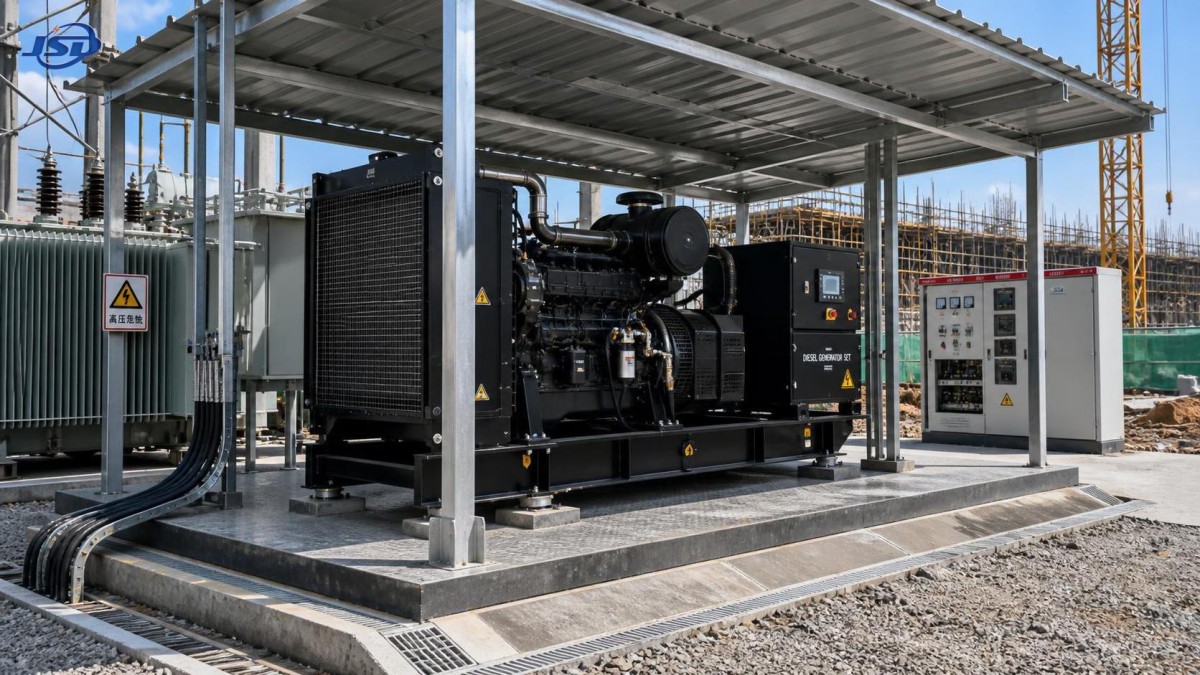
Ground conditions matter more than many people expect
A well-covered generator placed on poor ground is still at risk. Water problems often come from below, not above.
An open type generator should sit on a stable, raised base. Depending on site conditions, that may be a concrete pad, steel skid support, compacted aggregate platform, or another engineered temporary foundation. The point is to keep the unit out of standing water, reduce vibration movement, and maintain level operation.
This is especially important in sites with repeated rain, washdown activity, or unstable soil. Mud splash and pooled water can affect the alternator, lower frame, grounding points, and cable management. A generator that sits slightly tilted for weeks can also create secondary issues with fuel use, drainage, and serviceability.
Project managers sometimes approve a solid shelter but overlook the drainage path around it. Then the roof keeps the generator dry while the surrounding ground turns into a basin. That is not weather protection. It is just a delayed failure mode.
A practical site check is simple: after rain, can water leave the area quickly, or does it collect around the base? If it collects, correct that before the next storm cycle.
Dust protection is often the hidden priority for an open type generator
On transformer-related projects, grid works, cable trenching, and infrastructure builds, dust is often more persistent than rain. Fine dust can clog radiators, shorten filter life, contaminate electrical parts, and push operating temperatures upward. The generator may still run, but it runs harder and less reliably.
That is why weather protection for an open type generator should include dust strategy, not just waterproofing. Depending on site conditions, that may mean:
- Positioning the unit away from excavation edges and haul roads
- Avoiding direct alignment with prevailing dust-laden wind
- Installing side barriers that reduce dust drift without choking airflow
- Increasing cleaning and filter inspection frequency
- Using housekeeping controls such as road wetting where appropriate
There is also a planning decision here. If a site has highly variable or low-load demand with periods where the generator does not need to carry everything alone, some teams reduce generator exposure by pairing power infrastructure with energy storage for specific loads. In those hybrid situations, solutions such as 51.2V Stackable LiFePO4 Energy Storage Battery can be worth reviewing as part of a broader temporary power strategy. It is not a substitute for generator weather protection, but it may reduce runtime pressure in some applications.
Ventilation is where many protection plans go wrong
People try to protect the machine and end up overheating it.
An open type generator rejects a lot of heat. Any enclosure, screen, or weather barrier has to respect the cooling system layout. If the radiator discharge recirculates hot air, or if the engine intake keeps pulling in heated air from a confined shelter, operating temperature rises fast. In hot climates or at high load, that can lead to derating, alarms, or shutdown.
So when someone asks what weather protection an open type generator really needs, one direct answer is this: it needs shelter that protects against water and dust without disturbing designed airflow.
That means your site team should confirm:
- Radiator outlet is not blocked by walls, sheeting, or stored materials
- Hot exhaust is discharged safely away from work areas and covers
- Fresh air can enter freely from the correct side
- The shelter does not trap heat during peak daytime operation
If the cover design was made by a fabricator with no generator experience, check it carefully before relying on it. A tidy-looking enclosure can still perform badly.
Do not ignore cable entry, connectors, and daily handling areas
Some of the most vulnerable points on site are not the engine block or alternator housing. They are the practical touchpoints: cable terminations, changeover interfaces, grounding connections, refueling access, and operator walk paths.
Rain protection should extend to these areas too. Water entering cable joints or temporary distribution points can create faults long before the generator itself shows visible damage. The same applies to fuel management. Refueling in a slippery, congested, badly lit corner of a shelter is asking for mistakes.
For project use, a strong setup usually includes:
- Cable routes kept off wet ground where possible
- Protected termination points
- Clear separation between fuel handling and electrical access
- Non-slip footing for operators
- Adequate lighting for night inspection or refueling
These details do not look dramatic in a purchase checklist, but they are exactly what reduce incidents on real sites.
When a full enclosure may be the better answer
There are situations where an open type generator is still the right power source, but the site conditions make minimal weather protection unrealistic. Persistent heavy rain, coastal corrosion exposure, severe dust, theft risk, noise restrictions, or tightly controlled urban works may push the project toward a weatherproof or sound-attenuated enclosure instead.
This is where honest evaluation matters. If the generator will be in place for a short duration, with good access, moderate climate, and supervised operation, a properly designed shelter around an open unit can be cost-effective. If the site is harsh and long-running, repeated protection workarounds may cost more than using a more enclosed package from the start.
The same logic applies across power equipment selection more broadly. Companies such as Jinshida Electric Power Technology Co., Ltd., which work across transmission and distribution equipment, usually understand that reliability does not come from a single component. It comes from how equipment, operating environment, installation discipline, and maintenance standards work together on site.
A quick field rule for project managers
If you need a fast decision standard, use this one: an open type generator on site needs enough weather protection that rain cannot enter critical areas, water cannot pool at the base, dust cannot build unchecked, and air can still move through the machine as intended.
If one of those four conditions is not met, the setup is incomplete.
This sounds basic, but it prevents the two most common failures in temporary power planning: under-protection and over-enclosure.
Common mistakes that look acceptable at first
- Covering only the top of the unit and leaving cable points exposed
- Using side sheets that block radiator airflow
- Placing the generator in the lowest part of the site for convenience
- Ignoring runoff from nearby structures or stockpiles
- Assuming the supplier’s delivery condition is enough for field exposure
- Planning no extra inspection frequency during bad weather periods
These are not unusual mistakes. They happen because generator protection is often treated as a temporary detail, while the schedule pressure sits elsewhere. But in practice, the temporary detail is exactly what determines whether the power stays stable.
Before you finalize the setup
Check the actual site, not just the equipment spec. Look at drainage after rain. Stand where the dust moves in the afternoon. Review how refueling will happen at night. Confirm where hot air leaves the unit. Ask whether the planned shelter can still be serviced quickly during a fault.
That is the level of thinking an open type generator needs on a working project.
The best protection is rarely the most complicated. It is the one matched to the site: simple enough to operate, strong enough to reduce risk, and open enough to let the generator do its job. When that balance is right, an open type generator can work reliably even in demanding field conditions.
FAQ
Can an open type generator run in light rain?
It may run, but that does not mean it should be left exposed. Even light rain can affect terminals, controls, connectors, and long-term insulation condition.
Is a temporary roof enough protection for most sites?
Only if it also deals with drainage, airflow, and access. A roof alone solves just one part of the problem.
Should I build walls around the generator to stop dust?
Sometimes partial screening helps, but full surrounding walls can create heat problems. Dust control has to be balanced against ventilation.
When should I stop using an open type generator and choose an enclosed unit instead?
When the site has prolonged harsh weather, strict noise limits, severe contamination, or long deployment periods that make temporary protection inefficient or unreliable.
Image Placeholder List
Position suggestion: After the section discussing rain cover and before the discussion of ground conditions.
Image content: A practical site layout showing an open type generator under a raised weather shelter, with airflow clearance, drainage slope, cable routing, and safe access zones marked.
Alt text: Open type generator site weather protection setup with shelter, ventilation clearance, and drainage layout
Internal Link Anchor Text Suggestions
- How to choose temporary power equipment for construction sites: guide or solution page
- Generator ventilation and cooling layout basics: technical support page
- Power distribution equipment for infrastructure projects: category or industry page
- Battery energy storage for hybrid site power: product or application page
- Common installation mistakes in outdoor power systems: blog or knowledge base page
External Authoritative Source Suggestions
- Generator manufacturer official technical manuals
- Electrical safety guidance from government or regulatory agencies
- Industry association resources on temporary power and site safety

Get a Quote
Regardless of whether you require general advice or specific support, we are happy to help you.
Send Us Your Inquiry Today

Jinshida Electric remains committed to contributing to global energy development through professional manufacturing and superior service.