





Is a 5 kva silent generator suitable for small office backup power
A 5 kva silent generator is often suitable for small office backup power, but only when the office load is defined with some discipline. The rating sounds generous at first glance, yet backup performance depends on how many devices start at the same time, whether the power factor is poor, and whether the generator is expected to support only essential circuits or the whole office. In a compact workspace with computers, network equipment, LED lighting, access control, and a few low-demand office machines, this size can be a practical match. If air conditioning, electric heating, large printers, pantry appliances, or server-room cooling must stay online, the same unit may become undersized very quickly.
The first useful distinction is between running load and starting load. Desktop computers, monitors, routers, switches, and security recorders usually have manageable steady consumption. Problems arise when several devices energize together after a power cut. A laser printer warming up, a copier motor engaging, or a small split air conditioner compressor starting can create a brief surge that is much higher than the nameplate running figure. A generator that looks adequate on paper may then experience voltage dip, frequency instability, or nuisance tripping. For office backup, the question is not simply whether the total connected load is below 5 kva. The real question is whether the critical load profile remains stable during transfer and restart.
For this reason, many installations divide office equipment into two groups. The first group includes circuits that must continue through an outage: internet connection, emergency lighting, selected sockets for workstations, the modem rack, entry systems, and security devices. The second group includes loads that can remain off until utility power returns or until manual intervention is possible. Once this separation is made at the distribution board, a 5 kva silent generator becomes much easier to evaluate. In many offices, it is appropriate for essential continuity rather than full-building continuity.
How the transformer perspective changes the decision
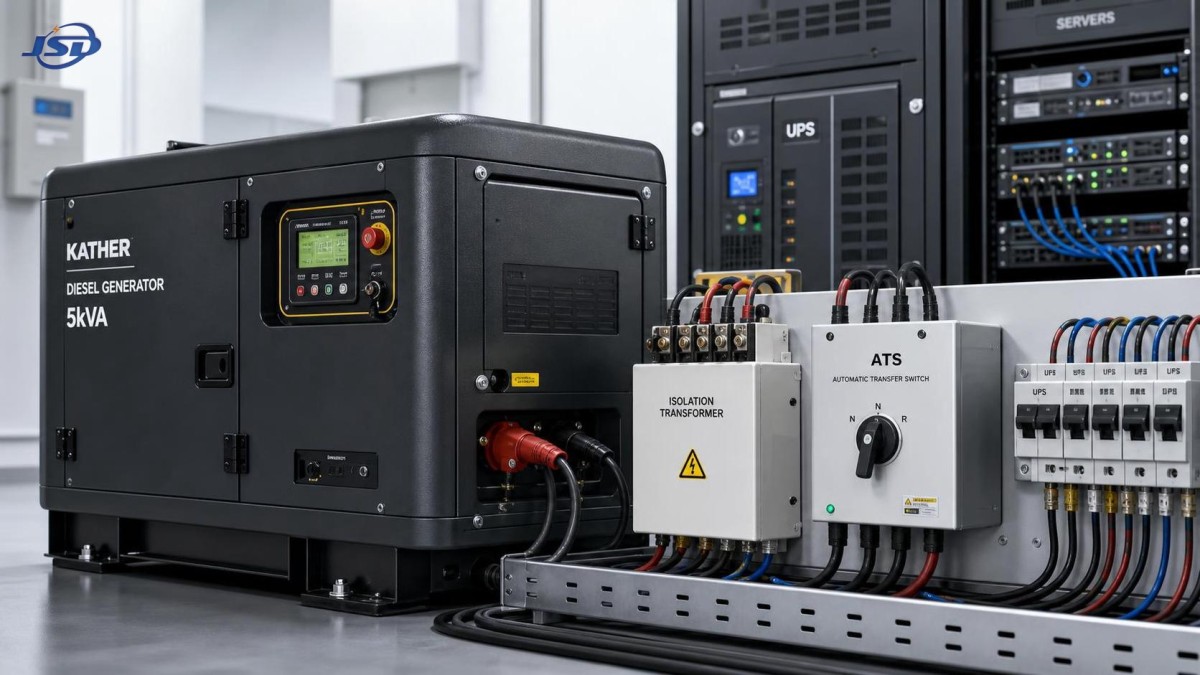
Although the immediate topic is a generator, transformer-related considerations matter because office electrical systems rarely behave as a simple sum of wattage labels. Step-down transformers, isolation transformers, UPS input stages, battery chargers, and switched-mode power supplies can affect inrush current and harmonic content. If the office uses a transformer to adapt voltage for imported equipment or to isolate sensitive circuits, the generator must tolerate magnetizing inrush when that transformer energizes. Even a small transformer can create a sharp transient when switched on at the wrong point in the waveform.
That is why sizing should consider the sequence of reconnection. If a UPS, stabilizer, or transformer-fed panel restarts before other loads, the generator sees a different electrical event than when all downstream circuits close at once. In a careful installation, the transfer arrangement, breaker coordination, and load pick-up order are just as important as the kva figure on the generator canopy.
When 5 kva works well
A 5 kva silent generator is usually a reasonable choice for a small office where backup power is limited to communication and basic operations. Typical acceptable conditions include modest lighting demand, a small number of computers, low-power network hardware, CCTV, and one or two specialized devices that do not draw heavy startup current. It also works better where the office already uses LED lighting instead of older fluorescent fittings with magnetic ballasts, and where printing is occasional rather than continuous.
It can also fit sites where a UPS bridges the first seconds of an outage. In that arrangement, the UPS carries sensitive electronics during transfer, while the generator takes over the broader essential load after stabilizing. This reduces the risk of workstation shutdowns and avoids subjecting computers directly to the transient behavior that can occur during generator startup and transfer. However, the UPS charger itself becomes part of the generator load, so it must be included in the calculation rather than treated as invisible.
Noise is one of the main reasons offices consider this capacity class. A silent generator with a proper acoustic canopy is easier to place near occupied buildings than an open-frame unit. The lower sound level can matter as much as fuel efficiency when the generator may need to run during working hours, near meeting rooms, or adjacent to neighboring tenants. Still, “silent” never means inaudible. It usually means the enclosure, exhaust silencing, and airflow design are intended to reduce disturbance to an acceptable range for commercial use.
Where small offices misjudge capacity
The most common error is treating all equipment labels as direct running demand and ignoring startup behavior. Another is forgetting auxiliaries that seem minor during planning: the charger for door access backup batteries, the network cabinet cooling fan, water dispenser heating, pantry microwave, under-desk heaters, and reception display screens. These loads may not be critical, but if they remain connected to the backed-up board, they consume capacity anyway.
A third mistake appears when office managers assume that because the utility supply rarely trips, a generator can be loaded close to its stated maximum. In practice, reserve margin is valuable. Engine-driven generation performs better when sudden load steps, site temperature, cable length, altitude, and maintenance condition are taken into account. A unit operating too close to its limit may show unstable voltage under motor starting or under nonlinear electronic loads. That instability can affect routers, storage devices, and some security electronics long before a protective breaker trips.
There is also a procurement-side misunderstanding around kva versus kw. Offices often list appliance wattage and compare it directly with generator kva without considering power factor. If the connected equipment has a poor power factor or a mix of electronic loads with harmonic distortion, the usable real power can be lower than assumed. This is especially relevant when transformers, UPS systems, or older office machines are present in the backed-up circuit.
Installation details that matter more than the brochure
The location of the generator should be decided with ventilation, fuel handling, exhaust routing, cable run length, and maintenance access in mind. A compact silent generator may physically fit in a narrow service area, but poor airflow can lead to overheating, reduced output, or repeated shutdowns. Exhaust discharge must also be directed away from air intakes, windows, and pedestrian areas. In office buildings, these constraints often limit installation choices more than the equipment footprint itself.
The transfer method deserves equal attention. Manual changeover can be acceptable where outages are infrequent and on-site staff can respond quickly. Automatic transfer is more suitable when connectivity, access control, or remote monitoring must resume with minimal delay. Either way, the interlocking arrangement must prevent backfeeding into the utility supply. Cable sizing, earthing continuity, and breaker discrimination should be checked against the generator’s short-circuit behavior rather than copied from a utility-fed arrangement without review.
Midway through specification, some projects compare enclosed diesel options such as Silent Canopy Diesel Generator Set configurations because the canopy, base frame, vibration isolation, and service access can influence real operating conditions as much as the alternator rating. That comparison is most useful when it stays technical: panel accessibility, drainage points, fuel tank integration, and ease of periodic inspection are usually more relevant than exterior appearance.
Fuel, transport, and site readiness
For office backup use, fuel management is often treated as an afterthought, yet it affects reliability directly. Diesel quality, storage duration, and water contamination can determine whether the generator starts cleanly after long idle periods. If the unit is only exercised occasionally, a routine for fuel inspection and periodic running under load is advisable. Short no-load starts are not enough to confirm actual backup readiness.
Transport and placement also deserve planning before purchase. A 5 kva unit is smaller than many industrial sets, but it still has weight, lifting points, and vibration considerations. If the route to the installation area involves ramps, soft ground, elevators, or narrow access doors, the delivery method should be checked early. An otherwise suitable generator can become a problem if it reaches site and cannot be positioned without removing barriers or altering the service area.
Site readiness includes the concrete pad or mounting base, weather protection where required, drainage around the equipment, and clearances for opening service doors. In coastal or humid regions, enclosure finish and corrosion exposure may influence long-term maintenance. In dusty environments, the air filtration schedule may need to be tighter than the nominal recommendation. These details do not change the headline rating, but they strongly affect whether the generator remains dependable after installation.
Operating strategy during an outage
A small office gets better results from a simple load sequence than from trying to restore everything instantly. Bring up network equipment, lighting, and essential sockets first. Delay heavier or less predictable loads until the generator has reached stable voltage and frequency. If an office air conditioner must be supported, it is often better to energize it separately after the base office load has settled. This approach reduces mechanical strain on the engine and limits the risk of voltage sag that can reboot electronics.
Where a transformer-fed subsystem is involved, energize that branch with awareness of inrush. If the transformer serves sensitive electronics, pairing it with a UPS or staged reconnection may reduce disturbance. If it serves a general-purpose panel, coordination with the breaker curve becomes more important. The aim is to avoid a situation where the generator is technically large enough, yet the first energizing event trips protection and leaves the office dark anyway.
Maintenance expectations for a backup unit
A 5 kva silent generator for office duty should be maintained like standby equipment, not like a decorative asset waiting in the corner. Battery condition, coolant level where applicable, lubricant quality, belt condition, fuel line integrity, and control panel alarms all need periodic review. Load testing at realistic operating conditions is more meaningful than a brief engine start. If the office relies on the unit for routers, storage, and access systems, the maintenance standard should reflect the importance of those circuits.
Acoustic enclosures also need inspection. Door seals, latches, ventilation paths, and exhaust insulation can deteriorate with age. A unit may remain electrically functional while becoming louder, hotter, or harder to service. In smaller office settings, those practical issues often lead to delayed use or neglected testing, which then undermines the original reason for choosing a silent generator.
So, is a 5 kva silent generator suitable for small office backup power? Yes, in many cases it is, provided the backed-up load is selective, startup surges are understood, and transformer or UPS-related inrush is not ignored. It is a poor fit when the office expects whole-premises support including comfort cooling and other high-demand equipment. The right answer comes from the distribution layout, the transfer sequence, and the actual electrical behavior of the circuits that must remain alive when the mains fail.

Get a Quote
Regardless of whether you require general advice or specific support, we are happy to help you.
Send Us Your Inquiry Today

Jinshida Electric remains committed to contributing to global energy development through professional manufacturing and superior service.