





What causes unstable voltage in a 5kw silent generator
What really causes unstable voltage in a 5kw silent generator
Unstable voltage in a 5kw silent generator usually shows up before a full failure does. Lights flicker, a pump starts harder than usual, a charger drops out, or a control board begins throwing random faults. In field service, that matters because the complaint is often “the generator runs, but the load is not happy.” The engine may sound acceptable, and yet the output is wandering enough to damage sensitive equipment or trip protection.
For maintenance work, the key is not to treat voltage fluctuation as one single fault. On small silent gensets, unstable output is often a chain reaction involving engine speed, excitation control, wiring condition, load behavior, and sometimes the environment around the machine. If you only replace the AVR or only adjust the governor, you may temporarily reduce the symptom without removing the root cause.
A 5kw unit is also small enough that it has less “forgiveness” than larger industrial sets. A sudden load step, poor fuel quality, or a loose neutral can disturb the whole system much faster than people expect.
Start with engine speed before touching the alternator
In many service calls, unstable voltage is actually unstable frequency first. Since generator output voltage and frequency both depend on rotational speed, an engine that hunts under load will usually produce a fluctuating electrical output. On a 50 Hz machine, even a small speed swing is enough to create noticeable voltage variation, especially on electronic loads.
Common mechanical causes include a poorly adjusted governor, sticky throttle linkage, clogged fuel filter, injector issues, contaminated fuel, or restricted air intake. Silent generator enclosures reduce noise, but they can also hide cooling and combustion problems. If airflow is poor, the engine may lose stability as temperature rises, and the voltage problem may only appear after 20 to 40 minutes of operation.
A practical check is simple: measure frequency during no-load and then under a stable resistive load. If frequency drifts or oscillates in step with the voltage, do not start by blaming the alternator. Solve the speed issue first.
AVR faults are common, but not every fluctuation is an AVR problem
The automatic voltage regulator is an obvious suspect because it directly controls excitation. When it fails, you may see overvoltage, undervoltage, slow recovery, or constant hunting. But field experience says the AVR is often replaced too quickly. A weak sensing connection, poor brush contact, damaged capacitor in some designs, or rotor excitation problems can produce very similar symptoms.
If the generator uses brushes and slip rings, inspect carbon brush wear, spring pressure, ring surface contamination, and heat discoloration. If excitation current is intermittent, the output will never stay steady. On brushless designs, rotating rectifier faults or winding insulation deterioration can create unstable response that looks like a control issue.
One easy mistake is adjusting the AVR repeatedly without first checking whether the sensed voltage is actually clean and correct at the terminal block. If the sensing line is loose or oxidized, the regulator is making decisions from bad information.
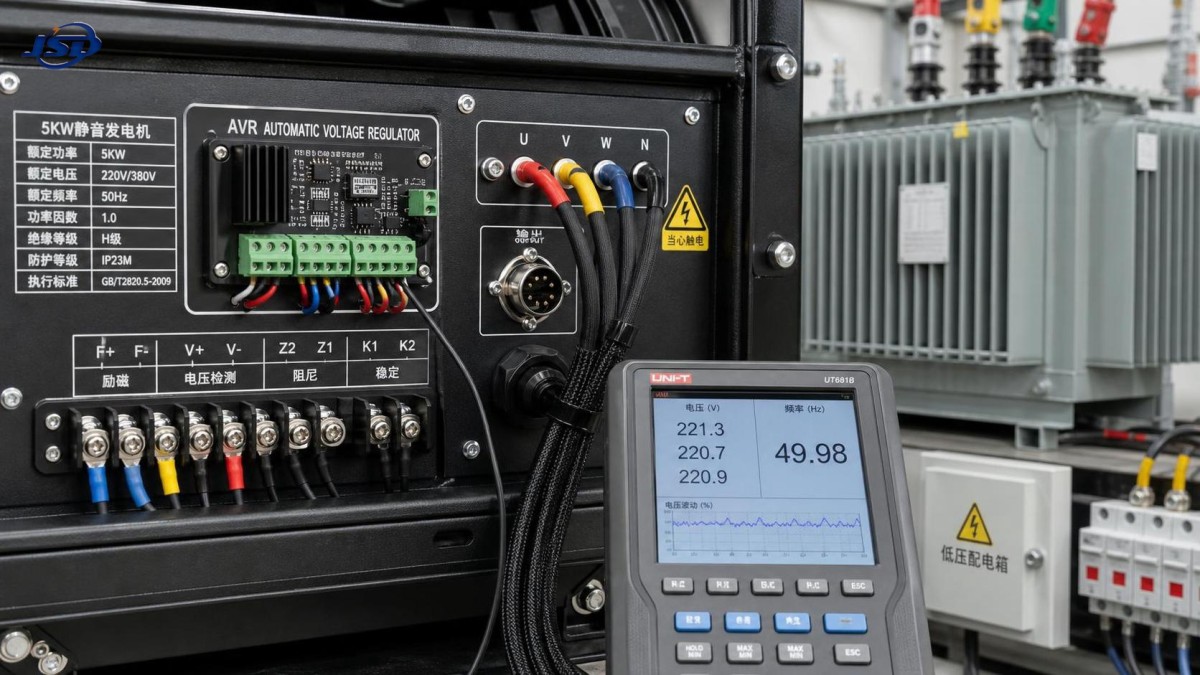
Loose terminals, poor neutral integrity, and cable problems are more serious than they look
Small generators are often moved, reconnected, and used with temporary cables. That makes terminal quality a real issue. A half-tightened output lug, overheated breaker contact, or damaged socket can create voltage drop and random fluctuation at the load side. In single-phase applications, a weak neutral connection is especially dangerous because users may describe it simply as “unstable power” while the real problem is intermittent return path resistance.
You can waste a lot of time testing the generator itself when the fault is in the extension cable reel, transfer switch, or downstream junction box. If the no-load output at the generator terminals is stable but the customer’s equipment sees wide swings, compare readings point by point under load. Heat marks, insulation smell, and discolored copper usually tell the story faster than paperwork does.
This is also where a transformer-minded approach helps. In power distribution work, stable output is never only about the source machine; it is about the whole path from source to load. Companies focused on transmission and distribution equipment, such as Jinshida Electric Power Technology Co., Ltd., tend to look at connection quality, voltage drop, and system matching together rather than isolating one component too early. That same habit is useful when diagnosing a 5kw silent generator in the field.
Load type changes the diagnosis
Not all loads disturb a generator in the same way. A resistive heater is easy. A motor, inverter, air compressor, welding machine, battery charger, or variable-speed drive is not. Many voltage complaints come from non-linear or high inrush loads that the generator can technically carry on paper, but not smoothly in real operation.
A 5kw set may hold acceptable voltage on a steady load and still collapse briefly when a compressor starts. To the user, that brief dip is “unstable voltage.” To the maintenance technician, it may actually be a sizing or load sequencing problem. If the customer has recently added a new charger, pump, or control cabinet, check that before replacing electrical parts.
This matters even more on sites where generator power interacts with broader distribution equipment. In some industrial or infrastructure setups, the generator is only one small part of a larger low-voltage network fed through devices such as an 30kV/0.4kV Oil-Immersed Power Distribution Transformer. In those cases, harmonics, switching behavior, and load grouping upstream or downstream can affect what operators perceive as generator instability. The fault may still be local, but the diagnosis should not stop at the genset enclosure.
Don’t ignore overheating and enclosure-related issues
Silent generators are compact by design. That is good for noise control, but it raises the importance of ventilation. If the cooling path is blocked by dust, bent acoustic lining, or poor installation clearance, both the engine and alternator can drift out of stable operating condition. Windings run hotter, resistance changes, AVR components are stressed, and the engine may begin hunting as intake temperature rises.
A useful field question is whether the voltage is unstable from startup or only after warm-up. If it appears only after temperature builds, inspect airflow, fan performance, radiator cleanliness, and enclosure exhaust routing. In hot climates or tight generator rooms, this is not a minor detail.
Winding condition and residual magnetism can also be part of the picture
On older or poorly stored units, stator or rotor winding condition should be considered. Moisture ingress, insulation aging, contamination with oil or dust, and long idle periods can all affect excitation behavior. Loss of residual magnetism usually presents as failure to build voltage, but partial excitation instability can sometimes create weak or erratic output depending on the design and fault severity.
This is where measured values matter more than assumptions. Insulation resistance testing, winding resistance comparison, and visual inspection of varnish condition can help, but the exact acceptance criteria need to match the generator design and maintenance standard in use. If service documentation is limited, be conservative rather than guessing.
A practical troubleshooting sequence that saves time
When a 5kw silent generator arrives with voltage instability, a sensible sequence usually looks like this:
- Confirm whether the complaint is true voltage instability, frequency instability, or both.
- Check output directly at the generator terminals before testing downstream wiring.
- Apply a known stable load if available, ideally something resistive.
- Observe whether the fault changes with temperature, load step, or run time.
- Inspect fuel, air intake, governor linkage, and engine speed response.
- Inspect terminals, neutral path, breaker contacts, sockets, and cable condition.
- Test AVR sensing circuit, excitation path, brushes or rotating rectifier as applicable.
- Only after that, judge whether major alternator repair is justified.
This order is not glamorous, but it prevents parts swapping. And on small units, unnecessary replacement can create a second fault just as easily as it solves the first.
A few field mistakes worth avoiding
One mistake is testing only with no load. Another is measuring with a low-grade meter that cannot capture unstable frequency or transient dips clearly. It is also common to overlook the customer’s application pattern: repeated motor starts, long undersized cables, or mixed electronic loads can turn a healthy small generator into a poor performer.
There is also a tendency to treat any output problem as a generator manufacturing issue. Sometimes that is true. But in many service situations, unstable voltage comes from installation conditions, maintenance gaps, or load mismatch rather than a defective core machine. A manufacturer with strong technical support and disciplined quality management can reduce those risks, but on-site diagnosis still has to be methodical.
If the same unit repeatedly returns with the same complaint, stop looking only at replaced parts and start documenting the operating environment: ambient temperature, cable length, connected load type, startup sequence, and whether the instability appears at fixed intervals. Those details usually reveal more than a bench test alone.
In short, unstable voltage in a 5kw silent generator is rarely mysterious. It is usually the result of speed instability, excitation problems, bad connections, difficult loads, or heat. The real skill is knowing which one to prove first, and resisting the temptation to jump straight to the most visible component.

Get a Quote
Regardless of whether you require general advice or specific support, we are happy to help you.
Send Us Your Inquiry Today

Jinshida Electric remains committed to contributing to global energy development through professional manufacturing and superior service.