





Is 10kwh battery storage enough for overnight backup in small facilities?
For many small facilities, the question sounds simple: is 10kwh battery storage enough to get through the night? In practice, it is a load-management question disguised as a capacity question. A 10 kWh system may be entirely adequate for one site and completely insufficient for another, even when both operate in the same industry and have similar floor area. What matters is not the battery label alone, but which loads must remain energized, for how long, and under what power quality constraints.
That distinction is especially important in power-related environments, where overnight backup is rarely about comfort loads. It is usually about keeping a narrow set of essential functions alive: control systems, security, monitoring, communications, emergency lighting, small HVAC for critical rooms, or low-power process continuity. For decision-makers, the right way to evaluate a 10 kWh system is to start with operational consequences of failure, then work backward into battery sizing, inverter rating, transfer logic, and upstream/downstream equipment compatibility.
The first decision is not battery size. It is what “overnight backup” really means at your site.
Many procurement discussions fail because “overnight” is treated as a fixed duration and “backup” is treated as all loads. Neither assumption holds in a real facility. Overnight could mean 8 hours, 10 hours, or a full off-shift window. Backup could mean everything in a small office-workshop, or only a protected critical bus serving a few essential devices.
If a facility expects 10kwh battery storage to support refrigerators, electric heating, large air-conditioning units, pumps, compressors, or high-inrush motor loads for the whole night, the answer is usually no. If the goal is to keep access control, cameras, fire alarm interfaces, network equipment, SCADA edge devices, and limited lighting online, then the answer may be yes, and sometimes comfortably so.
That is why experienced buyers look at three numbers before they look at battery marketing claims:
- Average critical load in kW, not total facility connected load
- Peak starting load, especially from motors and compressors
- Required backup duration after accounting for system losses and battery reserve
A simple example shows the difference. If the protected overnight load averages 600 W, then 10 kWh of nominal storage may appear to offer more than 16 hours. But nominal capacity is not the same as usable delivered energy. Inverter losses, battery management reserve, discharge limits, temperature effects, and aging all reduce what the site can actually use. In many practical systems, usable overnight energy may be meaningfully lower than the nameplate figure【待核实】. That means a design target based on 7 to 8 kWh usable energy may be more realistic than assuming the full 10 kWh is available every night.
Why nominal capacity often misleads buyers
In facility backup decisions, the most common misunderstanding is to treat battery capacity as if it were equivalent to runtime. It is not. Runtime depends on the whole chain: battery chemistry, depth of discharge policy, inverter efficiency, ambient conditions, cable losses, and the shape of the load over time.
For example, a site with a low average load but frequent surge events can still face problems if the inverter cannot handle momentary peaks. Conversely, a site with stable electronics loads may get predictable performance from a modest battery even when the total nominal capacity appears small.
This is where engineering discipline matters. A battery system should be evaluated as part of a backup architecture, not as an isolated energy box. In transformer-intensive facilities or sites with distributed low-voltage equipment, power continuity also depends on coordination with protection settings, transfer arrangements, grounding approach, and the behavior of connected power equipment during outage and restoration. A battery that is “large enough” on paper can still fail the application if the rest of the power path is not designed for stable switching and acceptable voltage quality.
When 10 kWh is usually enough
There are several small-facility scenarios where a 10 kWh class system can make sense:
- Telecom or IT edge rooms with efficient loads and no electric heating or cooling dependency beyond minimal support
- Security-focused backup for cameras, NVRs, access control, routers, and emergency lighting
- Remote monitoring stations, substations, control kiosks, and instrumentation panels with modest continuous demand
- Small offices or service points where backup is limited to communications, lighting, and basic digital operations
In these cases, the project often succeeds because the protected circuit is intentionally narrow. Loads are selected, nonessential devices are excluded, and operators understand what the system is supposed to carry. That clarity is far more valuable than buying a slightly larger battery without a load strategy.
Sites linked to distributed energy also sometimes use battery storage as part of a broader resilience package. In those environments, buyers may already be considering transformer selection for renewable integration, such as Transformer for Wind Power Generation, not because wind equipment is directly tied to small overnight backup, but because the underlying design issue is similar: the storage or transformer component must be chosen within the logic of the whole power system, not in isolation.
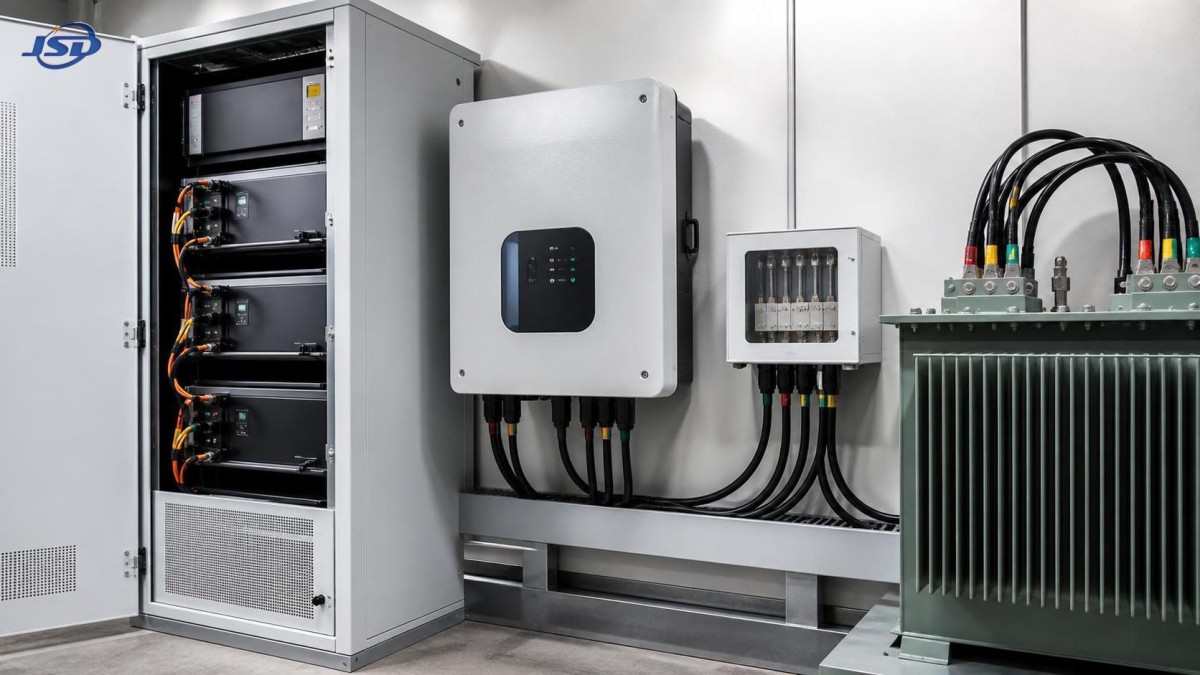
When 10 kWh is usually not enough
There are also clear cases where decision-makers should be skeptical.
If the site expects to maintain conventional HVAC through the night, even partially, 10 kWh may disappear quickly. The same applies to break-room appliances, water heating, pumps with frequent cycling, refrigeration with poor duty control, or any process equipment with significant startup current. Small facilities often underestimate these loads because they are familiar and distributed across the building, but from a battery perspective they are expensive energy consumers.
Another risk case is a facility that describes its backup need vaguely: “keep the site running until morning.” That phrase usually hides unresolved scope. Does “running” include production, only safety functions, or business continuity systems? Without that distinction, a 10 kWh purchase can become a politically convenient but technically weak compromise.
There is also a margin problem. Even if today’s overnight critical load appears to fit, many facilities gradually add devices: more cameras, additional networking, control upgrades, or environmental monitoring. A battery sized too tightly on day one becomes inadequate sooner than expected. That is why capacity headroom and future expansion options matter in selection.
What B2B buyers should check before approving the project
A useful evaluation framework is to ask whether the battery will support a defined critical-load panel or whether it is being used as a broad backup promise. If it is the latter, the risk of underperformance rises sharply.
Before moving ahead, decision-makers should verify at least the following:
- Load segregation: Are critical and noncritical loads physically separated in the distribution design?
- Usable energy: What portion of the 10 kWh is actually available under the intended discharge profile?
- Inverter capability: Can the inverter handle inrush current, harmonics, and sensitive electronics without nuisance trips?
- Transfer behavior: Is the switch-over time acceptable for the actual loads being protected?
- Thermal environment: Will the battery be installed in a temperature range that preserves expected performance?
- Aging allowance: What runtime remains after several years of cycling and calendar degradation【待核实】?
- Compliance and interface: Are there site-specific electrical standards, fire safety requirements, or utility interconnection conditions to satisfy?
In transformer and power equipment settings, one additional question deserves more attention than it often gets: what happens during restoration, not only during outage? Some loads are more stressed when power returns than when power disappears. Coordinating battery systems with protective devices and downstream equipment is part of avoiding nuisance resets, voltage instability, or unexpected restart behavior.
A practical sizing shortcut for early-stage decisions
For an initial screening, many buyers can use a conservative approximation instead of waiting for a full engineering study. Start with the site’s truly essential overnight load in kW. Multiply by the required hours. Then divide by a realistic system efficiency factor and include a reserve margin for aging and unexpected load growth.
In simplified form:
So if a facility needs 0.8 kW for 10 hours, the raw requirement is 8 kWh. That looks close to a 10 kWh battery. But once realistic losses and reserve are considered, the design may be tight. A buyer using this method will quickly see whether 10 kWh is a serious candidate or just an optimistic number.
This kind of screening does not replace detailed design, but it prevents a common mistake: approving storage based on budget convenience or vendor headline capacity before confirming the protected load strategy.
The transformer-sector view: backup decisions are really system decisions
From a power equipment perspective, storage sizing should not be separated from distribution architecture. Small facilities increasingly combine utility supply, backup storage, digital controls, and in some cases distributed renewable inputs. That makes interface quality more important than any single component rating.
For facilities that are expanding energy assets over time, battery backup should be assessed alongside future feeder arrangements, low-voltage equipment upgrades, and potential renewable integration pathways. In some projects, references such as Transformer for Wind Power Generation become relevant not because the current site is buying wind equipment immediately, but because planners are already moving toward a more hybrid electrical architecture and need components that fit long-term power quality and reliability goals.
That broader view also helps avoid overinvesting in storage where a smaller battery plus better load prioritization would do the job, or underinvesting where overnight continuity is mission-critical and a failure would disrupt safety, security, or contractual operations.
So, is it enough?
For a small facility with disciplined load selection, 10kwh battery storage can absolutely be enough for overnight backup. For a small facility that expects whole-site continuity, it often is not. The difference lies in whether the project is built around critical-load realism or around a vague expectation that the battery will “cover the night.”
That is the decision point enterprise buyers should focus on. If the site can define a protected essential load, confirm actual runtime after losses, and leave room for degradation and modest expansion, 10 kWh may be a sound and cost-effective choice. If those conditions are unclear, the safer conclusion is not that the battery is too small, but that the scope has not yet been engineered tightly enough to support procurement.

Get a Quote
Regardless of whether you require general advice or specific support, we are happy to help you.
Send Us Your Inquiry Today

Jinshida Electric remains committed to contributing to global energy development through professional manufacturing and superior service.