





When does a mobile energy storage system reduce generator runtime?
Generator hours are expensive in ways that are not always visible on the first project budget. Fuel is the obvious line item, but excessive runtime also means more maintenance intervals, more noise constraints, more emissions exposure, and more wear during the least efficient operating periods. That is why many operations teams are asking a practical question rather than a theoretical one: when does a mobile energy storage system actually reduce generator runtime?
The short answer is this: a mobile energy storage system delivers the most value when load profiles are uneven, peak demand is brief but intense, or generators are forced to run at low load for long stretches just to keep power available. In industrial, infrastructure, temporary power, and transformer-related field operations, that pattern is common. For business decision-makers, the real opportunity is not replacing every generator, but using storage to let the generator run less often, closer to its efficient operating window, and with better control over power quality.
This matters especially on sites where reliability cannot be negotiated. A project may have intermittent welding loads, crane movements, pump cycling, commissioning tests, or temporary substation support. In those moments, the energy challenge is rarely “How do we produce electricity at all?” It is more often “How do we avoid wasting fuel while still protecting operations?”
What generator runtime really means in operating cost
Many teams still evaluate temporary or hybrid power systems by rated capacity alone. Yet runtime behavior often matters more than nameplate size. A generator that idles or runs lightly loaded for much of the day can consume fuel disproportionately relative to useful energy delivered. It may also experience carbon buildup, inefficient combustion, and shortened service intervals.
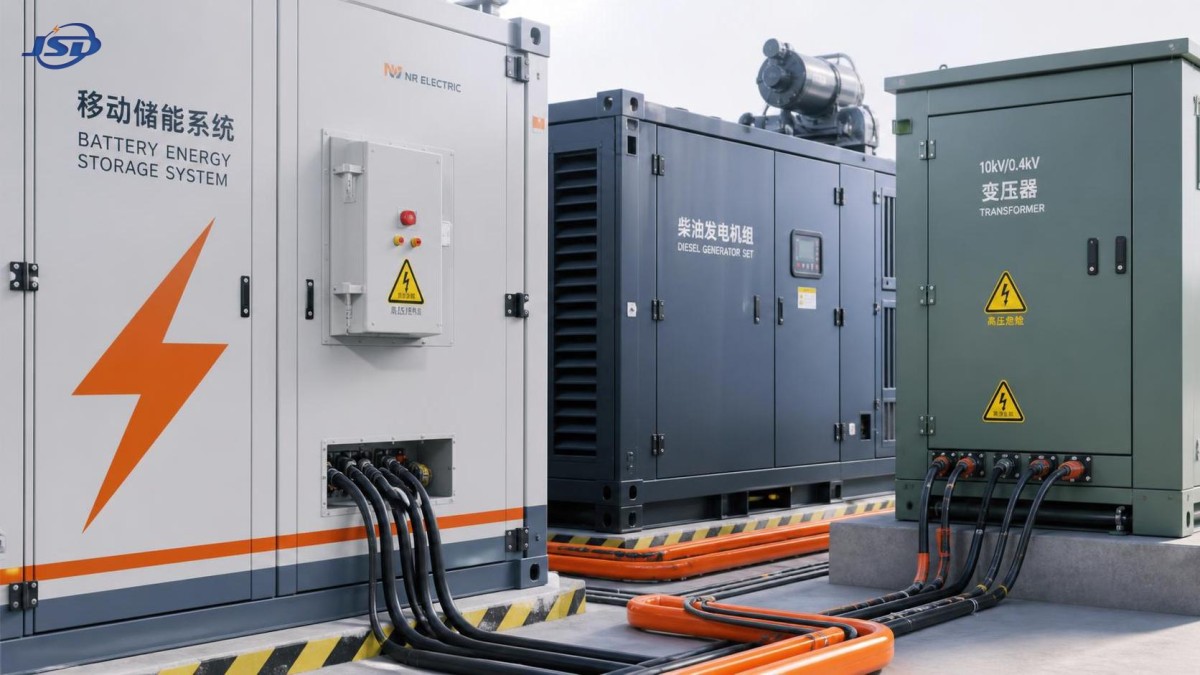
A mobile energy storage system changes that operating pattern. Instead of letting the generator chase every fluctuation in demand, the battery system can absorb low and medium loads for certain periods and respond instantly to short-duration peaks. The generator can then start only when needed, run for a shorter period, and charge the battery while supplying the base load. In simple terms, storage creates breathing room between the site’s power demand and the generator’s mechanical operating limits.
The clearest situations where storage cuts generator hours
Decision-makers usually benefit most when they stop thinking in terms of “battery versus generator” and start looking at specific load behavior. Several site conditions consistently favor reduced generator runtime.
1. When loads swing sharply during the day
Construction sites, mobile substations, temporary grid support stations, and industrial service areas often see uneven power use. A few hours may be busy with equipment startup, testing, or heavy machinery, while the rest of the day remains relatively quiet. Without storage, the generator may stay on continuously just to cover those unpredictable peaks. With a mobile energy storage system, the battery can cover light-load periods and respond to sudden demand surges, allowing the generator to stay off longer.
2. When peak demand is short, but generator sizing is driven by that peak
Sometimes a site needs a large generator not because average demand is high, but because a brief startup event or motor inrush requires extra capacity. That creates a familiar inefficiency: a large generator runs most of the time at a low load factor simply to be ready for occasional peaks. In this case, storage can supply the peak power event while a smaller or more selectively operated generator handles the average load. Runtime drops because the system no longer depends on a continuously running oversized unit.
3. When night loads or standby loads are modest
Sites with overnight lighting, communications equipment, monitoring systems, or security loads often keep generators running far longer than necessary. These loads may be too small to justify continuous generator operation, yet too critical to leave unpowered. A mobile energy storage system can carry those low-demand hours quietly and efficiently, especially where fuel logistics, neighborhood noise, or emissions restrictions affect operations.
4. When refueling is difficult or expensive
Remote projects and temporary infrastructure deployments often face fuel delivery constraints. Every additional generator hour increases not only direct fuel use but also transport complexity, on-site handling requirements, and operational risk. Storage reduces runtime by trimming unnecessary engine hours, which in turn lowers how often fuel must be moved, stored, and managed.
5. When power quality and continuity matter as much as fuel savings
Some decision-makers focus narrowly on diesel reduction and miss another reason storage can shorten runtime: system stability. Batteries can smooth fast load transitions, support voltage and frequency during abrupt changes, and maintain continuity during generator start-stop sequences. This means operators can shut generators down more confidently because power availability is not tied to every engine cycle.
How the hybrid operating logic works in practice
In a well-designed hybrid setup, the mobile energy storage system does not merely sit beside the generator as backup. It becomes an active control layer. During low-demand periods, the battery supplies the load. As the battery reaches a set threshold, the generator starts, runs near an efficient loading point, powers the site, and recharges the battery. Once charging is complete and demand falls again, the generator shuts down.
This operating method is often more effective than leaving a generator running continuously at partial load. The engine spends less time idling and more time operating in a more favorable range. For operations teams, that can translate into lower fuel use per delivered kilowatt-hour, fewer unnecessary maintenance hours, and less disruption around sensitive work zones.
In power distribution environments, this logic becomes even more valuable where temporary supply must be dependable. For example, when supporting field electrification, maintenance bypass work, or project-based distribution nodes, hybrid systems may be paired with broader equipment packages. In those scenarios, downstream equipment selection matters too. A distribution solution such as the American-Type Pad-Mounted Substation can be part of a more stable temporary or semi-permanent power arrangement, especially where safe load transfer and organized distribution are priorities.
When a mobile energy storage system may not reduce runtime very much
Not every site will see dramatic changes. If the load is steady, high, and continuous for most of the operating day, storage may improve resilience or quality, but generator runtime reduction could be limited. The same is true if battery capacity is too small relative to the site’s real demand pattern. In those cases, the battery may help with transient peaks while the generator still carries the bulk of daily energy needs.
Another common mistake is focusing only on total energy consumption instead of time-based load shape. Two sites can consume the same daily energy and still produce very different results. One may have long quiet periods that favor storage. The other may operate nearly flat around the clock, leaving little room to switch the generator off. Runtime reduction depends less on total consumption than on how that consumption rises and falls.
Questions decision-makers should ask before investing
A good purchasing decision usually starts with a few hard operational questions rather than a generic product comparison.
- How variable is the load during a normal day? Look for gaps between average load and peak load.
- How long do peak events last? Short peaks are often ideal for battery support.
- How often does the generator run below an efficient load level? Persistent low-load operation signals wasted runtime.
- Are there quiet hours, emissions limits, or refueling constraints? These increase the value of reducing engine hours.
- Is power continuity critical during switching or load transitions? Storage may justify itself through stability as much as fuel savings.
These questions matter in transformer and distribution-related projects because power supply is rarely judged by energy alone. Reliability, switching behavior, temporary deployment speed, and safety all influence the right system design. That is where an experienced power equipment partner becomes important. Jinshida Electric Power Technology Co., Ltd., with its focus on transmission and distribution equipment, technical development, and dependable power application support, operates in exactly the type of environment where hybrid power decisions need to be practical, not abstract.
Common misconceptions that lead to poor system design
One misconception is that bigger batteries automatically produce better economics. In reality, an oversized system can add cost without proportionate runtime reduction if the site does not have enough idle periods or peak-shaving opportunities. Another is that the generator becomes irrelevant once storage is introduced. On many commercial and industrial sites, the best answer is still a coordinated hybrid system, not a battery-only configuration.
There is also a tendency to treat storage as a portable accessory rather than a power strategy. That usually leads to underestimating integration needs: controls, switching, protection, load prioritization, and compatibility with site distribution equipment. If these elements are ignored, the battery may be technically present but operationally underused.
Where this approach is especially relevant in the transformer and power equipment sector
For companies involved in grid construction, infrastructure energization, industrial expansion, and new energy projects, mobile systems are often used in transitional stages: temporary supply during upgrades, backup during maintenance windows, remote commissioning, and power support before permanent energization is complete. In these settings, a mobile energy storage system reduces generator runtime not by changing the mission of the project, but by making temporary power smarter and less wasteful.
That can be particularly useful when mobile loads interact with field distribution assemblies, compact substation layouts, or staged installation plans. In some deployments, combining storage with distribution equipment such as the American-Type Pad-Mounted Substation helps create a more orderly and resilient temporary power architecture, especially where site mobility and electrical safety must coexist.
The business case is often operational, not just environmental
Yes, reduced fuel burn and emissions are part of the appeal. But for most enterprise buyers, the stronger argument is operational control. Fewer unnecessary engine hours can mean fewer service interruptions, less dependence on fuel delivery schedules, better compliance with noise-sensitive work conditions, and improved confidence in unstable or remote project environments.
So when does a mobile energy storage system reduce generator runtime? It does so when it is matched to real-world load behavior: variable demand, short peaks, low overnight loads, difficult refueling conditions, or situations where continuous generator operation is simply the bluntest and costliest tool available. For decision-makers, the key is not adopting storage because it is new. It is understanding whether your site has the right load profile for storage to take over the inefficient hours that generators handle poorly.
That is where better system thinking begins: not with a product in isolation, but with a clearer view of how power is actually used on the ground.

Get a Quote
Regardless of whether you require general advice or specific support, we are happy to help you.
Send Us Your Inquiry Today

Jinshida Electric remains committed to contributing to global energy development through professional manufacturing and superior service.