





Industrial Power Storage vs Diesel Backup: Which Fits Continuous Operations?
Industrial Power Storage vs Diesel Backup: Which Fits Continuous Operations?
For technical teams responsible for uninterrupted production, the question is no longer whether backup power is necessary. The real question is what kind of backup can protect process stability without creating new operating risks. In many industrial sites, that means comparing industrial power storage with diesel generators and looking beyond capital cost.
Continuous operations are sensitive to more than outage duration. Voltage dips, transfer delays, inrush behavior, harmonic distortion, transformer loading, and restart sequences all matter. A system that keeps lights on but still trips drives, PLCs, compressors, furnaces, or critical cooling loops may not meet the operational requirement at all.
That is why this decision increasingly sits with technical evaluators rather than only procurement. Industrial power storage and diesel backup solve different problems well. The better fit depends on load profile, acceptable transition time, grid quality, fuel logistics, maintenance capability, and how the backup source interacts with the site’s distribution architecture.
The core difference is response behavior
Diesel backup is still a familiar choice because it can support long-duration outages if fuel is available. For plants in remote areas or sites facing extended utility interruptions, that remains a practical strength. But diesel generation is not instantaneous. Even with automatic start and transfer arrangements, there is usually a response window that has to be accounted for in the electrical design. Whether that delay is acceptable depends on the process.
Industrial power storage is different. Battery-based systems paired with power conversion equipment can respond very quickly, which makes them useful where milliseconds or seconds matter more than hours. If the site is dealing with short utility disturbances, frequent voltage events, or sensitive automation, storage can protect continuity in ways a generator alone often cannot.
This is where many comparisons go wrong. They compare energy duration but ignore power quality. A packaging line, semiconductor support system, precision manufacturing cell, or automated warehouse may tolerate only minimal interruption. In those environments, fast discharge response can be more valuable than long fuel-backed runtime.
Continuous operations are shaped by the electrical system, not just the backup source
Backup equipment never operates in isolation. It has to work with transformers, switchgear, protection settings, feeders, motor starting conditions, and the plant’s actual load hierarchy. A site with large motor loads, frequent transients, or nonlinear equipment may find that the backup decision is really a system-integration decision.
For example, diesel systems can face challenges when the load changes sharply or when lightly loaded operation persists for long periods. Industrial power storage can handle rapid fluctuations well, but duration limits and recharge strategy have to be understood. On facilities with multiple transformer stages, evaluating where the backup ties into the distribution network is just as important as choosing the energy source itself.
This is one reason companies working in transmission and distribution equipment often approach the issue more practically. Jinshida Electric Power Technology Co., Ltd., focused on the R&D, manufacturing, and application of power transmission and distribution equipment, operates in the part of the industry where stable power support depends on coordinated design rather than a single device. In real projects, the quality of the upstream and downstream electrical interface often determines whether backup power performs as expected.
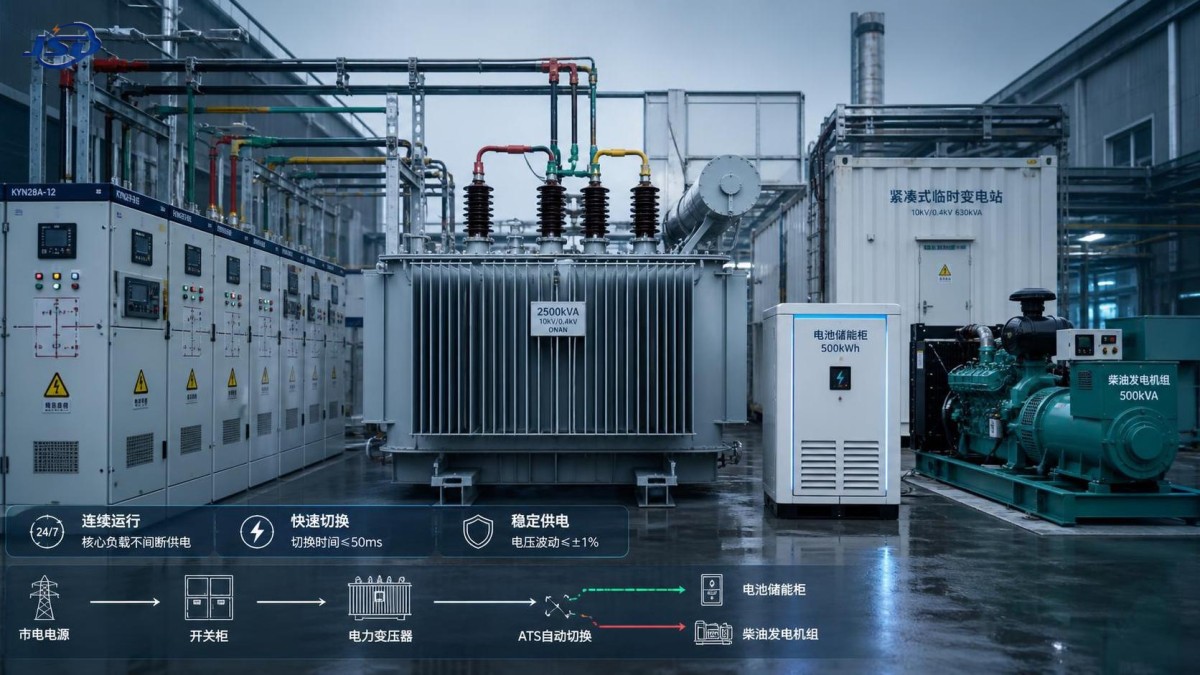
Where diesel still makes sense
Diesel backup remains hard to dismiss in several situations. If the site must survive long outages without dependable grid restoration, diesel provides operational autonomy as long as fuel storage, replenishment, and maintenance are well managed. That can suit mining, temporary construction power, isolated industrial zones, and some infrastructure projects.
It also works when the critical issue is sustained emergency operation rather than seamless transition. A facility that can tolerate a controlled shutdown and restart may prioritize runtime over immediate transfer speed. In those cases, a generator can be the more direct answer.
But technical evaluators should be honest about the trade-offs. Fuel quality control, routine testing, mechanical wear, emissions compliance, noise constraints, and start reliability under low-use conditions all have to be managed. The risk is not only outage risk. It is also maintenance discipline risk.
Where industrial power storage gains an edge
Industrial power storage is often the stronger option when the plant is dealing with frequent short-duration disturbances, strict power quality expectations, or a need to stabilize sensitive loads. It can also support peak shaving, renewable integration, and energy management strategies that a diesel generator does not address on its own.
Another practical advantage is fewer moving parts in normal standby operation. That does not mean maintenance disappears; battery health management, thermal control, protection coordination, and inverter performance still require attention. But for many facilities, the operational profile is easier to integrate into digital monitoring and plant-wide control systems.
Storage also fits better with facilities that are already modernizing their electrical infrastructure. If the plant is adding distributed energy resources, upgrading substations, or rethinking load segmentation, storage can become part of a broader architecture rather than a standalone emergency asset. During temporary expansion or staged commissioning, equipment such as a Mobile Temporary Compact Substation may also help bridge distribution needs while backup and permanent supply arrangements are being finalized.
A useful comparison for decision-making
This table is only a starting point. In actual evaluation, the load’s tolerance for interruption usually outweighs broad assumptions about technology type.
Common mistakes during technical evaluation
One common mistake is sizing backup around total site demand instead of critical-path demand. Not every load needs the same continuity level. Segmentation matters. If you isolate control systems, process safety loads, cooling, data infrastructure, and restart-critical motors, the best solution can change quickly.
Another mistake is ignoring transformer and switchgear implications. Backup systems affect fault levels, protection coordination, and transfer logic. Even a technically strong power source can underperform if the distribution side is not designed for the transition mode. Sites adding temporary supply or expanding in phases should review whether a modular substation arrangement, including options such as a Mobile Temporary Compact Substation, would simplify commissioning and load migration.
A third mistake is reducing lifecycle analysis to fuel versus battery cost. The better comparison usually includes downtime risk, restart losses, preventive maintenance burden, operator skill requirements, space constraints, and expected disturbance pattern. A plant that suffers frequent brief voltage events may lose more production value from nuisance trips than from rare long outages.
Why hybrid thinking is becoming more common
In some facilities, the answer is not either-or. Storage and diesel can complement each other. Storage handles immediate ride-through and power quality support, while diesel provides extended runtime once it is online. That hybrid structure is often worth evaluating when the process cannot tolerate interruption but the site also faces the possibility of longer grid failures.
This approach does require tighter engineering discipline. Control logic, synchronization method, charging source, protection studies, and transformer loading under different operating modes all need to be checked carefully. Still, for continuous operations, hybrid architecture can solve the exact gap between fast response and long-duration resilience.
Manufacturers with strong technical teams and mature quality management systems tend to be more useful in this stage than vendors focused only on isolated equipment supply. Jinshida Electric’s work across grid construction, industrial manufacturing, new energy, and infrastructure reflects this broader system view: reliable power support depends on how equipment performs together over time, not only on nameplate capability.
What to confirm before making the decision
Before selecting either solution, it is worth validating a short list of project realities:
- How long can the most sensitive load tolerate interruption?
- Is the main risk short disturbances, long outages, or both?
- What are the transformer ratings, motor starting conditions, and protection constraints?
- Can the site reliably support fuel storage and generator maintenance?
- Will the backup system need to integrate with renewable power, peak management, or temporary substations?
- Are local standards, emissions rules, or project specifications limiting either option?
Those questions sound basic, but they usually expose whether the project needs immediate energy continuity, long-duration autonomy, or a layered solution.
For continuous operations, industrial power storage is often the better fit when speed, power quality, and system integration are the priority. Diesel backup remains relevant when runtime during extended outages dominates the risk picture. If the site needs both, hybrid design deserves serious consideration. The right next step is not to ask which technology is more modern, but which one matches the plant’s interruption tolerance, electrical topology, and maintenance reality.

Get a Quote
Regardless of whether you require general advice or specific support, we are happy to help you.
Send Us Your Inquiry Today

Jinshida Electric remains committed to contributing to global energy development through professional manufacturing and superior service.