





How to compare diesel genset manufacturers beyond unit price
When procurement teams compare diesel genset manufacturers, the first quote often gets more attention than it deserves. Unit price is easy to compare, easy to report internally, and easy to use as a negotiation anchor. But in real projects, the cheapest genset on paper can become the most expensive option once fuel efficiency, maintenance intervals, commissioning support, spare parts access, emissions compliance, and downtime risk start to show up. For buyers responsible for continuity, the question is not simply “Who is cheaper?” but “Which supplier creates the lowest operational and project risk over the life of this asset?”
That distinction matters even more in sectors where gensets are tied to broader power distribution systems rather than used as isolated machines. Industrial plants, infrastructure sites, utility support projects, and temporary power deployments usually need a supplier that can fit the genset into a larger electrical environment. In those cases, comparing diesel genset manufacturers purely on equipment price misses the real procurement job.
Start with the operating scenario, not the catalog
A common procurement mistake is to compare suppliers before clearly defining the duty profile. A standby generator for occasional emergency backup should not be evaluated the same way as a prime power unit for remote operations or a load-sensitive generator supporting construction, mining, or temporary grid applications.
Before you compare offers, clarify a few things internally:
- Will the unit run mainly for standby, prime, or continuous duty?
- What load pattern is expected: stable, cyclical, low-load, or high inrush?
- What are the site conditions: temperature, altitude, dust, humidity, transport limitations, noise limits?
- How important are fast delivery, containerization, mobility, and ease of installation?
- Will the genset operate independently or as part of a wider substation or distribution arrangement?
Manufacturers can look equally qualified until these conditions are made explicit. Once they are, differences become easier to spot. One supplier may be strong in standard industrial backup packages, another in harsh-environment engineering, and another in custom control integration. Price only becomes meaningful after technical fit is established.
Look beyond engine brand name
Many buyers use engine brand as a shortcut for quality. That is understandable, but incomplete. A diesel genset is not just an engine. The alternator, controller, canopy, fuel system, cooling design, protection logic, wiring quality, and factory integration discipline all affect field performance.
Two manufacturers may use the same engine brand and still deliver very different results in reliability and maintainability. The stronger supplier usually shows better consistency in the details that are harder to see in a quotation sheet: cable routing, vibration isolation, accessibility for service, load acceptance behavior, enclosure durability, and documentation quality.
When reviewing offers, ask for the exact bill-of-materials level configuration rather than accepting a broad brand-based description. “Powered by a known engine” does not tell you enough about the full system you are buying.
Lifecycle cost usually outweighs the purchase discount
Procurement teams under budget pressure often need to justify why a higher initial price may still be the stronger commercial choice. The cleanest way to do that is to compare lifecycle cost rather than unit price alone.
In practical terms, that means looking at:
- Fuel consumption across likely load bands, not only at one ideal test point
- Scheduled maintenance intervals and routine consumables cost
- Expected availability of filters, belts, sensors, controllers, and alternator parts
- Lead time for critical replacement components
- Commissioning and training support
- Downtime exposure if the unit fails or trips unexpectedly
A lower-priced machine with weaker service access can quickly lose its cost advantage, especially where downtime disrupts production, contractual delivery, or site safety. For many buyers, the real risk is not overspending on capex but underestimating the cost of interruptions.
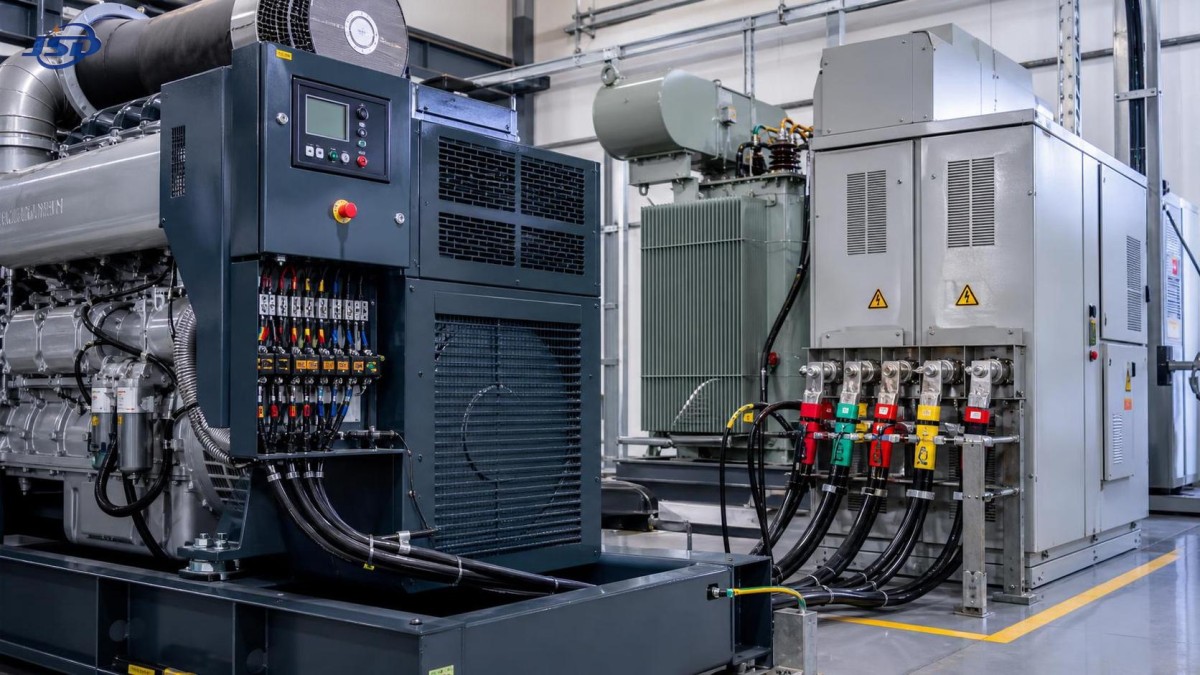
That same thinking applies when temporary or transitional power has to connect with medium- or low-voltage distribution assets. In some project environments, buyers may evaluate gensets alongside compact distribution solutions such as Mobile Temporary Compact Substation units to reduce installation time and simplify deployment logic. The point is not that these products replace gensets, but that procurement decisions improve when power supply equipment is assessed as a system rather than as isolated line items.
Compliance should be verified, not assumed
Compliance claims in this market are often presented too casually. Buyers should verify what standards actually apply to their project and market, then confirm whether the manufacturer can document compliance at unit level.
Depending on destination and use case, relevant requirements may involve emissions, noise, electrical safety, protection settings, enclosure ratings, factory testing, and local grid or project-owner specifications. Some suppliers are comfortable listing broad certifications in marketing materials, but the procurement question is more specific: what documents will be delivered for this exact configuration, and are they accepted in the target country or by the end customer?
If a supplier cannot answer that directly, the risk is not theoretical. It can surface later as customs delays, failed inspections, site rework, or commissioning disputes. For export projects, even small documentation gaps can turn into expensive timeline problems.
Manufacturing capability matters more than presentation quality
Well-designed brochures and responsive sales teams can create confidence early in the buying process, but manufacturing depth is what determines repeatable quality. Buyers should try to understand whether the supplier is mainly assembling standard sets from purchased components or whether it has a mature production and quality-control system behind the product.
Useful questions include:
- What tests are performed before shipment: load test, insulation test, control function test, protection verification?
- Can the factory provide test records for the ordered unit?
- How are incoming components inspected and traced?
- What is the process for nonconformity handling?
- How much of the enclosure, control integration, and electrical assembly is controlled in-house?
For procurement teams, this is often where stronger manufacturers separate themselves from low-price competitors. Reliable delivery quality is rarely just a product feature; it is usually a manufacturing discipline.
Delivery capability is part of the technical offer
In urgent projects, buyers sometimes treat lead time as a commercial issue and technical suitability as a separate one. In practice, they are closely linked. A manufacturer that promises aggressive delivery but depends on unstable engine allocation, outsourced panel integration, or inconsistent testing capacity may create more schedule risk than a supplier with a slightly longer but more credible timeline.
Ask for a delivery breakdown, not just a shipment date. Understand which parts are standard stock, which are custom-built, which components are long-lead, and what factory bottlenecks could affect dispatch. If the project is phased, it may also be worth asking whether the supplier can support partial delivery, pre-assembly, or modular packaging to match site readiness.
This is especially relevant for infrastructure and temporary power projects, where civil works, switchgear readiness, and energization milestones do not always move on the same schedule.
After-sales support should be examined before the PO is issued
Many procurement teams only realize the value of after-sales support when something goes wrong. By then, leverage is limited. A stronger comparison process checks service capability early.
Important points to clarify include response time, technical support channels, spare parts stocking strategy, remote diagnostics capability, and whether the manufacturer can support commissioning on site or through local partners. If the project is overseas, language capability and documentation clarity also matter more than many buyers expect.
One practical test is to ask technical questions that require cross-functional answers. A capable manufacturer will respond with coordinated input from sales, engineering, and service teams. A weaker one will often provide vague assurances or simply repeat brochure language.
Compare supplier behavior during bidding, not just their final numbers
The bidding stage itself reveals useful signals. Manufacturers that ask detailed application questions are often easier to work with later because they are trying to reduce mismatch risk from the start. Suppliers that quote quickly without clarifying load profile, ambient conditions, control interface needs, or compliance destination may appear efficient, but they may also be pricing assumptions that fail on site.
Pay attention to how each bidder handles exceptions and ambiguities. Do they flag technical risks? Do they define exclusions clearly? Do they explain optional items like ATS integration, synchronization, weatherproofing, attenuation, remote monitoring, or fuel tank sizing? Serious suppliers tend to expose complexity rather than hide it.
That is usually a good sign for procurement. It means fewer surprises after award.
A simple comparison table can prevent expensive mistakes
For internal alignment, it helps to score suppliers against a broader set of criteria. The goal is not to turn procurement into a spreadsheet exercise, but to stop unit price from overwhelming everything else.
This kind of structure is useful when multiple departments are involved. Procurement may focus on commercial control, engineering on performance, and operations on maintainability. A clearer framework helps those priorities meet in one decision.
Be cautious with claims that sound absolute
In this market, several common claims deserve scrutiny.
- “Lowest price means best value.” Only if service, performance, and reliability risks are equivalent, which they often are not.
- “A famous engine brand guarantees a good genset.” It improves confidence, but integration quality still determines field results.
- “All certifications are basically the same.” They are not. Market acceptance and project compliance can vary significantly.【待核实】
- “Standard units are always faster and cheaper.” Sometimes true, but site adaptation costs can erase the apparent saving.
- “Warranty length tells you everything.” Warranty wording, exclusions, response process, and parts availability matter just as much.
Procurement decisions tend to go wrong when these shortcuts replace application-level judgment.
What stronger buyers do differently
The more experienced procurement teams usually approach diesel genset manufacturers in a way that looks less like price shopping and more like risk screening. They define the operating scenario clearly, ask for configuration-level detail, verify compliance evidence, compare lifecycle cost, and test the supplier’s responsiveness before award.
They also recognize when the genset is only one part of a wider power solution. In projects involving temporary expansion, industrial distribution, or fast-track site energization, adjacent equipment choices can change what “best value” really means. A supplier that understands the interface between generation and distribution may be more useful than one that only offers a lower standalone machine price.
That is usually the real procurement question behind searches for diesel genset manufacturers: not who can quote fastest, but who can deliver dependable power performance with manageable cost and fewer unpleasant surprises after the contract is signed.

Get a Quote
Regardless of whether you require general advice or specific support, we are happy to help you.
Send Us Your Inquiry Today

Jinshida Electric remains committed to contributing to global energy development through professional manufacturing and superior service.