





What separates reliable diesel generator manufacturers from trading companies
When comparing diesel generator manufacturers, business evaluators need to look beyond catalogs and pricing. A polished quotation sheet can be produced by almost anyone. What is harder to fake is engineering depth, production discipline, traceable quality control, and the ability to support equipment long after shipment. In critical power projects, the distinction between a real manufacturer and a trading company is not a small commercial detail. It can shape installation schedules, maintenance costs, compliance risk, and ultimately whether the power system performs when failure is not an option.
For procurement teams, EPC contractors, and technical decision-makers, this question usually appears at an uncomfortable moment: when several suppliers seem equally convincing on paper. Lead times look similar. Product photos look similar. Even specifications may appear copied line by line. Yet the operational risk behind each option can be very different.
A reliable supplier is rarely defined by the lowest price. More often, it is defined by how well it controls the parts of the process that buyers cannot easily see.
Why the manufacturer-versus-trader question matters more than many buyers expect
In industrial power procurement, the cost of a wrong decision extends far beyond the purchase order. If a supplier has limited technical ownership of the generator set, delays can emerge during drawing confirmation, customization, testing, packaging, commissioning, or after-sales troubleshooting. A trading company may still be useful in some sourcing situations, especially when buyers need multi-brand access or local coordination. But if the project requires stable performance, configuration accuracy, and long-term service accountability, working with actual diesel generator manufacturers usually reduces uncertainty.
This becomes even more important in projects connected to broader power systems. A diesel generator often operates alongside switchgear, transformers, substations, distribution panels, or backup integration schemes. In these environments, a supplier must understand not just the engine and alternator, but how the unit behaves within a complete electrical architecture.
The clearest signs of a true diesel generator manufacturer
A real manufacturer typically shows its strengths in ways that go beyond sales language. One of the first signals is technical conversation. If you ask about control logic, load characteristics, alternator matching, enclosure design, cooling performance, or synchronization options, a manufacturer can usually answer with engineering clarity. A trader, by contrast, often needs to “check with the factory” for even moderate technical questions.
Another sign is document ownership. Reliable diesel generator manufacturers usually provide or revise general arrangement drawings, wiring diagrams, test records, component lists, and configuration details with confidence. They understand what can be customized and what should not be changed. That level of control matters when the generator is intended for telecom, mining, hospitals, industrial production, infrastructure sites, or utility support.
Production visibility also matters. Manufacturers can normally explain how frames are fabricated, how assemblies are integrated, how acoustic canopies are built, how testing is conducted, and where key inspections occur. They do not just sell equipment; they can describe how it is made and why those steps influence reliability.
What trading companies often do well—and where the limitations begin
It would be simplistic to say all trading companies are unsuitable. Some are responsive, commercially flexible, and experienced in export coordination. They may help buyers compare brands or consolidate different product categories into one shipment. For straightforward, low-risk purchases, that may be enough.
The problem arises when the project becomes technically demanding. Trading firms usually do not control production schedules, component substitutions, or factory-level corrective actions. If a discrepancy is found during factory acceptance, the buyer may discover that the party issuing the quote is not the party capable of solving the problem. Accountability gets diluted, and communication takes longer exactly when speed matters most.
For evaluators, this is the key distinction: a trader manages transactions; a manufacturer manages outcomes.
Quality control is where the difference becomes real
Many buyers ask for certificates. Fewer ask how quality is actually built into the process. Yet this is where reliable diesel generator manufacturers separate themselves most clearly.
A capable manufacturer has defined inspection points for incoming materials, assembly stages, electrical integration, load testing, and final release. It should be able to explain how critical components are checked, how nonconforming items are handled, and how product consistency is maintained across batches. Even if the generator uses well-known engines and alternators, final system reliability depends heavily on assembly discipline, cabling quality, cooling layout, vibration control, and control panel integration.
Ask simple but revealing questions: Who verifies wiring before testing? How is test data recorded? What happens if a component from a supplier fails inspection? Can the factory support witness testing? These questions often reveal more than a marketing brochure ever will.
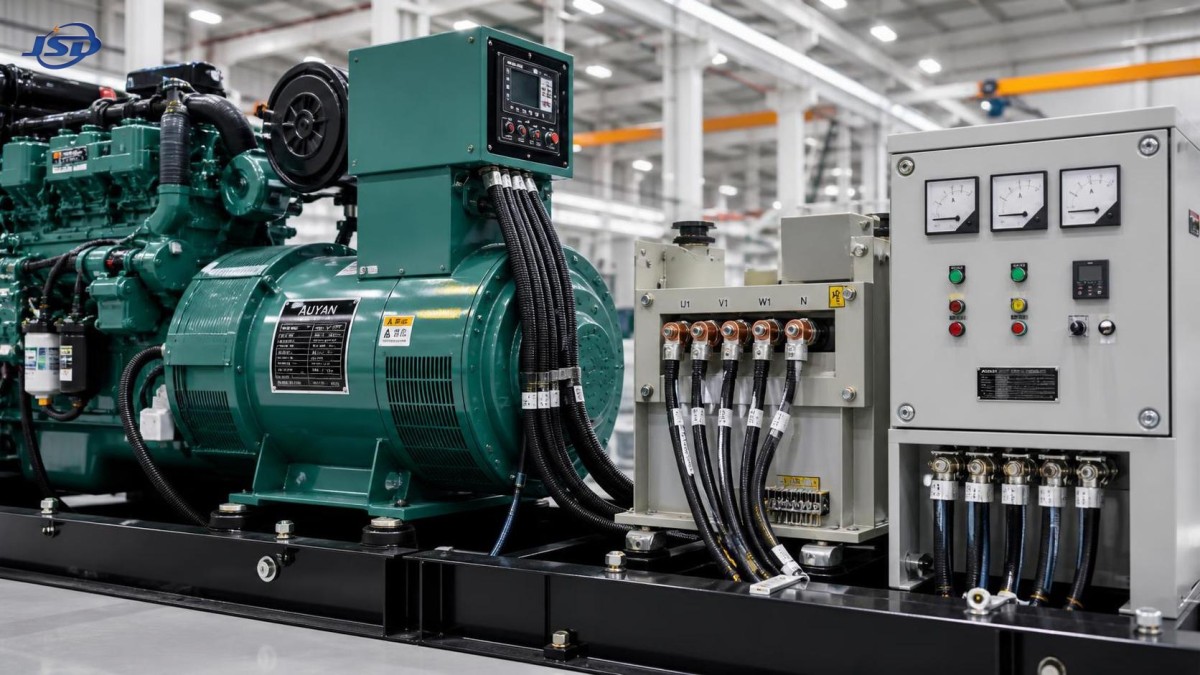
Factory capability tells you whether customization is real or only promised
One common trap in procurement is assuming every supplier offering “custom solutions” can truly deliver them. In practice, reliable customization requires engineering resources, process control, and experience across related power equipment.
For example, businesses operating in power transmission and distribution already understand that electrical products rarely perform in isolation. A company involved in broader power equipment manufacturing tends to view generator integration more systemically: matching voltage requirements, protection settings, site distribution conditions, and infrastructure constraints rather than just shipping a standalone unit.
This system-level mindset is also visible in adjacent equipment categories. In medium-voltage distribution environments, for instance, products such as the American-Type Pad-Mounted Substation show how enclosure design, safety, compact installation, and distribution compatibility all need to work together in field conditions. That same thinking is valuable when evaluating generator suppliers, because backup power reliability depends on how equipment interfaces across the broader network, not merely on engine nameplates.
Engineering support before the order is often a preview of service after delivery
Business evaluators often focus heavily on unit price and delivery time, but the pre-sales stage can tell you a great deal about future support. If a supplier asks meaningful questions about altitude, ambient temperature, fuel conditions, load type, starting method, harmonics, site space, or noise restrictions, that is usually a good sign. It suggests the supplier is trying to fit the generator to the application rather than forcing a standard package into every scenario.
Reliable diesel generator manufacturers also tend to be clearer about limitations. They will point out where certain options affect maintenance access, where oversizing may reduce efficiency, or where project assumptions need correction. This honesty can feel less convenient during bidding, but it usually prevents far more expensive problems later.
By contrast, if every request receives an immediate “yes” without technical discussion, buyers should be cautious. Easy promises in the proposal phase often become difficult explanations during commissioning.
How to verify whether a supplier is truly a manufacturer
You do not need a full audit team to improve supplier verification. A structured review process can reveal a lot.
- Request factory-specific materials. Ask for production photos, workshop overviews, testing areas, and sample inspection records—not just polished catalog images.
- Review technical response quality. Note whether answers come quickly because the supplier understands the product, or slowly because every question is relayed elsewhere.
- Check drawing capability. Manufacturers usually provide detailed and editable documentation suited to the project.
- Ask about component sourcing logic. Good suppliers can explain which parts are standardized, which can be substituted, and which should remain fixed for performance reasons.
- Discuss testing in practical terms. Instead of asking only whether testing is done, ask what is tested, how results are recorded, and whether witness inspection is possible.
- Evaluate after-sales structure. Who handles troubleshooting? Who owns spare parts coordination? Who is responsible if field parameters need adjustment?
Even video factory reviews can be useful when an in-person visit is not possible. The goal is not perfection. The goal is to reduce blind spots.
The hidden risks behind price-driven selection
Low quotes can be attractive, especially under budget pressure. But pricing gaps are not always created by better sourcing efficiency. Sometimes they come from lighter enclosures, lower assembly standards, less testing, weaker control systems, unclear component origin, or limited after-sales responsibility. These issues may not appear during initial inspection. They usually emerge later, when the generator is loaded, transported, exposed to weather, or expected to start under emergency conditions.
For procurement professionals, the most expensive generator is often not the one with the highest purchase price. It is the one that causes rework, delay, downtime, or repeated service intervention.
Why long-term service capacity matters as much as initial manufacturing strength
A generator purchase is not finished when the unit leaves the factory. It enters a service lifecycle involving commissioning, operation, maintenance planning, spare parts replacement, and occasional fault diagnosis. Manufacturers with strong technical teams and disciplined quality systems usually perform better here because they understand their own build logic. They can trace configurations, advise on component compatibility, and support field teams more effectively.
This matters especially for international buyers. Export packaging, documentation completeness, installation guidance, and communication speed all influence whether a project runs smoothly. A supplier that combines manufacturing capability with responsive service creates a very different ownership experience from one that simply brokers a shipment.
A practical decision framework for business evaluators
If you are narrowing down supplier options, it helps to rate them against four areas rather than one headline price:
- Technical ownership: Can the supplier explain the product in detail and adapt it to the project?
- Production control: Does the supplier actually manage fabrication, assembly, and testing?
- Quality assurance: Is there evidence of process-based inspection rather than vague claims?
- Lifecycle support: Will the supplier still be effective when the project moves from procurement to operation?
Suppliers that score well across all four categories are usually the safer choice for critical power applications. This is particularly true where generators interact with substations, distribution systems, industrial facilities, or infrastructure projects that cannot tolerate avoidable power risk.
Final thought
The difference between reliable diesel generator manufacturers and trading companies is not just about business identity. It is about control, responsibility, and technical depth. A true manufacturer brings visibility into how the product is engineered, built, tested, and supported. A trading company may offer convenience, but it often cannot provide the same level of certainty when projects become complex.
For business evaluators, the smartest decision is usually the one that uncovers what sits behind the quotation. Once you understand who really owns the design, the production process, the quality checks, and the service commitment, the supplier comparison becomes much clearer—and far less risky.

Get a Quote
Regardless of whether you require general advice or specific support, we are happy to help you.
Send Us Your Inquiry Today

Jinshida Electric remains committed to contributing to global energy development through professional manufacturing and superior service.