





What defines a reliable silent diesel generator manufacturer?
For business evaluators, choosing a silent diesel generator manufacturer is rarely a matter of comparing a few catalog noise figures and selecting the lowest quotation. The generator may be intended to support a factory during grid outages, protect a data-sensitive commercial facility, serve a construction site near residential areas, or provide emergency power for public infrastructure. In each case, the buying decision carries operational, financial, and sometimes safety consequences.
A quiet enclosure is important, but silence alone does not define reliability. The real question is whether the manufacturer can deliver stable power under actual operating conditions, document how the set is built and tested, support the project after delivery, and help the buyer avoid expensive surprises over the equipment’s working life.
Reliability starts with the application, not the brochure
Before evaluating suppliers, a procurement team should clarify what “reliable” means for the specific project. A standby generator for a commercial building operates differently from a prime-power unit at a remote industrial site. A generator used only during occasional outages may prioritize fast automatic transfer and low maintenance burden. A unit expected to run for extended hours must be assessed for fuel efficiency, cooling capacity, engine loading, service intervals, and parts availability.
Noise requirements also need context. A manufacturer may quote a sound level measured at a defined distance, with a particular load condition, in an open-field test environment. That number is useful, but it does not automatically predict the sound experienced at a site boundary, inside a plant room, or beside reflective concrete walls. Evaluators should ask how the acoustic performance was measured, what enclosure configuration was used, and whether accessories such as exhaust silencers, ventilation ducts, or external fuel tanks will affect the final result.
A dependable supplier will not treat these questions as obstacles. It will ask for operating hours, altitude, ambient temperature, fuel quality, load profile, starting loads, local emission expectations, and installation constraints. That early technical dialogue is often a better indicator of manufacturer capability than a polished sales presentation.
What separates a capable silent diesel generator manufacturer from an assembler?
Many suppliers can source an engine, alternator, controller, and steel canopy. The distinction lies in how these components are engineered into a complete power system. A reliable silent diesel generator manufacturer should have control over the integration process: structural design, vibration isolation, airflow management, wiring layout, protection logic, surface treatment, testing, and final inspection.
Consider the acoustic enclosure. Its job is not simply to contain sound. It must reduce noise while still allowing sufficient intake air, exhaust flow, and heat dissipation. Poorly designed attenuation can create excessive back pressure or high internal temperatures, reducing engine performance and component life. Likewise, an enclosure that looks robust but has weak door seals, inadequate panel stiffness, or poorly protected fasteners may quickly become noisy and difficult to maintain in outdoor service.
The same principle applies to the electrical system. Reliable output depends on correct alternator sizing, voltage regulation, cable routing, grounding provisions, breaker selection, and control-panel configuration. Buyers should look for evidence that the manufacturer understands transient loads—not only rated kilowatts. Motors, pumps, compressors, cranes, and certain industrial processes can create significant starting currents. If the generating set is chosen only by nominal load, voltage dips and nuisance trips may follow.
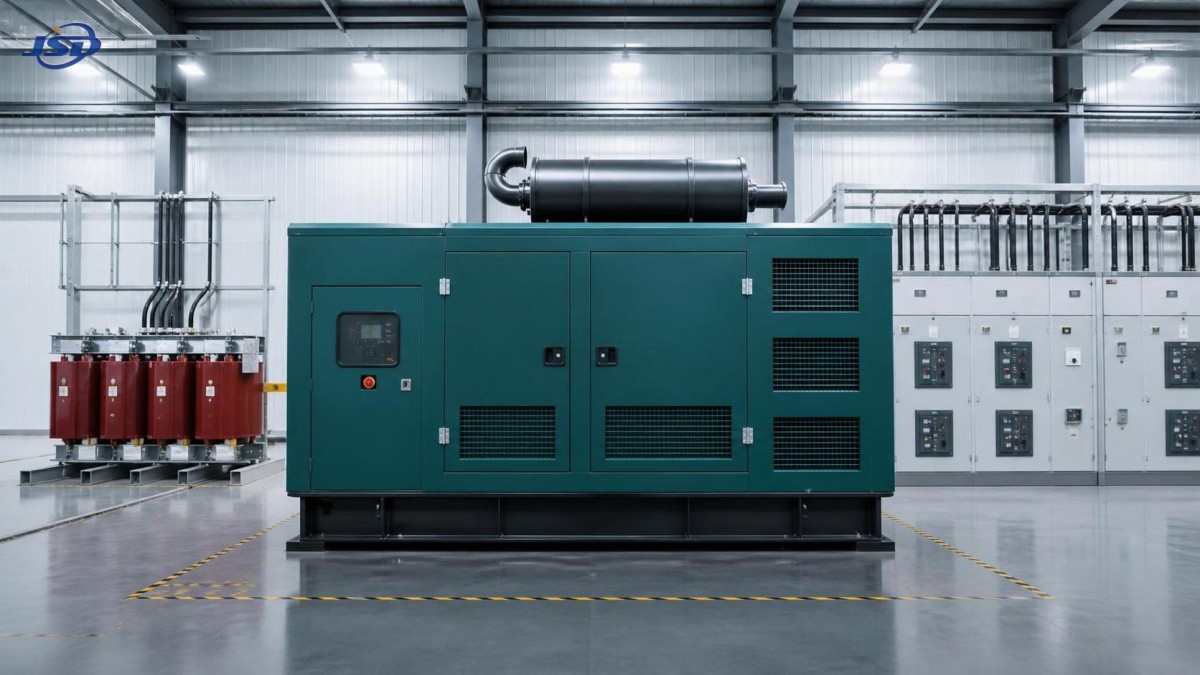
Factory quality control should be visible and traceable
Procurement decisions become safer when quality claims can be verified. Ask a manufacturer to explain its inspection path from incoming materials to dispatch. The answer should cover more than a final start-up test.
- Incoming inspection: Are engines, alternators, controllers, breakers, acoustic materials, and fabricated parts checked against approved specifications?
- Fabrication control: How are welding quality, enclosure alignment, corrosion protection, and paint thickness managed?
- Electrical assembly checks: Are harnesses labeled, terminals torqued, insulation tested, and protection settings recorded?
- Load testing: Is each completed generator tested under meaningful load conditions, with voltage, frequency, oil pressure, temperature, and alarms verified?
- Documentation: Will the buyer receive test records, wiring diagrams, manuals, component lists, and commissioning guidance?
A manufacturer does not need to reveal confidential internal methods to answer these questions clearly. What matters is whether its process is disciplined, repeatable, and supported by records. Vague statements such as “every unit is strictly tested” offer little procurement value unless the supplier can identify the test scope and acceptance criteria.
Quality management is especially important when multiple generator sets are required. Consistency across a batch affects installation, spare-parts planning, operator training, and future expansion. A well-managed manufacturer controls revisions so that a control panel, enclosure, or wiring arrangement does not change unexpectedly between deliveries.
Evaluate total operating cost, not only the purchase price
The lowest initial offer can become the most expensive choice if it leads to oversized fuel consumption, frequent downtime, difficult maintenance access, or unavailable replacement parts. For commercial evaluators, the practical cost comparison should include capital expenditure and the predictable costs that follow.
Fuel consumption deserves close attention, particularly for prime or long-duration standby applications. Request fuel-use data at several load points rather than relying on a single full-load figure. Diesel generators often operate below their nameplate capacity, and prolonged light loading can create operational concerns. The supplier should be able to recommend a suitable rating and discuss the likely duty cycle honestly.
Maintenance access is another overlooked cost driver. Can filters, batteries, radiators, belts, and control components be reached without removing major panels? Are service doors large enough for technicians to work safely? Is there a clear plan for oil drainage and routine inspection? These details may seem minor during bid comparison, but they influence labor time throughout the equipment lifecycle.
Buyers should also assess the availability of consumables and critical spares. A manufacturer with a defined supply chain, documented component models, and a responsive service structure is usually easier to support than one that offers an attractive unit price but cannot identify lead times for replacement controllers, sensors, breakers, or acoustic enclosure parts.
Noise performance needs a system-level review
“Silent” is a market term, not a universal guarantee of a specific sound level. The right approach is to define an acoustic target for the project and make it part of the technical agreement. This target may include the measurement distance, generator load, ambient conditions, and whether the exhaust system is included.
In dense urban projects, sound may travel through ventilation openings, rooftop structures, or adjoining walls. On industrial sites, the concern may be worker exposure rather than neighborhood disturbance. A knowledgeable manufacturer can recommend combinations of weatherproof canopy design, acoustic lining, inlet and outlet attenuation, exhaust silencing, vibration mounts, and installation measures. The generator set and the installation environment should be treated as one acoustic system.
It is also worth asking whether sound reduction has compromised serviceability. An enclosure packed with insulation but poorly ventilated is not a durable solution. The goal is balanced engineering: lower noise, safe operating temperature, weather protection, access for maintenance, and reliable airflow.
Power generation must fit the wider electrical architecture
A diesel generator does not operate in isolation. It interacts with automatic transfer switches, switchboards, protection devices, distribution transformers, power factor correction equipment, and the loads it serves. A manufacturer that understands this wider picture can reduce commissioning risk and help prevent incompatibilities between the generator and downstream equipment.
For example, industrial and infrastructure projects may require coordination between standby generation and medium-voltage or low-voltage distribution. Where a project uses dry-type distribution equipment, procurement teams may also review solutions such as the 20kV Three-Phase Cast Resin Dry-Type Distribution Transformer. This type of transformer can serve rural grids, industrial facilities, commercial sites, new-energy installations, and public facilities where fire performance, compact installation, and reduced maintenance are important considerations.
Its relevance to generator procurement is not that one product replaces the other, but that both must be specified as part of a coordinated power system. Voltage levels, transformer inrush, protection coordination, earthing arrangements, and the sequence of generator loading all deserve engineering review. A supplier with experience in power transmission and distribution applications is more likely to recognize these interface issues before they become site problems.
Service capability is proven before an emergency occurs
When a generator fails during an outage, the buyer does not need a general contact form; they need informed technical support, accurate documentation, and access to the correct part. This makes after-sales capability a core element of manufacturer reliability rather than an optional add-on.
During evaluation, ask practical questions: Who provides commissioning support? Is remote troubleshooting available? What warranty boundaries apply to the engine, alternator, controller, and enclosure? How are warranty claims assessed? Can the supplier provide recommended preventive-maintenance schedules and operator training? A credible answer will be specific without making unrealistic promises.
For overseas projects, communication and export readiness matter as much as technical knowledge. Clear packing methods, shipment documentation, installation manuals in the required language, and responsive coordination can prevent delays that are otherwise attributed to “equipment problems.”
A useful bid-review method for procurement teams
Rather than scoring quotations mainly by price and rated capacity, create a weighted review sheet that reflects project risk. Technical fit should cover duty rating, load acceptance, environmental conditions, acoustic target, controls, and protection. Manufacturing confidence should cover factory process, test evidence, component traceability, and documentation. Commercial assessment should include delivery terms, spare-parts planning, warranty clarity, and lifecycle cost.
It is often helpful to identify the assumptions behind each bid. Has one supplier included an upgraded alternator for motor starting while another has not? Does one quotation include a fuel tank, battery charger, automatic transfer interface, or enhanced corrosion protection? Are sound figures stated under the same conditions? A lower price may simply reflect a narrower scope.
Requesting a technical clarification meeting before award is usually worthwhile for larger or critical projects. The purpose is not to pressure suppliers into generic assurances; it is to confirm that everyone is working from the same operational expectations.
Choosing a long-term power partner
A reliable silent diesel generator manufacturer combines disciplined production with an understanding of how power equipment performs in the field. It listens carefully to site requirements, engineers around real constraints, verifies each unit through documented inspection and testing, and remains available when the equipment enters service.
For buyers evaluating industrial, grid-related, infrastructure, or new-energy projects, this broader perspective is essential. Jinshida Electric Power Technology Co., Ltd. approaches power equipment through the connected needs of transmission, distribution, operational safety, energy efficiency, and long-term support. Backed by technical expertise, advanced manufacturing processes, and rigorous quality management, the company focuses on delivering dependable power solutions suited to demanding applications.
In the end, the strongest procurement decision is not based on the quietest claim or the cheapest line item. It is based on evidence: sound engineering, transparent testing, appropriate electrical integration, maintainable design, and a manufacturer prepared to stand behind the system long after it leaves the factory.

Get a Quote
Regardless of whether you require general advice or specific support, we are happy to help you.
Send Us Your Inquiry Today

Jinshida Electric remains committed to contributing to global energy development through professional manufacturing and superior service.