





How to Estimate Payback Period for a Commercial Battery Storage Project
For financial decision-makers, a commercial battery storage proposal rarely fails because the technology is unfamiliar. It usually stalls because the numbers feel uncertain. The project may promise lower peak demand charges, better use of on-site solar, and more resilience during grid disturbances, yet the approval process often comes down to one practical question: when does the investment pay for itself?
Estimating payback period for commercial battery storage is not complicated in theory, but it can be misleading in practice if the wrong assumptions are used. A short payback on paper can disappear once operating limits, tariff details, integration costs, or transformer capacity constraints are taken into account. For buyers in power-intensive facilities, the strongest business case is built not on optimism, but on a disciplined understanding of where savings actually come from.
That is especially true in projects connected to industrial plants, logistics parks, commercial campuses, and renewable energy sites, where storage must work as part of a broader power distribution system. In those environments, investment decisions are tied not only to energy economics, but also to equipment reliability, grid interface, and long-term operational value.
What payback period really means in a battery storage decision
At its simplest, payback period is the time required for cumulative financial benefits to equal the initial project cost. For a finance approver, this metric is useful because it translates technical performance into a familiar investment lens. It does not answer every question, but it quickly shows whether a project deserves deeper review.
The basic formula is straightforward:
Payback Period = Total Initial Investment / Annual Net Financial Benefit
However, almost every term in that formula deserves scrutiny. “Total investment” may include far more than the battery container itself. “Annual benefit” may depend on utility tariffs, dispatch strategy, degradation, and site operating patterns. If either side is oversimplified, the resulting payback estimate can lead a buyer in the wrong direction.
Start with the full project cost, not just the battery price
One of the most common procurement mistakes is using equipment price as a shortcut for capital cost. A commercial battery project interacts with the facility’s electrical infrastructure, control systems, and protection scheme. That means the real upfront investment often includes several layers.
Typical cost categories include:
- Battery system and battery management system
- Power conversion system or inverter
- Energy management and monitoring platform
- Installation, commissioning, and civil works
- Grid interconnection and protection upgrades
- Engineering design and compliance costs
- Transformer, switchgear, cable, or panel modifications if required
For some sites, the electrical balance-of-system cost is modest. For others, it becomes the deciding factor. A factory adding storage to an existing medium-voltage network may need to assess whether transformer loading, voltage drop, or fault coordination will change under charging and discharging cycles. In such cases, the storage payback cannot be evaluated separately from the distribution architecture supporting it.
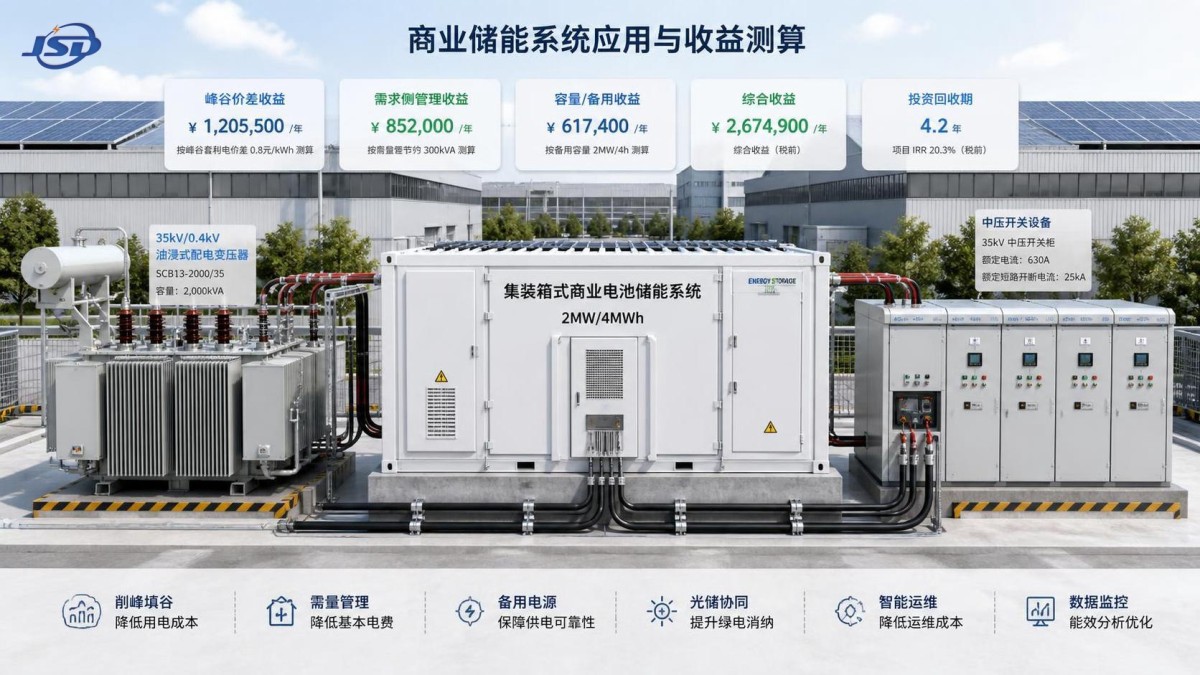
That is why many buyers review battery economics alongside supporting power equipment. In facilities where capacity expansion or voltage transformation is part of the same project, components such as the 35kV/0.4kV Oil-Immersed Power Distribution Transformer may influence both total capital outlay and future operating stability. It is not a battery component, of course, but in real procurement planning, upstream and downstream equipment often shape the actual return profile.
Identify the cash benefits with care
Most commercial battery storage projects generate value from more than one source. That is good news for the investment case, but it also makes the analysis easier to overstate. A careful estimate separates each revenue or savings stream and checks whether the same battery capacity is being counted twice.
The most common benefit categories are these:
Demand charge reduction
In many commercial and industrial tariffs, demand charges are the primary driver of battery payback. If a facility is billed based on its highest short-duration peak during a month, a properly controlled battery can discharge during those moments and reduce the billed peak. The financial value depends on the tariff structure, the timing of peaks, and how predictable those peaks are.
Facilities with sharp, recurring demand spikes often see the clearest opportunity. But if peaks are irregular, operationally driven, or seasonal, the forecast should be conservative.
Energy arbitrage
Some sites charge the battery when electricity prices are lower and discharge when prices are higher. This is more relevant where time-of-use tariffs have a meaningful spread between off-peak and peak pricing. The gross saving is easy to calculate, but net saving must account for round-trip efficiency losses.
Solar self-consumption improvement
Where on-site photovoltaic generation exists, battery storage may reduce solar curtailment or export dependency by shifting excess daytime generation into evening use. This value can be meaningful where export compensation is low or self-consumed power offsets more expensive grid electricity.
Backup and resilience value
Some buyers assign financial value to avoided downtime, product spoilage, or process interruption. This can be valid, especially in manufacturing and critical operations, but it should be handled with discipline. If resilience value is difficult to quantify with confidence, treat it as a strategic benefit rather than a core payback driver.
A practical way to estimate annual net benefit
Instead of jumping directly to a single payback number, build the estimate in layers.
- Calculate expected annual gross savings from each valid use case.
- Subtract annual operating and maintenance costs.
- Adjust for battery efficiency losses.
- Reflect realistic usable capacity rather than nameplate capacity.
- Consider performance degradation over time, especially if a simple payback is close to the project threshold.
For example, a demand charge reduction model should not assume the battery can eliminate every monthly peak. It should reflect discharge duration, control response, state-of-charge availability, and the chance that multiple peaks occur before the system can recharge. Likewise, an arbitrage model should not assume all stored energy is recovered. Battery efficiency and conversion losses matter.
What finance teams often want is not a perfect forecast, but a believable one. A slightly conservative model is generally more useful than a theoretically optimal dispatch scenario that operations teams may never achieve in real life.
Do not ignore the operating profile behind the savings
The same battery can produce very different payback periods at two sites with similar electricity bills. The difference usually lies in the load profile.
A warehouse with a stable daytime load may gain limited benefit from peak shaving unless charging equipment or refrigeration creates short demand spikes. A manufacturing line with motor-heavy starts and stop cycles may offer stronger demand reduction potential. A commercial campus with solar generation may benefit more from shifting energy into the evening. In short, battery economics are shape-driven, not just cost-driven.
This is why interval load data matters. Monthly utility totals are not enough for a reliable estimate. At minimum, finance reviewers should ask for load data with sufficient time resolution to show when peaks occur, how long they last, and how often they repeat. If solar is part of the picture, generation data should be reviewed with the same discipline.
Where payback calculations often go wrong
Even experienced teams can make storage payback look better than it really is. The usual problems are not mathematical; they are assumptions hidden inside the model.
- Using nameplate power and capacity as fully available all year: actual usable performance depends on operating limits and control strategy.
- Counting overlapping benefits twice: capacity used for demand shaving at one moment may not be available for arbitrage at the same time.
- Ignoring degradation: while simple payback is a first-step metric, long operating life should still be viewed realistically.
- Overlooking infrastructure upgrades: interconnection, transformer adaptation, and protection revisions can materially affect capex.
- Assuming tariff stability: if value depends heavily on current peak pricing, sensitivity analysis is wise.
For procurement teams, these issues matter because they affect not only ROI but also vendor comparison. Two proposals may quote the same battery size while relying on very different operational assumptions. Unless those assumptions are normalized, the shorter payback estimate may simply be the more aggressive model.
Simple payback is useful, but it should not be the only filter
Financial approvers like payback because it is intuitive. Yet a commercial battery storage project is a power asset, not just a spreadsheet exercise. If two options show similar payback periods, the better procurement decision may come from broader evaluation criteria:
- System reliability and safety architecture
- Integration complexity with existing power distribution equipment
- Expandability for future load growth or renewable additions
- Service support, monitoring visibility, and maintenance access
- Compatibility with site voltage levels and protection schemes
In industrial and infrastructure projects, storage sits inside a larger ecosystem of transmission and distribution assets. Companies such as Jinshida Electric Power Technology focus on this broader reality: reliable energy performance depends on how equipment works together, from transformation and distribution to site-level application. For buyers, that systems perspective reduces the risk of approving a project that appears attractive financially but proves difficult operationally.
How to present a battery payback case to internal stakeholders
If you are preparing the project for budget approval, the strongest internal case usually includes three scenarios rather than one headline figure: conservative, expected, and upside. This gives management a more decision-ready picture than a single optimistic result.
Your presentation should show:
- Total installed cost with major assumptions clearly stated
- Primary savings drivers ranked by confidence level
- Data source for load profile and tariff assumptions
- Operational constraints that could limit performance
- Sensitivity to tariff changes, lower battery utilization, or added infrastructure cost
This approach does two things. First, it helps finance teams understand the downside risk. Second, it makes the technical team’s recommendation more credible. Decision-makers do not expect certainty; they expect transparency.
When a longer payback may still make sense
Not every good energy project has a short payback. A battery installation with moderate direct savings may still deserve approval if it supports a larger strategic goal: enabling renewable integration, avoiding future demand-related network upgrades, improving power quality coordination, or preparing a facility for electrification growth.
For example, if a site is already reviewing distribution improvements, adding storage may be more rational when considered as part of the complete electrical plan. In some cases, evaluating associated assets such as the 35kV/0.4kV Oil-Immersed Power Distribution Transformer alongside storage clarifies whether the project is simply an energy-saving measure or a step in long-term capacity planning.
A grounded conclusion for finance-led procurement
To estimate payback period for a commercial battery storage project, begin with discipline rather than enthusiasm. Use the full installed cost. Base savings on interval data, actual tariffs, and realistic dispatch behavior. Separate benefit streams clearly. Test sensitivity. Then ask whether the result still works when the assumptions become less generous.
For financial decision-makers, that is the difference between approving a promising concept and approving a bankable project. In the power equipment sector, where storage performance depends on the quality of integration as much as the battery itself, a sound payback estimate is not just a financial tool. It is a risk filter, a procurement guide, and often the clearest path to confident investment.

Get a Quote
Regardless of whether you require general advice or specific support, we are happy to help you.
Send Us Your Inquiry Today

Jinshida Electric remains committed to contributing to global energy development through professional manufacturing and superior service.