





Commercial Energy Storage: 7 Questions to Ask Before Final Approval
Final approval is the moment when a commercial energy storage project stops being an interesting idea and becomes a long-term operational commitment. For enterprise decision-makers, that step is rarely about batteries alone. It is about whether the system will work with existing power infrastructure, how it will behave under stress, what it will cost over time, and whether it will actually support business continuity instead of introducing new uncertainty.
In the transformer and power equipment sector, those questions matter even more. Energy storage does not sit in isolation; it interacts with transformers, switchgear, protection systems, site loads, backup assets, and grid conditions. A well-selected system can improve energy efficiency, smooth peak demand, support renewable integration, and strengthen power reliability. A poorly matched one can create technical friction, hidden costs, and approval delays. Before signing off, it helps to pressure-test the proposal through seven practical questions.
1. What exact business problem is this commercial energy storage system supposed to solve?
This may sound basic, but many projects become vague just before approval. The proposal might promise peak shaving, resilience, energy arbitrage, renewable support, and sustainability benefits all at once. In reality, the system should be judged against a clearly ranked set of objectives.
If your facility suffers from unstable power quality, the storage solution should be evaluated for response speed and integration with existing distribution equipment. If your main goal is reducing demand charges, then discharge duration, scheduling logic, and local tariff patterns become more important. If the priority is backup support for critical operations, then transition behavior, control coordination, and emergency operating strategy deserve closer attention.
For procurement and executive teams, the practical question is not whether commercial energy storage has benefits in general. It is whether this specific configuration addresses your site’s most expensive or risky power challenge. Approval becomes easier when the project has one primary use case, one secondary use case, and measurable decision criteria.
2. Is the system technically compatible with our existing electrical infrastructure?
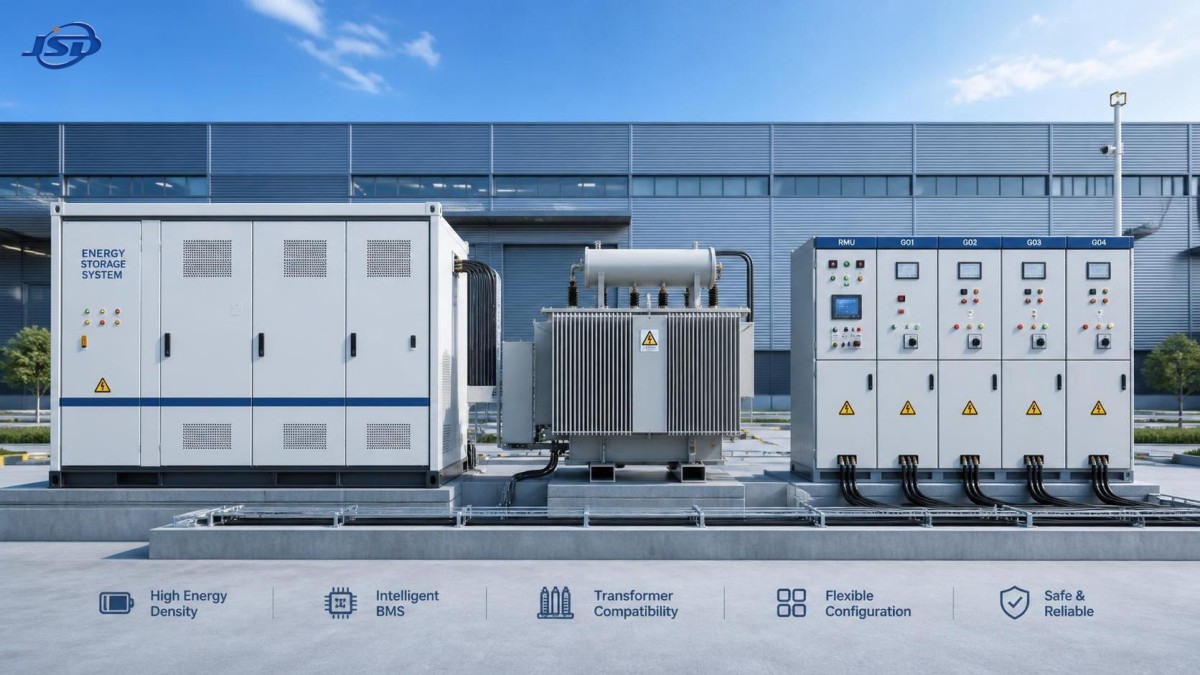
Compatibility is where many attractive proposals become complicated. A storage system may look strong on paper but still create issues once it meets the reality of your site. Voltage level, transformer capacity, load profile, harmonics, protection coordination, short-circuit requirements, available installation space, and communication interfaces all influence whether the solution will fit smoothly into your power architecture.
For industrial and commercial facilities, the transformer is often one of the most important checkpoints. Decision-makers should ask whether the charging and discharging profile will affect transformer loading, thermal performance, or service life. It is also worth reviewing whether the existing transformer and distribution arrangement can accommodate future expansion if the storage system is scaled later.
Beyond basic electrical matching, ask how the storage controls interact with your current energy management system, diesel backup configuration, renewable assets, or power quality equipment. In some facilities, storage works best as part of a broader resilience strategy that may still include conventional backup generation. For sites that need layered reliability, equipment such as an Open Type Diesel Generator Set can remain relevant alongside battery-based systems, especially when outage duration risk extends beyond battery autonomy.
A proposal deserves closer scrutiny if it treats interconnection as a minor detail. In real projects, system compatibility often determines installation complexity, commissioning risk, and long-term stability.
3. What safety strategy supports the project beyond the product brochure?
Safety is one of the first concerns executives raise, and rightly so. But “safe design” is too broad to be useful unless it is translated into engineering and operating details. Commercial energy storage approval should include questions about cell chemistry, thermal management, fire detection and suppression approach, enclosure design, fault isolation, ventilation, emergency shutdown logic, and maintenance access.
Decision-makers do not need to become battery experts, but they should insist on understanding how abnormal conditions are identified and contained. What happens if a module overheats? How is the issue isolated? What alarm hierarchy is in place? How will on-site teams respond? Is the installation plan aligned with local codes, insurance expectations, and fire safety review procedures?
In transformer-related environments, safety also includes electrical coordination. The system should not introduce unmanaged fault pathways or protection blind spots. Ask whether the supplier has considered the complete power chain, from incoming connection to distribution output, instead of focusing only on the storage cabinet itself.
Strong suppliers usually speak about safety in layers: product design, system architecture, installation standards, monitoring logic, and response planning. That layered answer is far more meaningful than a simple reassurance.
4. What is the real lifecycle cost, not just the initial capital price?
Final approval often gets stuck on the purchase budget, but commercial energy storage decisions should be made on lifecycle economics. A lower upfront price can be attractive until replacement timing, degradation, service requirements, auxiliary power consumption, software dependence, and downtime risk are considered.
Ask for clarity on the full cost structure: installation, grid interconnection work, transformer or switchgear upgrades if needed, commissioning, monitoring platform fees, preventive maintenance, expected performance decline, and end-of-life planning. Also ask how the projected savings depend on usage assumptions. A business case built on aggressive charge-discharge cycling may look strong in a spreadsheet while increasing wear and reducing long-term value.
This is especially important for companies managing manufacturing sites, logistics hubs, data-sensitive operations, or energy-intensive facilities. The cost of underperformance may be much larger than the cost difference between two suppliers. A more reliable system that preserves stable operation can be financially wiser than a cheaper system that creates uncertainty in production or facility management.
For decision-makers, a useful approval lens is this: not “What will we pay to install it?” but “What will we spend, save, and risk across the useful life of the system?”
5. How will the system perform after year three, year five, and beyond?
Commercial energy storage is often sold through current specifications, yet approval should focus on future performance. Rated capacity at commissioning is only the starting point. What matters is how the system behaves after repeated cycling, seasonal temperature changes, grid disturbances, and evolving load demands.
That means asking about degradation assumptions, operating windows, battery management strategy, expected efficiency under real site conditions, and the service plan for replacing modules or maintaining system balance. Long-term performance is not just a battery issue; it also depends on inverter quality, thermal design, controls, and the reliability of the broader electrical environment.
For companies operating critical infrastructure or industrial lines, a small decline in performance can have outsized consequences if the application depends on precise timing or demand management. If the project is intended to support renewable generation, then the storage system should also be evaluated for its ability to handle variable charging behavior over time without destabilizing the rest of the distribution network.
Experienced power equipment partners understand that durability is tied to system design discipline. Jinshida Electric Power Technology Co., Ltd., with its focus on transmission and distribution equipment, emphasizes the importance of stable power support, technical integration, and quality control across the wider power chain. That perspective is valuable because storage success depends as much on infrastructure coordination as on battery selection.
6. Who will be responsible when operation, service, and troubleshooting begin?
The approval package may look complete until someone asks a very practical question: who owns performance after handover? Commercial energy storage is not a plug-and-forget asset. It needs monitoring, periodic inspection, software oversight, operational discipline, and a clear service pathway when alarms or performance deviations appear.
Decision-makers should understand whether support will come from a single accountable provider or from multiple parties passing issues between battery, inverter, controls, transformer, and installation teams. Fragmented responsibility can become expensive during fault diagnosis. A project that seems technically acceptable can still become difficult to manage if after-sales structure is weak.
It is also worth asking how your internal team will interact with the system. Will facility managers need special training? How visible will operating data be? Can the system provide actionable reporting for finance, operations, and sustainability teams, or will it simply produce technical data without business context?
In some sites, commercial energy storage is only one part of a broader continuity plan that includes conventional generation for long-duration backup scenarios. When comparing support models, companies should evaluate how storage and standby assets are coordinated operationally. In those cases, a balanced power solution may include both battery controls and equipment such as the Open Type Diesel Generator Set, depending on the resilience requirements of the facility.
7. Does this project still make sense if our load, tariffs, or energy strategy changes?
The best approval decisions leave room for change. Energy policy shifts, electricity pricing evolves, facilities expand, production schedules move, and corporate sustainability targets become more ambitious. A commercial energy storage system that only works under one narrow operating assumption may lose value faster than expected.
Ask whether the project is scalable in power or capacity, whether the control strategy can be updated, and whether the system can adapt to future additions such as rooftop solar, EV charging, microgrid functions, or revised backup requirements. Flexibility is not a luxury feature. For many businesses, it is what protects the investment from becoming obsolete.
This question is especially relevant in sectors where load behavior is not static. Manufacturing plants may add equipment, commercial campuses may electrify more functions, and infrastructure operators may face stricter uptime expectations. A well-designed system should support changing energy priorities without forcing a complete redesign of site power architecture.
Approval should follow clarity, not pressure
By the time a project reaches final approval, there is often schedule pressure from operations, finance, or sustainability teams. But commercial energy storage should not be approved simply because it aligns with a trend or because the proposal appears technically modern. It should be approved because the business case is clear, the infrastructure fit has been verified, the safety strategy is credible, and the long-term operating model makes sense.
For enterprise decision-makers, the seven questions above create a more grounded way to evaluate options. They move the conversation away from broad promises and toward site-specific judgment. In the transformer and power equipment industry, that discipline matters. Storage is most valuable when it strengthens the wider power system around it, not when it is treated as an isolated purchase.
The strongest projects are rarely the ones with the most aggressive claims. They are the ones where technical teams, procurement leaders, and executives can all answer the same question with confidence: why this system, for this site, under these operating conditions? Once that answer is solid, final approval becomes much less risky—and far more strategic.

Get a Quote
Regardless of whether you require general advice or specific support, we are happy to help you.
Send Us Your Inquiry Today

Jinshida Electric remains committed to contributing to global energy development through professional manufacturing and superior service.