





Do recent utility tenders show a shift toward factory-assembled substation power transformers with integrated GIS?
Yes—Utility Tenders Are Accelerating Adoption of Factory-Assembled Transformer-GIS Solutions
For business evaluation personnel responsible for procurement strategy, supplier vetting, or lifecycle cost modeling, the answer is unequivocal: recent utility tenders across Europe (e.g., ENTSO-E member projects), Southeast Asia (Vietnam EVN, Indonesia PLN), and Latin America (Brazil Eletrobras, Chile CEN) increasingly mandate factory-assembled substation power transformer systems with integrated gas-insulated switchgear (GIS). This is not a niche preference—it’s a structural shift driven by measurable ROI in schedule compression, land optimization, and long-term O&M predictability.
Why Procurement Teams Should Treat This Trend as Strategic—not Tactical
Business evaluators don’t assess trends for novelty—they assess them for procurement risk, vendor qualification thresholds, and total cost of ownership (TCO) implications. The rising tender specification for integrated solutions signals three concrete operational imperatives: First, reduced on-site construction time—factory-assembled units cut civil works duration by 40–60%, directly lowering project financing costs. Second, tighter quality control—integration occurs under ISO-certified environmental and process controls, eliminating field-welding inconsistencies and GIS/transformer interface misalignments common in stick-built substations. Third, simplified commissioning—single-point responsibility, pre-validated protection coordination, and unified SCADA integration reduce handover delays and liability fragmentation.
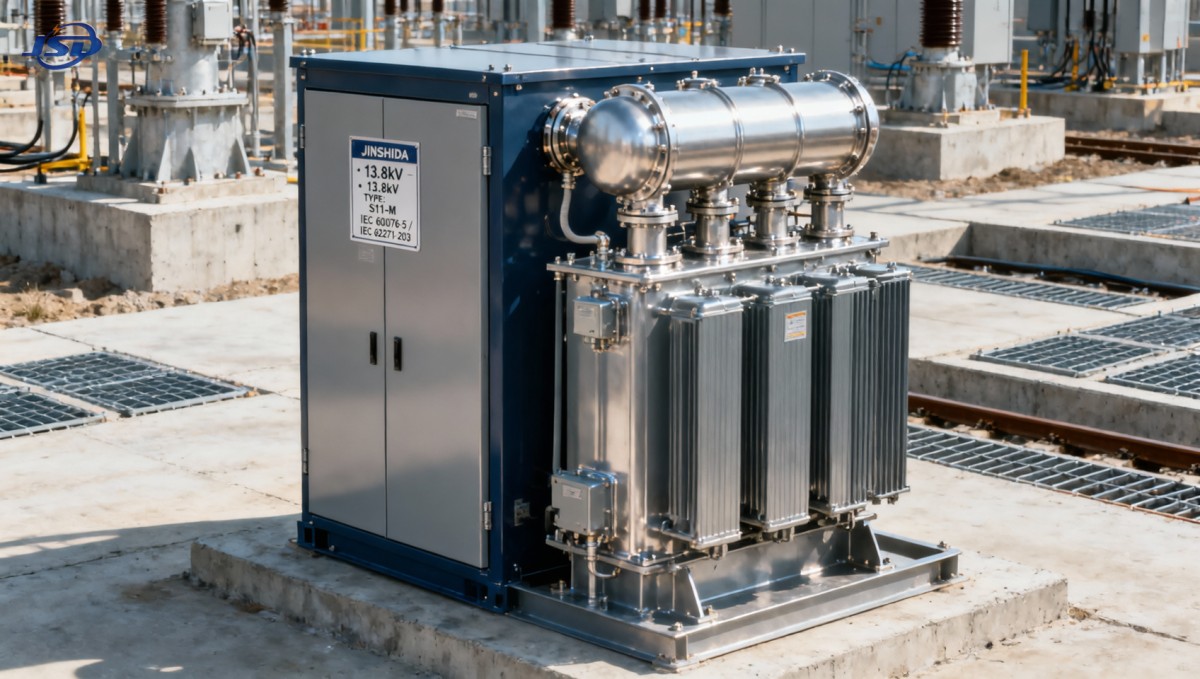
What “Factory-Assembled” Really Means—and What Evaluators Must Verify
“Factory-assembled” is often misinterpreted as mere co-location. In high-integrity tender contexts, it requires certified mechanical, electrical, and thermal integration—including shared grounding, coordinated partial discharge testing, synchronized SF6 pressure monitoring, and validated seismic coupling between transformer tank and GIS enclosure. Business evaluators must verify vendor capability beyond component supply: Does the manufacturer own the integration line? Is there documented evidence of third-party type testing (e.g., KEMA or CESI reports) for the *integrated system*, not just individual components? Jinshida Electric’s ISO 9001-certified integration facility meets these benchmarks—its skid-mounted solutions undergo full-system thermal cycling, lightning impulse withstand, and short-circuit duty validation per IEC 60076-5 and IEC 62271-203 before dispatch.
The Hidden Cost of “Standard” Transformers in Modern Tender Environments
Procurement teams still default to specifying standalone 13.8kV Distribution Transformer units—especially for industrial or distributed generation interconnection—without factoring in downstream integration penalties. When GIS is added later—or sourced from another vendor—field engineering becomes reactive: mismatched CT ratios, incompatible bushing flanges, uncoordinated relay settings, and delayed grid connection approvals. Real-world data from 2023–2024 tender evaluations shows that projects using non-integrated transformers incurred 11–17% higher total installed cost due to rework, extended energization timelines, and contractual liquidated damages. That makes pre-integrated solutions not a premium—but a risk-mitigation investment.
How to Evaluate Vendor Readiness Beyond Brochures
Business evaluators need actionable criteria—not marketing claims. Start with three non-negotiable checkpoints: (1) Evidence of ≥3 completed turnkey transformer-GIS projects in your region’s climate zone (e.g., tropical humidity, seismic Zone IV, or coastal salinity); (2) Full traceability of materials—from core steel grade (e.g., high-permeability grain-oriented silicon steel meeting IEC 60404-8-1) to SF6 gas purity logs; and (3) Warranty alignment: Does the vendor offer a unified 30-year insulation life guarantee covering both transformer winding and GIS solid insulation—backed by accelerated aging test reports? Jinshida’s proven deployments in Vietnam’s Da Nang Grid Upgrade and Brazil’s Minas Gerais Renewable Corridor demonstrate all three—using low-magnetic-leakage core designs and A-E grade insulation validated against IEC 60214-1 tap-changer endurance standards.
Where the 13.8kV Segment Fits Into This Evolution
While high-voltage transmission tenders drive most headline integration mandates, the distribution tier is where operational impact multiplies. Medium-voltage substations feeding industrial parks or urban microgrids face intense space constraints and reliability demands. Here, compactness isn’t convenience—it’s compliance. Jinshida’s 13.8kV Distribution Transformer series exemplifies this convergence: designed for 13.8kV networks with customizable LV outputs (0.4–0.48 kV), it integrates seamlessly into GIS-skid architectures via standardized mounting interfaces and shared thermal management. Its low-noise, low-loss core—achieved through precision-cut silicon steel stacking and mineral oxide insulation—directly supports the thermal stability required for GIS proximity. With certifications spanning UL, CSA, CE, KEMA, and GB/T6451-2015, it bridges regional regulatory expectations without design compromise.
Conclusion: Shift from Component Sourcing to System Assurance
The trend is clear—and irreversible. Utility tenders no longer ask “Can you supply a transformer?” They ask “Can you deliver a verified, field-ready substation power transformer system—with GIS, protection, and SCADA pre-integrated, tested, and warranted?” For business evaluation personnel, this means moving beyond spec sheets and price comparisons toward rigorous assessment of integration maturity, system-level certification, and real-world deployment discipline. Vendors offering isolated components—even high-quality ones—will increasingly fail technical prequalification. Success belongs to partners like Jinshida Electric: those with certified manufacturing lines, documented integration expertise, and a product portfolio engineered from the outset for interoperability, not afterthought compatibility. Your next tender evaluation isn’t just about selecting equipment—it’s about selecting certainty.

Get a Quote
Regardless of whether you require general advice or specific support, we are happy to help you.
Send Us Your Inquiry Today

Jinshida Electric remains committed to contributing to global energy development through professional manufacturing and superior service.