





How do harmonic distortion levels from non-linear loads impact thermal aging in distribution transformers?
2026.09.13
Jinshida
Harmonic distortion from non-linear loads—such as VFDs, rectifiers, and renewable energy inverters—significantly accelerates thermal aging in distribution transformers, compromising insulation integrity and shortening service life. For technical evaluation personnel responsible for grid reliability and asset longevity, understanding the quantitative relationship between harmonic current magnitude, loss amplification, and hotspot temperature rise is critical. This article examines how IEEE C57.110 and IEC 60076-7 guidelines inform thermal aging assessments under real-world harmonic conditions—and how Jinshida’s high-efficiency distribution transformers, engineered with low-loss amorphous cores and optimized cooling design, mitigate these effects while maintaining compliance and performance.
Harmonic currents do not merely add to fundamental load losses—they interact nonlinearly with transformer winding resistance, stray flux paths, and core hysteresis. The dominant mechanism of accelerated aging lies not in average temperature rise, but in localized hotspot formation at conductor bends, lead exits, and tank walls where eddy currents concentrate. Under sinusoidal excitation, hotspot-to-average temperature differentials typically range from 10–15 K. With harmonic content—especially 3rd, 5th, and 7th orders—the differential can exceed 25 K, even when total RMS current remains within nameplate limits. This is because harmonic losses scale with the square of frequency: skin effect increases AC resistance by √f, while stray flux losses scale approximately with f². A 5th harmonic current contributes up to 25× more stray loss per ampere than the fundamental.
IEEE C57.110 provides a widely adopted methodology for estimating harmonic heating effects through the *K-factor*, defined as:
$$
K = sum_{h=1}^{n} h^2 cdot I_h^2
$$
where $I_h$ is the per-unit harmonic current magnitude. A K-factor of 4 indicates that harmonic losses equal 4× those of the fundamental at rated current. Transformers rated for K-4 or higher are designed with reduced conductor cross-sections, transposed conductors, and enhanced cooling near hotspots. However, K-factor alone is insufficient for modern applications. It assumes steady-state harmonic spectra and does not account for dynamic loading patterns typical of solar inverters or cyclical industrial drives—where harmonic phase angles shift rapidly, altering flux cancellation in three-phase windings and causing transient hotspot spikes that exceed steady-state predictions.
IEC 60076-7 takes a more granular approach. It requires thermal modeling based on measured or representative harmonic spectra, assigning weighting factors to each order (e.g., 3rd harmonic carries higher thermal weight due to zero-sequence behavior in delta-wye transformers). Crucially, it mandates hotspot temperature validation—not just top-oil or average-winding temperatures—using thermocouples or fiber-optic sensors placed at geometrically sensitive locations. Field measurements confirm that under mixed harmonic loads (e.g., 30% 5th + 15% 7th + 8% 11th), hotspot temperatures in standard distribution transformers often exceed 110 °C during peak load periods—even when top-oil stays below 95 °C. At this level, insulation paper (kraft) degradation accelerates exponentially: every 6 K above 98 °C halves remaining life per Arrhenius kinetics.
This has direct implications for transformer specification. A conventional 20kV/0.4kV oil-immersed unit built to IEC 60076-1 with standard copper windings and mineral oil may meet nameplate ratings under linear loads—but its thermal margin collapses under harmonic-rich duty cycles. Over time, repeated exposure degrades cellulose insulation tensile strength, increases dielectric loss tangent, and raises risk of turn-to-turn failure during voltage transients. Maintenance intervals shrink, and dissolved gas analysis (DGA) shows elevated CO₂ and furanic compounds earlier than expected.
Design adaptations that demonstrably improve resilience include:
- **Amorphous metal cores**, which reduce no-load losses by ~70% and exhibit lower harmonic magnetizing current distortion;
- **FR3 vegetable oil**, with 15% higher specific heat and superior oxidation stability—slowing acid formation under thermal stress;
- **Optimized duct geometry** in windings to minimize eddy current concentration zones;
- **Enhanced radiators with directional flow control**, ensuring consistent cooling at high-loss regions regardless of ambient gradients.
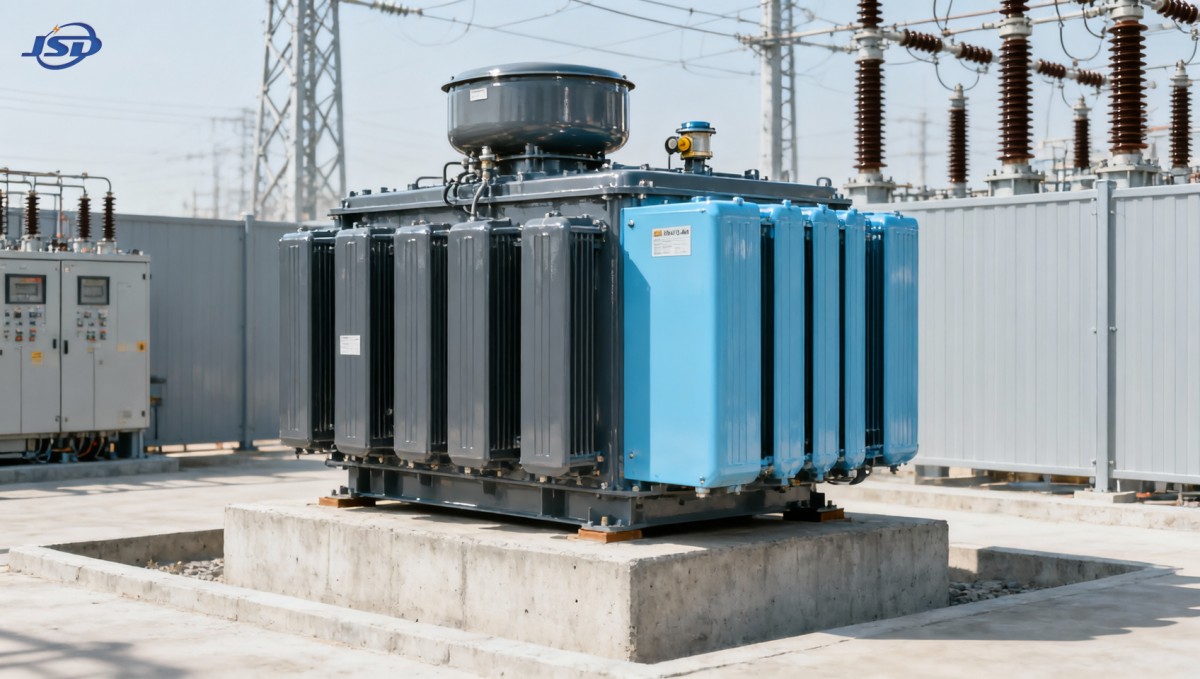
These features are integrated into Jinshida’s 20kV/0.4kV Oil-Immersed Power Distribution Transformer, particularly in models designated for renewable energy grid interconnection and industrial VFD clusters. Its thermal design complies with IEC 60076-7 Annex B requirements for harmonic-loaded operation, verified via finite-element electromagnetic-thermal coupling simulations across 15 representative harmonic spectra—including IEEE 519-2022-compliant profiles for data centers and petrochemical facilities.
A key operational insight often overlooked is that harmonic-induced aging is not additive—it is synergistic with overload and ambient temperature. For example, a transformer operating at 120% load with 20% THD experiences hotspot temperatures 35–40 K above ambient—well beyond the 120 °C limit recommended for sustained operation in IEC 60076-7. In such cases, even brief overloads become thermally irreversible. That is why Jinshida’s design includes explicit thermal derating curves tied to measured harmonic spectra—not just RMS current—enabling evaluators to map actual field conditions directly to remaining insulation life estimates.
Finally, compliance does not guarantee suitability. A transformer certified to K-13 may still age prematurely if installed downstream of unfiltered 11th-order harmonics from large SCR rectifiers, because K-factor weighting underrepresents higher-order losses in certain geometries. Technical evaluation must therefore combine standards-based rating with spectral analysis of site-specific loads, validated against hotspot measurement protocols—not just nameplate checks.
 For technical evaluation personnel, the takeaway is methodological: thermal aging under harmonics cannot be assessed through single-point metrics like THD or K-factor alone. It requires spectrum-aware modeling, hotspot-focused verification, and application-specific derating. Standards provide frameworks—not pass/fail thresholds. The most robust units integrate material selection, electromagnetic layout, and cooling architecture to decouple thermal stress from harmonic content—not merely tolerate it.

Get a Quote
Regardless of whether you require general advice or specific support, we are happy to help you.
Send Us Your Inquiry Today

Jinshida Electric remains committed to contributing to global energy development through professional manufacturing and superior service.