





Can electric power transformers be retrofitted with smart monitoring sensors without interrupting grid operation?
Yes—But Not All Retrofit Paths Are Equal
The short answer to “Can electric power transformers be retrofitted with smart monitoring sensors without interrupting grid operation?” is yes—provided the retrofit strategy accounts for three non-negotiable constraints: electrical isolation, mechanical accessibility, and data integration architecture. For project managers overseeing live substations or mission-critical industrial feeders, downtime isn’t just costly—it’s often contractually prohibited or safety-prohibited. That means bolt-on sensor deployment must function as a surgical upgrade, not a system overhaul.
Jinshida Electric Power Technology Co., Ltd. has supported over 40 transformer retrofit projects across Asia and Eastern Europe where zero-downtime was mandated—not optional. In those cases, success hinged less on sensor specs and more on how the sensing layer interfaces with existing transformer infrastructure: oil flow paths, tank wall integrity, bushing geometry, and grounding topology. A sensor that reads temperature well but requires drilling into a sealed conservator tank? That’s not a retrofit—it’s a scheduled outage waiting to happen.
Where Passive Integration Wins
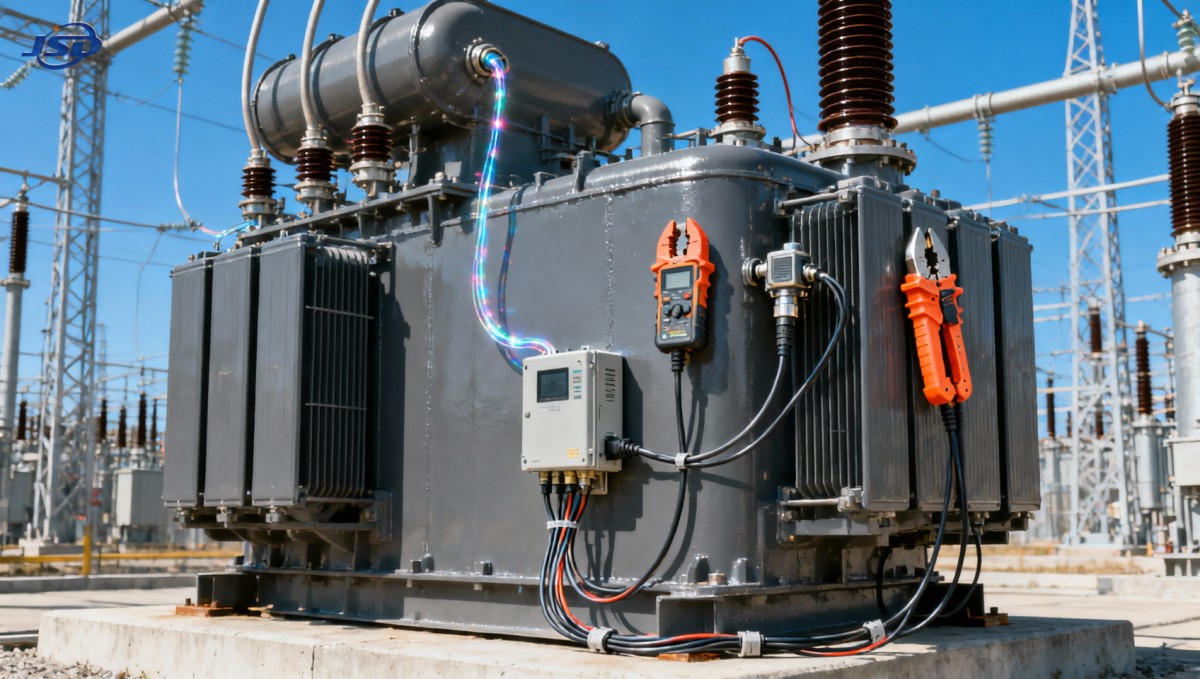
The most reliable non-intrusive approaches rely on passive coupling: clamp-on current sensors, ultrasonic vibration transducers mounted externally on tank walls, and fiber-optic temperature probes threaded through existing breather or sampling ports. These don’t require breaking seals, modifying oil circuits, or rewiring primary windings. They’re field-tested, calibrated pre-installation, and validated against IEEE C57.12.90 and IEC 60076-22 standards for partial discharge and thermal profiling.
What’s often underestimated is the role of edge processing. Raw sensor data—especially from acoustic emission or dissolved gas analysis—is noisy. Transmitting it directly to a cloud platform without local filtering risks false positives and alarm fatigue. Jinshida’s retrofit packages include embedded edge gateways that normalize, timestamp, and compress streams before transmission—reducing bandwidth load and enabling real-time threshold alerts without latency spikes.
Why “Plug-and-Play” Is a Red Flag
Some vendors market “wireless sensor kits” as drop-in solutions. In practice, wireless RF propagation inside a steel-clad transformer bay is highly variable. Signal reflection, harmonic interference from nearby breakers, and shielding from radiators can degrade packet delivery by 30–60%—making battery-powered nodes unreliable over time. Wired, shielded RS-485 or fiber-based backhauls remain the default for critical assets, especially where predictive maintenance decisions hinge on continuous waveform fidelity.
Also worth noting: retrofitting isn’t only about hardware. Legacy SCADA systems rarely speak Modbus TCP natively—and even when they do, mapping sensor tags to existing HMI screens often demands custom scripting. Jinshida’s engineering team includes control system specialists who align new sensor logic with client-specific DCS/SCADA architectures—not just install sensors and hand over a manual.
When You Need Power Independence—Not Just Data
Smart monitoring doesn’t operate in a vacuum. Sensors need stable, clean power—even during brownouts or switching transients. In remote substations or temporary construction sites where grid quality fluctuates, relying solely on station service transformers introduces a single point of failure. That’s where mobile, self-contained energy resources become part of the reliability stack.
For example, during a recent retrofit at a wind farm substation undergoing expansion, Jinshida deployed an 50kW/100kWh Portable Trailer Energy Storage System to power both the sensor gateway and temporary lighting. Its LiFePO4 chemistry delivered consistent voltage across wide temperature swings (-20°C to +55°C), while its IP54 rating and automatic fire suppression met site safety requirements. Crucially, it charged via solar PV during daylight hours—eliminating diesel generator dependency and reducing operational noise near sensitive wildlife zones.
The Real Bottleneck Isn’t Tech—It’s Documentation
Most failed retrofits stall not at installation—but at handover. Without updated as-built schematics showing sensor locations, cable routing, grounding points, and communication topology, the next maintenance cycle becomes guesswork. Jinshida embeds digital twin-ready documentation: geotagged photos, 3D mounting diagrams, and a lightweight web interface that maps each sensor to its physical location on a simplified transformer model. It’s not flashy—but it cuts commissioning time by 35–50% on average.
And because transformer fleets age unevenly, we avoid one-size-fits-all firmware. Older units may lack Ethernet ports or TLS support; newer ones may run legacy RTU protocols. Our firmware layer abstracts those differences—so whether you’re connecting to a 2008 Siemens SIPROTEC or a 2023 SEL-421, the data pipeline remains consistent.
So—What Should You Confirm Before Proceeding?
Start with your transformer’s OEM documentation. Look for: approved tapping points for oil sampling (for DGA sensors), external mounting flanges rated for vibration loads, and whether the nameplate lists compliance with IEC 60076-22 Annex B for condition monitoring interfaces. If those aren’t present—or if your unit predates 2010—you’ll likely need a hybrid approach: non-intrusive sensors for thermal and mechanical trends, supplemented by periodic offline DGA or FRA testing.
Also clarify your data governance needs upfront. Does your utility require encrypted data-at-rest? Do you need audit logs for sensor calibration history? Are alarms routed to existing dispatch centers—or to a new cloud dashboard? Jinshida’s deployments are scoped around those operational realities—not just sensor counts or uptime percentages.
Retrofitting an electric power transformer isn’t about adding intelligence—it’s about extending trust. Trust that the asset will behave predictably. Trust that alerts reflect real degradation—not noise. Trust that the solution integrates without forcing compromises elsewhere in your system. That kind of trust isn’t sold. It’s built—unit by unit, project by project, with attention to what’s under the tank, behind the panel, and inside the spec sheet.

Get a Quote
Regardless of whether you require general advice or specific support, we are happy to help you.
Send Us Your Inquiry Today

Jinshida Electric remains committed to contributing to global energy development through professional manufacturing and superior service.