





Which Load Profiles Justify a Low-Loss Power Distribution Transformer Investment?
Which Load Profiles Justify a Low-Loss Power Distribution Transformer Investment?
For enterprise decision-makers, a low loss power distribution transformer is not automatically the right answer simply because it offers better efficiency. The investment becomes compelling when the transformer’s loss pattern matches the way a site actually consumes electricity. Operating hours, average loading, load volatility, energy prices, planned capacity growth, and the cost of downtime all influence the result.
The central issue is straightforward: transformer losses occur whenever the unit is energized, but not all losses behave in the same way. Core, or no-load, losses are present continuously as long as the transformer is connected to the supply. Load losses rise with current and therefore become more significant as loading increases. A facility that operates around the clock will experience the first category very differently from a site that is energized only during limited working shifts. A site with sustained heavy demand will feel the second category much more strongly than a lightly loaded building.
That distinction should shape the procurement discussion. Instead of asking whether a higher-efficiency transformer is “worth it” in general, decision-makers should ask which losses are dominant in their own operating profile, how long the equipment will remain in service, and whether the electrical system is likely to change over its expected life.
Start With the Two Losses That Drive Lifecycle Cost
No-load loss is associated mainly with the energized magnetic core. It continues day and night, whether a factory is at full production, a commercial building is empty, or an industrial line is temporarily stopped. For transformers that remain connected throughout the year, even a modest reduction in no-load loss can accumulate over a long operating period.
Load loss is linked to current flowing through windings and related conductive parts. It generally grows with the square of load current, which means that a transformer running at a high percentage of rated capacity can incur materially more load-related loss than one operating at a moderate level. Harmonic currents, poor power factor, elevated ambient temperature, and uneven phase loading can further complicate the picture by increasing thermal stress and reducing the margin between actual and intended duty.
A low loss power distribution transformer may be designed to reduce one or both categories, but the relative economic value depends on how it will be used. Comparing only quoted efficiency at a single loading point is rarely enough. Procurement teams need the guaranteed no-load loss, load loss at the stated reference temperature, impedance, cooling arrangement, and the conditions under which those values apply.
Load Profiles Where the Investment Usually Has the Strongest Case
24/7 facilities with stable base demand
Data infrastructure, process industries, hospitals, water treatment assets, transport facilities, and certain large commercial operations often maintain a persistent electrical base load. Even if their demand changes during the day, the transformer is energized continuously and seldom spends long periods inactive. This is the clearest setting in which reduced no-load loss deserves close attention.
A continuously energized transformer does not need to be heavily loaded for low core losses to matter. If the site runs well below nameplate rating for much of the year, choosing a model with lower no-load loss can be more relevant than paying for an unusually low load-loss design. The better decision comes from the actual annual load curve, not from a generic assumption that high efficiency always means lower total cost.
High-utilization manufacturing and process loads
A plant operating multiple shifts, continuous furnaces, compressors, pumps, automated lines, or large motor-driven equipment may keep its transformer at a substantial share of rated load for extended periods. In these applications, load losses become a major part of the energy equation. Lower winding loss can reduce heat generation while helping preserve thermal headroom during production peaks.
This is especially relevant where a transformer has been selected close to present demand and management expects production growth. A unit that appears acceptable at today’s average load may become a source of unwanted heat, higher energy consumption, and accelerated insulation aging after a capacity expansion. A low-loss design can be justified when it supports a more durable operating margin rather than merely reducing a line item on an electricity bill.
Sites with expensive energy or internal carbon-accounting pressure
The same physical loss has different financial consequences in different markets. Where electricity prices are high, where demand-side energy management is tightly monitored, or where an organization assigns an internal cost to energy-related emissions, the payback case can improve. Still, energy tariffs should not be treated as static. Buyers should test the project against a realistic range of future energy costs instead of relying on a single favorable estimate.
For multi-site organizations, standardizing on more efficient distribution equipment may also simplify energy reporting. That benefit is operational rather than purely electrical, but it can matter when facilities teams need a consistent basis for comparing performance across factories, campuses, or infrastructure assets.
Remote installations where maintenance access is difficult
In remote pumping stations, renewable-energy support infrastructure, mining auxiliaries, and dispersed utility networks, heat and reliability can be as important as energy cost. Lower losses reduce internal thermal burden, although they do not replace proper thermal design, correct installation, or monitoring. If a failed transformer requires specialized logistics or causes a long interruption, selecting equipment with a more conservative loss and temperature-rise profile may be prudent.
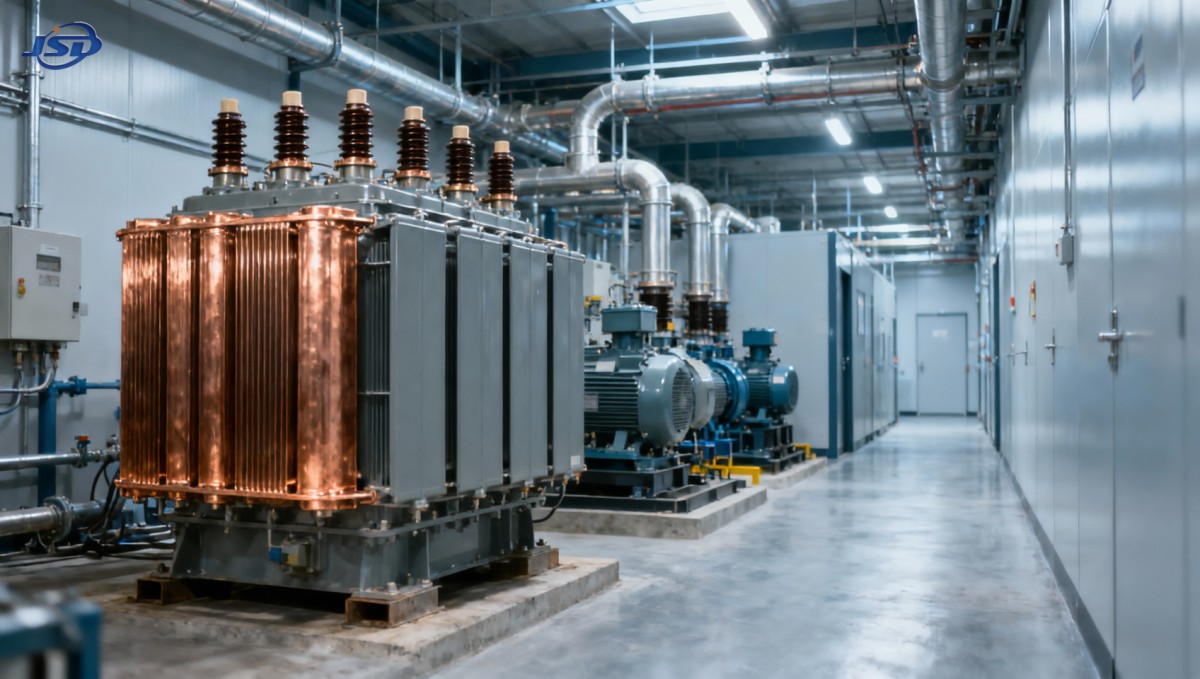
This becomes more nuanced where site loads are temporary or seasonal. For example, construction power, temporary communications support, disaster recovery, and off-grid work may require a mobile energy resource alongside conventional distribution equipment. A trailer-mounted storage unit such as the 100kW/215kWh Mobile Trailer Energy Storage System can support short-term load management, backup power, or temporary deployment. With a 100kW PCS, 215kWh LiFePO4 battery capacity, grid, solar PV, and diesel-generator charging options, it may reduce the need to size temporary transformer capacity around brief peaks. That does not eliminate the transformer selection task; it simply makes the net load profile more important to understand.
When a Premium-Efficiency Design May Not Pay Back Quickly
Low operating hours weaken the financial case for lower no-load losses. A warehouse, seasonal facility, lightly used auxiliary building, or project site that can be de-energized for long periods may not capture the same annual savings as a continuously operating facility. In such cases, switching arrangements, operating discipline, and the ability to safely de-energize idle equipment can deserve as much attention as transformer efficiency.
Likewise, a transformer that is significantly oversized for years may have low load losses simply because it carries little current, while its core loss continues uninterrupted. Oversizing is sometimes necessary for planned growth, motor starting, redundancy, or fault-level requirements. But it should not be accepted without examining alternatives such as staged transformer capacity, parallel units, or a different expansion sequence. Buying a larger unit “just in case” can lock in avoidable fixed losses.
There is also a practical limit to pursuing the lowest available losses. Designs optimized for one loss category may involve trade-offs in initial price, physical dimensions, weight, sound level, impedance, lead time, or suitability for the local network. A sound investment is not necessarily the transformer with the lowest individual loss figure; it is the transformer that meets system requirements with the best whole-life balance.
Use the Load Curve, Not the Nameplate, as the Decision Tool
Nameplate kVA indicates what a transformer can supply under specified conditions. It does not reveal how the unit will actually perform economically at a particular site. A useful evaluation begins with interval meter data where available. At minimum, examine annual operating hours, minimum night load, average load, maximum demand, the duration of peak periods, expected expansion, and major nonlinear loads.
For each candidate transformer, estimate annual losses using the supplier’s guaranteed loss figures and the site’s expected loading distribution. In simplified form, annual no-load energy is based on no-load loss multiplied by energized hours. Annual load-loss energy must account for the square of the load fraction over time; using only average demand can understate the effect of recurring high-load intervals. The calculation should be reviewed against the applicable loss reference temperature and expected operating environment.
A comparison should also include more than energy cost:
- initial purchase price, transport, installation, and civil works;
- loss capitalization methodology, if the project owner uses one;
- temperature rise and cooling suitability for the installation location;
- impedance and coordination with protection, parallel operation, and fault duty;
- harmonic exposure from drives, rectifiers, chargers, or other power-electronic loads;
- maintenance access, spare strategy, and the cost of an unplanned outage;
- the anticipated load profile after expansion, electrification, or renewable integration.
This process often exposes an overlooked issue: demand growth is not always smooth. A site adding EV charging, variable-speed drives, battery charging, or new production lines may create sharper peaks and greater harmonic content rather than simply raising average consumption. Transformer sizing and loss optimization should be revisited when the electrical character of the load changes.
Questions That Prevent an Incomplete Comparison
Before approving an investment, ask suppliers to state loss values clearly and identify the basis of the test or guarantee. Confirm the rated voltage, vector group, frequency, insulation class, cooling method, tapping requirements, and installation assumptions. If equipment will operate outdoors, in a confined substation room, at altitude, or in high ambient temperatures, those conditions should be incorporated early rather than treated as site details after purchase.
It is also worth asking whether the proposed transformer is optimized for the expected loading range. A supplier may offer several efficiency configurations, and the correct choice can differ between a lightly loaded 24-hour facility and a heavily loaded production transformer. The evaluation should not reward a design that looks favorable at one arbitrary loading point but is poorly aligned with actual operating hours.
Quality of manufacturing and documentation matters here because lifecycle calculations rely on dependable technical inputs. Jinshida Electric Power Technology Co., Ltd. focuses on the research, manufacturing, and application of power transmission and distribution equipment for grid construction, industrial manufacturing, new energy, and infrastructure projects. Its technical team, manufacturing processes, and quality-management approach are directed toward stable, energy-efficient power support. For buyers, the practical value of this kind of supplier engagement lies in working through actual duty conditions, loss requirements, and project interfaces before the transformer specification is finalized.
A Better Threshold for Investment
A low loss power distribution transformer is most likely to justify its additional cost when it will remain energized for long hours, operate at meaningful and reasonably stable loading, face high energy costs, or support an installation where heat and reliability carry a substantial operational consequence. The argument strengthens further when the organization expects a long asset life and can validate the expected load curve with measured data.
The weakest decisions are made from nameplate capacity alone or from a broad promise of energy savings. The stronger approach is to model no-load and load losses against the real duty cycle, check future expansion assumptions, and compare candidates on total installed and operating cost. If the site data is incomplete, begin with measured demand and energized-hour information. That small step usually produces a more defensible transformer decision than any generic efficiency claim.

Get a Quote
Regardless of whether you require general advice or specific support, we are happy to help you.
Send Us Your Inquiry Today

Jinshida Electric remains committed to contributing to global energy development through professional manufacturing and superior service.