





Power Distribution Transformer for Mining: Specifying for Dust and Vibration
Power Distribution Transformer for Mining: Specifying for Dust and Vibration
Mining projects demand power systems that remain reliable under abrasive dust, constant vibration, and heavy operational loads. Selecting the right power distribution transformer for mining protects equipment, reduces downtime, and supports safe production.
For project managers, the central decision is not simply selecting adequate kVA capacity. The transformer must withstand site conditions while maintaining voltage quality, thermal performance, and maintainability throughout its planned operating life.
A transformer that performs well in a clean utility substation may fail prematurely beside crushers, conveyors, mills, underground ventilation systems, or mobile processing equipment. Mining specifications must therefore begin with real environmental exposure.
The strongest procurement outcome comes from defining operating conditions, load behavior, installation constraints, protection requirements, and service responsibilities before comparing transformer quotations. Lowest initial price rarely represents the lowest project cost in mining.
Start with the Actual Mining Duty, Not a Generic Rating
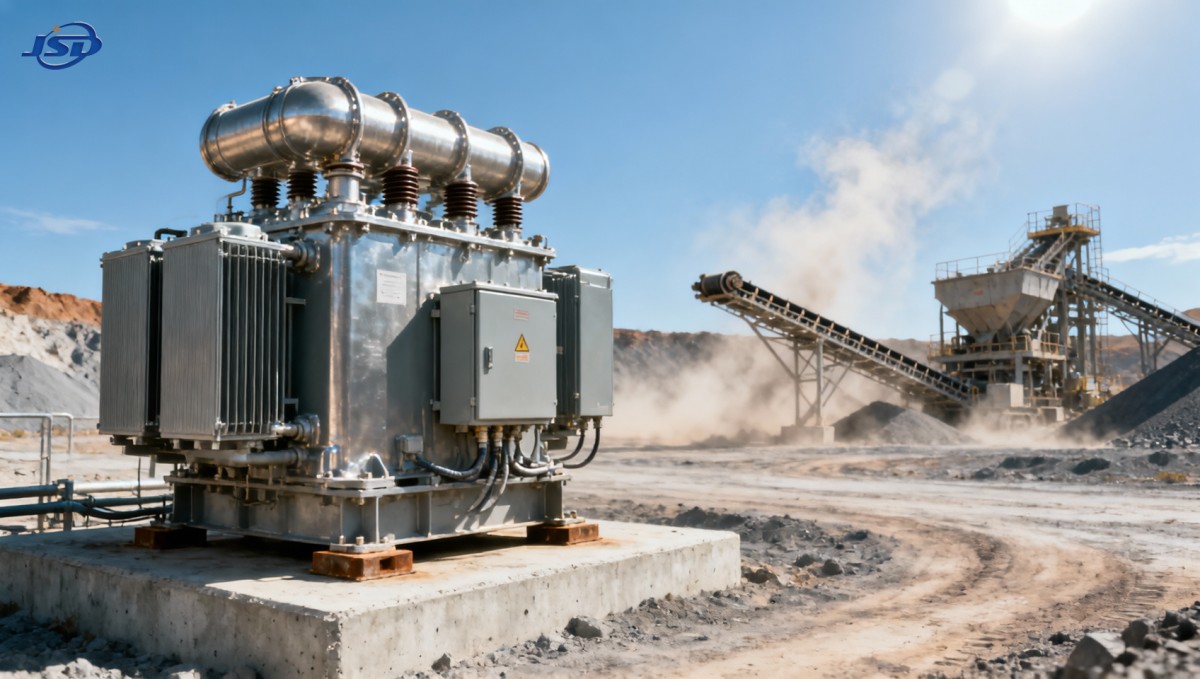
Project teams should document where the transformer will operate, what it will supply, and how often its load changes. These answers determine the appropriate electrical, mechanical, and environmental design.
Surface mines may expose equipment to windblown dust, solar radiation, rain, temperature swings, and haul-road vibration. Underground mines can add humidity, limited ventilation, corrosive gases, and restricted access for maintenance.
Loads also vary considerably. A transformer feeding conveyors may see long operating periods, while one serving crushers, hoists, or large motors can experience repeated starts, high inrush current, and rapid load fluctuations.
Specify the expected load profile instead of only the maximum connected load. Include normal demand, peak demand, motor-starting conditions, harmonic-producing loads, future expansion, and required operation during process upsets.
This information allows the manufacturer to assess winding temperature rise, short-circuit withstand capability, impedance selection, tap range, cooling requirements, and protective coordination. It also prevents oversizing without an operational reason.
For critical production areas, identify the financial consequence of a transformer outage. Lost throughput, repair access, safety exposure, and replacement lead time often justify a more robust specification or planned redundancy.
Control Dust Ingress Before It Becomes an Insulation Problem
Dust is not merely a housekeeping issue. Fine conductive or abrasive particles can obstruct cooling paths, degrade insulation surfaces, contaminate terminals, impair moving mechanisms, and accelerate corrosion within electrical enclosures.
A power distribution transformer for mining should be specified according to its installation environment. The enclosure, cable boxes, marshalling cabinet, radiators, glands, and external accessories require consistent ingress-protection consideration.
For dry, dusty outdoor locations, project specifications should define an appropriate IP rating for auxiliary enclosures and control cabinets. The selected rating must align with ventilation, heat dissipation, and inspection access.
Sealed equipment may reduce contamination but can trap heat if poorly designed. Ventilated designs can cool effectively but require filtered airflow, maintainable screens, and placement away from direct dust discharge points.
Ask how filters are inspected and replaced, how often they require service, and whether maintenance can occur safely while the transformer remains energized. A theoretical protection rating has limited value without maintainable details.
Transformer location matters as much as enclosure selection. Avoid placing equipment directly beside transfer points, crusher discharge zones, unpaved haul routes, or exhaust outlets where dust concentration and vibration are highest.
Where relocation is impossible, consider a purpose-designed transformer room, weatherproof enclosure, filtered ventilation system, or physical barriers. The solution should preserve adequate airflow and provide clear access for lifting and inspection.
Specify Vibration Resistance as a Mechanical Design Requirement
Persistent vibration can loosen fasteners, damage cable terminations, fatigue brackets, disturb instrumentation, and increase mechanical stress on bushings. These failures can develop gradually before causing an unexpected electrical shutdown.
Mining vibration sources include crushers, mills, screens, conveyors, pumps, blasting activity, mobile equipment traffic, and structural resonance. Each source has different frequency and amplitude characteristics, which should be evaluated at the installation point.
Do not rely on a statement that the transformer is “rugged” or “industrial grade.” Request the manufacturer’s vibration design basis, mounting recommendations, component retention methods, and evidence of applicable testing or field experience.
The specification should address base-frame stiffness, anchor-bolt arrangement, anti-vibration pads where appropriate, radiator support, cabinet latches, conduit connections, and protection-device mounting. Accessories are often the most vulnerable components.
Transformer foundations require particular attention. A flat, adequately reinforced foundation with correctly positioned anchor points reduces uneven loading and structural movement. Installation tolerances should be included in civil and electrical interface documents.
Flexible connections can reduce transmitted stress in selected applications, especially for cable routes and auxiliary conduits. However, flexibility must not compromise grounding continuity, cable support, bend radius, or short-circuit mechanical strength.
Where a transformer is mounted near high-impact process equipment, request a site-specific vibration assessment. This is more valuable than adding generic protective features that may not address the actual vibration path.
Choose Cooling and Thermal Margins for Dirty, High-Load Operation
Heat is a major driver of insulation aging. In mining environments, blocked cooling surfaces, high ambient temperatures, and overloaded duty can reduce transformer life well before operators notice a visible problem.
Oil-immersed transformers are commonly selected for larger outdoor mining duties because they offer effective cooling and robust insulation systems. Their suitability still depends on radiator exposure, oil containment, fire strategy, and maintenance capability.
Dry-type transformers can be suitable for indoor, underground, or fire-sensitive locations. Their design must account for dust accumulation, ventilation quality, altitude, ambient temperature, and the practical ability to clean cooling passages.
ONAN cooling may provide simplicity and fewer moving parts. ONAF cooling can deliver additional capacity, but fans add maintenance requirements and can be vulnerable in abrasive, dusty operating environments.
When specifying forced cooling, define fan enclosure protection, bearing quality, control logic, alarm functions, spare parts, and manual override provisions. Confirm whether the transformer can continue operating safely if cooling fans fail.
Ambient design temperature must reflect site data rather than general regional averages. Consider direct sunlight, radiant heat from process equipment, enclosure heat buildup, elevation, seasonal extremes, and future changes to nearby operations.
Temperature monitoring should support decisions, not only alarms. Winding and oil temperature indicators, remote contacts, trend data, and escalation thresholds help maintenance teams identify declining cooling performance before insulation damage occurs.
Make Insulation, Bushings, and Terminations Suitable for the Site
Dust, moisture, contamination, and thermal cycling all affect insulation reliability. The insulation system should be selected as part of the entire installation, including cables, surge protection, earthing, and switching equipment.
For outdoor applications, choose bushings with suitable creepage distance for the expected pollution level. Contaminated surfaces can create leakage current and flashover risk, particularly where dust combines with humidity or salt-laden air.
Terminations must be accessible for inspection and torque checks. Specify cable box arrangement, gland plate material, phase separation, earthing points, space for bending large cables, and protection against accidental mechanical impact.
Mining networks often include long cable runs and large motor loads. These conditions can introduce switching surges and voltage transients that affect transformer windings, particularly when vacuum switching equipment is involved.
Coordinate surge arresters, cable characteristics, switching devices, and transformer insulation levels. A technically sound transformer can still be exposed to damaging transient conditions when system-level coordination is incomplete.
Where variable-speed drives, rectifiers, or other nonlinear loads are present, provide harmonic data during the enquiry stage. Harmonics increase losses and heating, requiring design review rather than a standard transformer selection.
A clear insulation and termination specification helps project managers compare bids accurately. It also reduces late-stage redesign when the selected transformer cannot accommodate the installed cable system or protection arrangement.
Set Electrical Parameters That Support Process Reliability
Capacity selection should allow for continuous loading, credible peak demand, starting duty, ambient conditions, and future growth. A margin is useful only when it reflects a defined operational requirement.
Impedance is especially important in mining systems. It influences voltage drop during motor starts, fault current levels, parallel operation, and protection coordination. An unsuitable impedance can create process interruptions or protection complications.
Tap-changer requirements should be based on supply voltage variation and process sensitivity. Off-circuit taps may suit stable sites, while more dynamic networks may need a different voltage-control strategy at the system level.
Specify the vector group to match the site earthing system, downstream equipment, and parallel transformers. This decision affects zero-sequence behavior, harmonic performance, phase displacement, and practical connection compatibility.
Losses should be assessed over the transformer’s expected operating profile. Low-loss designs can provide meaningful lifecycle savings where equipment runs continuously, especially when energy costs and carbon targets are relevant to project evaluation.
Jinshida Electric applies this same lifecycle approach across demanding energy applications. Its Transformer for Wind Power Generation range illustrates how robust outdoor construction, copper windings, and IEC 60076 design principles support continuous operation in variable environments.
Although wind and mining applications have different load patterns, both require careful attention to environmental exposure, thermal performance, mechanical durability, and maintainability. Project teams should evaluate transferable design disciplines, not assume identical specifications.
Require Documentation That Makes Quotations Comparable
A detailed datasheet is one of the most effective risk-control tools in transformer procurement. It turns broad expectations into measurable requirements and allows technical teams to compare offers on an equivalent basis.
At minimum, include rated capacity, primary and secondary voltages, frequency, vector group, impedance, tap range, cooling class, insulation level, temperature-rise limits, installation arrangement, and applicable standards.
Environmental requirements should state ambient temperature range, altitude, pollution level, dust exposure, humidity, corrosion category, seismic needs where relevant, vibration conditions, and expected service location such as underground or outdoor.
Also define accessories clearly. Typical items include temperature indicators, pressure-relief devices, oil-level gauges, alarm and trip contacts, marshalling boxes, space heaters, surge arresters, neutral earthing provisions, and lifting facilities.
Request general arrangement drawings early. Confirm transport dimensions, total weight, lifting points, foundation loads, cable entry direction, radiator clearance, maintenance access, and the route from delivery point to final installation location.
Factory acceptance testing should be specified according to applicable standards and project needs. Routine electrical tests are essential, while additional testing may be justified for critical equipment, unusual duty, or demanding contractual requirements.
Require complete test records, nameplate data, manuals, wiring diagrams, oil information where applicable, recommended spares, and commissioning instructions. These documents shorten handover time and improve long-term asset management.
Evaluate Cost Through Downtime Risk and Serviceability
Initial purchase price is visible, but downtime costs are usually much larger. A failed transformer can halt extraction, processing, ventilation, pumping, or material handling, with consequences extending beyond direct repair expenses.
Project managers should evaluate total cost of ownership. Consider expected losses, maintenance labor, cleaning needs, spare availability, installation complexity, inspection access, repair lead time, and likely production losses during an outage.
Serviceability is particularly important in remote mines. Equipment should permit safe routine inspections, straightforward accessory replacement, practical oil sampling where relevant, and access to common service points without unnecessary disassembly.
Ask suppliers about regional technical support, commissioning availability, warranty response, recommended critical spares, and replacement manufacturing lead times. These issues should be assessed before award, not after commissioning problems occur.
A robust design can justify a higher capital cost when it reduces forced outages, lowers maintenance frequency, improves safety, and extends usable asset life. The business case should quantify these benefits where possible.
For essential loads, consider resilience beyond the transformer itself. Spare capacity, sectionalized distribution, standby generation, and a replacement strategy can reduce the operational impact of a single equipment failure.
Use a Practical Pre-Award Review
Before releasing a purchase order, conduct a joint review involving electrical engineering, process operations, maintenance, civil works, procurement, and the transformer supplier. This catches interface issues that isolated reviews often miss.
Verify the installation location against dust sources, vibration sources, ambient temperatures, flood exposure, ventilation paths, access routes, lifting requirements, and required clearance from adjacent equipment and structures.
Check that transformer ratings match the latest single-line diagram and load list. Reconcile voltage levels, fault studies, protection settings, earthing design, cable schedules, and motor-starting assessments before finalizing the design.
Confirm all deviations from the specification in writing. Small exceptions involving enclosure protection, accessories, cooling, test scope, or material selection can materially affect reliability in a harsh mining environment.
Finally, establish commissioning and maintenance responsibilities. Define who will inspect connections, verify alarms, check earthing, review test records, establish baseline temperatures, and schedule the first post-energization inspection.
Conclusion: Specify for the Mine You Have, Not an Ideal Environment
The right power distribution transformer for mining is defined by more than voltage and capacity. It must tolerate dust, vibration, heat, load variation, contamination, and maintenance realities without compromising production continuity.
For project managers, the most valuable approach is to translate site conditions into explicit requirements for enclosure protection, mechanical construction, cooling, insulation, electrical performance, documentation, and service support.
When those requirements are resolved early, procurement comparisons become clearer, installation risks decrease, and lifecycle costs become more predictable. The resulting transformer is better positioned to deliver reliable power throughout the mine’s operating life.

Get a Quote
Regardless of whether you require general advice or specific support, we are happy to help you.
Send Us Your Inquiry Today

Jinshida Electric remains committed to contributing to global energy development through professional manufacturing and superior service.