





Does a 10kw silent generator lose output in high temperatures
When evaluating a 10kw silent generator for demanding projects, one critical question is whether high temperatures reduce its actual output. For technical assessment teams, understanding how heat affects efficiency, load stability, and component performance is essential to selecting reliable power equipment. This article examines the key factors behind output loss in hot environments and what to consider for consistent operation.
The short answer is yes: a 10kw silent generator can lose usable output in high ambient temperatures. The more important answer, however, is how much, under what conditions, and whether that reduction is a normal derating behavior or a sign of poor system design. In real project evaluation, that distinction matters more than the simple fact that heat affects performance.
Many buyers assume a generator rated at 10 kW should continuously deliver 10 kW in any weather as long as fuel quality is acceptable. That is rarely true. Generator ratings are tied to specific reference conditions, and once ambient temperature rises beyond those conditions, both the engine and alternator operate under more thermal stress. In a silent enclosure, the issue becomes even more sensitive because sound attenuation and thermal ventilation often work against each other.
Why high temperatures reduce generator output
A generator set is not a single component. Its delivered output depends on the combined behavior of the diesel or gasoline engine, alternator, cooling system, air intake path, exhaust path, control logic, and enclosure ventilation. High temperature affects nearly all of these.
The first effect is reduced air density. Hot air contains less oxygen per unit volume than cooler air. For internal combustion engines, less oxygen means less efficient combustion unless the engine compensates adequately. On naturally aspirated engines, this directly reduces power potential. Turbocharged engines can compensate better, but only within design limits.
The second effect is reduced cooling margin. Engines, alternators, voltage regulators, and power electronics all rely on heat dissipation. As ambient temperature rises, the temperature difference between the component and surrounding air becomes smaller, so heat removal becomes less effective. That can force the unit to reduce load or trigger protection functions earlier.
The third effect is enclosure-related airflow restriction. A silent generator uses acoustic insulation, ducting, and baffled ventilation openings to suppress noise. These features improve acoustic performance but increase airflow resistance. In moderate climates this may be acceptable. In hot environments, especially above 40°C, the same enclosure design may not evacuate heat fast enough for continuous full-load operation.
Engine derating is usually the first practical limitation
For technical assessors, the engine datasheet is often more revealing than the generator nameplate. A 10kw silent generator may carry a nominal output label, but the engine manufacturer typically defines power under standard reference conditions. If site temperature rises significantly above that reference, available mechanical shaft power may decrease.
Actual derating depends on engine design, aspiration method, fuel system calibration, and cooling arrangement. Naturally aspirated engines usually show more noticeable power loss in hot weather than turbocharged models. Small gensets used in mobile or temporary applications are often especially sensitive because they are built around compact packaging rather than generous cooling reserve.
In practice, technical teams should ask a basic but often skipped question: is the generator’s 10 kW rating standby, prime, or continuous? If the advertised figure is based on standby use, expecting stable 10 kW output for long-duration operation in high heat can lead to misjudgment. Some output “loss” is actually the result of applying the wrong duty definition rather than abnormal performance.
The alternator also has its own thermal limits
Even if the engine can still produce enough mechanical power, the alternator may become the limiting factor. Copper winding resistance increases with temperature. As the alternator heats up, electrical losses rise, insulation aging accelerates, and voltage regulation can become less stable under fluctuating loads.
Manufacturers often rate alternators according to insulation class and allowable temperature rise, but these figures do not mean the machine can ignore ambient heat. A well-built alternator may tolerate high internal temperatures, yet sustained operation near the thermal limit reduces long-term reliability. For this reason, some generator sets are intentionally configured to derate before reaching the theoretical maximum output.
Technical evaluators should pay attention to whether the alternator is brushless, the specified temperature rise class, ingress protection rating, and whether the alternator cooling path is independent or shares air with the engine compartment. Shared hot airflow can create a compounding thermal problem inside a silent canopy.
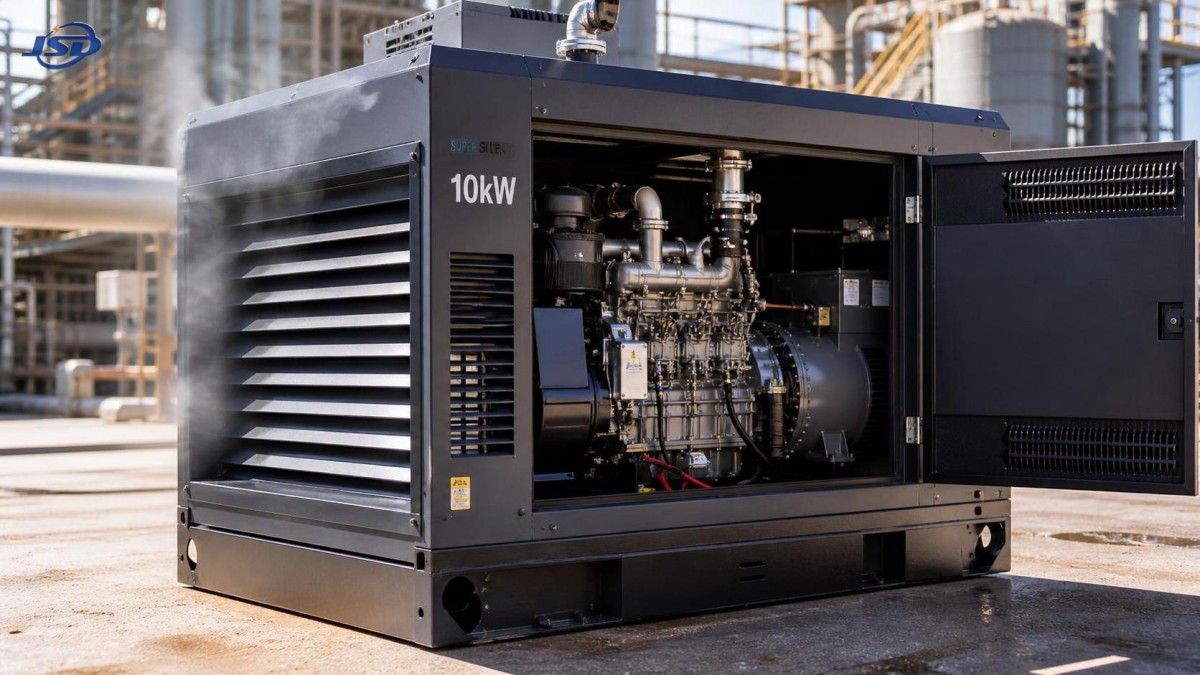
Silent enclosure design often determines real-world performance
The term “silent” can be misleading in technical comparison. Two 10kw silent generator models may have similar noise ratings in brochures but very different thermal behavior on site. The acoustic enclosure layout matters: intake louver size, fan capacity, radiator sizing, internal airflow path, insulation material placement, and maintenance clearance all affect whether full-rated output is sustainable.
This is one reason field users sometimes report that one brand “weakens” in summer while another remains stable. The root cause is not always the engine itself. It may be the enclosure’s thermal management design. A generator intended for temperate markets may perform differently in the Middle East, South Asia, Africa, or enclosed industrial yards with poor ventilation.
For mobile or temporary power planning, some project teams are now comparing conventional generators with hybrid support systems to reduce peak thermal stress and runtime. In such cases, a trailerized battery system such as the 100kW/215kWh Mobile Trailer Energy Storage System can be used in broader site power architecture to absorb transient peaks, reduce generator loading swings, and limit unnecessary continuous high-load operation in extreme weather. That does not replace proper generator sizing, but it changes how thermal derating risk is managed at the system level.
What “output loss” looks like in the field
Output loss does not always appear as a dramatic shutdown. More often, it shows up as one or more operational symptoms:
- the unit cannot hold rated kW without frequency droop;
- voltage becomes unstable during motor starting or load step changes;
- high coolant temperature alarms appear at loads that were previously acceptable;
- the controller initiates protective derating or shutdown after extended runtime;
- fuel consumption rises disproportionately at the same useful load;
- the enclosure becomes heat-soaked after several hours, especially in low-wind environments.
For technical teams, these symptoms should be separated from unrelated issues such as poor fuel quality, dirty filters, undersized cables, harmonic-heavy nonlinear loads, or maintenance neglect. High ambient temperature may be the trigger, but not always the sole cause.
Standards and rating conditions should be checked carefully
One of the most common assessment mistakes is comparing generators by headline output without checking the rating basis. Relevant standards may include ISO 8528 for engine-driven AC generating sets and other manufacturer-specific declarations. Exact application of standards and regional certification requirements should be verified against the supplier’s technical file and project jurisdiction.【待核实】
What matters in practice is whether the supplier clearly states:
- reference ambient temperature for rated output;
- reference altitude;
- power factor used for kVA/kW conversion;
- duty type: standby, prime, or continuous;
- allowable overload conditions, if any;
- cooling system performance assumptions.
If these conditions are missing from a quotation or datasheet, the nominal 10 kW figure is not enough for technical approval.
High temperature and altitude together create a bigger problem
Heat is often discussed in isolation, but many harsh project sites combine high temperature with elevation. That combination is more severe because altitude further reduces air density. A 10kw silent generator installed in a mining site, plateau construction project, or inland logistics facility may face derating from both factors simultaneously.
Assessment teams should therefore avoid a simple “summer temperature” review. The correct approach is a site condition matrix: maximum ambient temperature, daily temperature profile, altitude, enclosure installation condition, dust level, and load pattern. A generator that passes a short acceptance test in the morning may still fail to support afternoon peak loads.
Load profile matters as much as nameplate rating
Not all 10 kW applications stress a generator in the same way. A mostly resistive and stable load behaves very differently from a site with frequent motor starts, compressor cycling, pump inrush, or inverter-driven nonlinear equipment. Under high temperatures, these dynamic events become harder to support because thermal headroom is already reduced.
This is why technical assessment should focus on usable output under actual load profile, not only rated output under ideal conditions. For example, if a generator must support repeated HVAC compressor starts in a hot environment, the practical safe loading may be lower than expected. The same applies to telecommunications backup, field workshops, temporary site offices, and mobile medical or event power units enclosed in compact spaces.
How to assess whether a supplier’s rating is credible
For technical review, several checks are more useful than relying on brochure claims.
- Request the engine derating curve versus ambient temperature and altitude.
- Request alternator temperature rise data and insulation class details.
- Confirm radiator sizing and maximum designed ambient temperature.
- Review enclosure airflow drawings or at least fan and louver specifications.
- Ask whether the quoted 10 kW is available continuously in the stated site conditions.
- Check whether testing was done in free-air conditions or inside the final silent canopy.
- Verify controller alarm thresholds and automatic protection logic.
If a supplier cannot provide most of this information, the technical risk is higher, especially for export procurement into hot-climate markets.
Mitigation options if high-temperature derating is expected
Derating does not automatically mean the generator is unsuitable. It means the project should be engineered around realistic operating limits. Common mitigation measures include selecting a higher-capacity set, improving canopy ventilation, using a larger radiator package, reducing continuous loading, separating peak and base loads, or introducing storage support where the duty cycle justifies it.
In some applications, pairing generation with mobile storage can improve thermal and fuel performance by smoothing short peaks rather than forcing the generator to chase every transient at high ambient temperature. Solutions such as the 100kW/215kWh Mobile Trailer Energy Storage System are more relevant in integrated temporary power design than in standalone small genset selection, but the broader market trend is clear: technical teams increasingly evaluate generator performance as part of a hybrid power system rather than as an isolated machine.
Common misconceptions that lead to bad decisions
One misconception is that all output reduction in heat indicates poor manufacturing. In reality, some derating is normal engineering behavior. The issue is whether the derating is transparent, predictable, and acceptable for the application.
Another misconception is that “silent” only refers to noise. In field selection, silent design is also a thermal design question. A quieter enclosure is not automatically a better enclosure if it compromises cooling under real operating conditions.
A third misconception is that short test runs prove capacity. Heat-related output loss often appears after hours of operation, once coolant, alternator windings, enclosure surfaces, and internal air circulation reach steady-state high temperatures.
What technical assessment teams should conclude
A 10kw silent generator can lose output in high temperatures, and in many cases it should be expected to some degree. The real evaluation question is not whether heat has an effect, but whether the generator can deliver the required usable power at the project site without unacceptable thermal stress, instability, or shortened service life.
For technical approval, the safest approach is to judge the unit against actual ambient temperature, altitude, duty cycle, load dynamics, and enclosure ventilation conditions. If the supplier’s rating basis is vague, if cooling reserve appears marginal, or if the project depends on stable full-load output in extreme climates, the nominal 10 kW label should not be treated as guaranteed field performance.
In other words, high-temperature output loss is less a yes-or-no issue than a design transparency issue. The better the derating data, thermal design evidence, and site-condition matching, the more confidence a technical team can have in the generator’s real operating capability.

Get a Quote
Regardless of whether you require general advice or specific support, we are happy to help you.
Send Us Your Inquiry Today

Jinshida Electric remains committed to contributing to global energy development through professional manufacturing and superior service.