





Substation ONAN Transformer Overheating: Airflow, Oil Level, and Load Checks
Substation ONAN Transformer Overheating: Airflow, Oil Level, and Load Checks
When a substation ONAN power transformer runs hotter than expected, maintenance teams need a systematic check—not an immediate assumption of internal failure. Restricted airflow around radiators, an oil level outside the temperature-adjusted range, or sustained loading beyond rated limits can undermine oil-natural, air-natural cooling. The useful starting point is to compare temperature readings with operating conditions, then inspect ventilation and oil level safely before reviewing load trends. Follow site safety procedures and manufacturer guidance throughout, and escalate promptly if overheating is accompanied by alarms, leakage, or abnormal noise.
ONAN cooling has no fans or pumps to compensate for poor installation conditions. Heat moves from the windings into the oil, natural oil circulation carries it toward the cooling surfaces, and surrounding air removes it. A restriction anywhere along that path can raise operating temperature without an electrical fault inside the transformer.
Establish whether the temperature is abnormal
A high reading is not meaningful without its context. Record top-oil temperature, the winding-temperature indication if fitted, ambient temperature near the cooling-air inlet, phase currents, and the time of observation. Include recent load changes and how long the transformer has been operating under those conditions. Oil temperature responds slowly, so a reading taken just after production stops may still reflect the previous operating period.
Compare the measurements with the nameplate, approved operating limits, alarm settings, and manufacturer documentation. There is no single temperature limit suitable for every ONAN transformer. Insulation design, specified temperature rise, installation conditions, and loading history all matter. IEC 60076-7 or IEEE C57.91 may support a loading assessment where applicable, but neither replaces equipment-specific instructions.
Also question the measurement before blaming the equipment. A winding-temperature indicator may represent a thermal model rather than directly measure the hottest winding point. Compare local instruments with remote readings and check for implausible jumps or a stuck pointer. Infrared inspection can help identify uneven heating, but surface emissivity and reflections affect accuracy; a tank-surface reading is not an internal oil-temperature measurement.
Treat smoke, pressure-relief operation, gas-protection alarms, rapid unexplained temperature rise, or substantial leakage as escalation conditions. Follow the emergency operating procedure rather than continuing routine troubleshooting. Do not reset protection or repeatedly re-energize the transformer simply to see whether the condition returns.
Inspect the air path, not just the radiator surface
An ONAN installation needs room for cooler air to approach the lower cooling surfaces and warmer air to leave above them. A radiator can look clean while the surrounding enclosure traps hot air. In an indoor substation, check whether inlet louvers are obstructed, exhaust openings are blocked, or building ventilation is recirculating warm air back toward the transformer.
For outdoor equipment, look for vegetation, stored materials, temporary screens, and nearby structures that reduce the specified clearance. A recently installed barrier or acoustic enclosure deserves particular attention when overheating begins after site alterations. Do not assume that a clearance acceptable for electrical access also provides adequate cooling space.
Inspect radiator passages for accumulated dust, leaves, oily deposits, or damaged fins. Observe from permitted positions and maintain electrical clearances. Cleaning, close inspection, and work around energized equipment require the applicable isolation and work-control procedures. Avoid aggressive washing that could damage coatings or introduce water into electrical components.
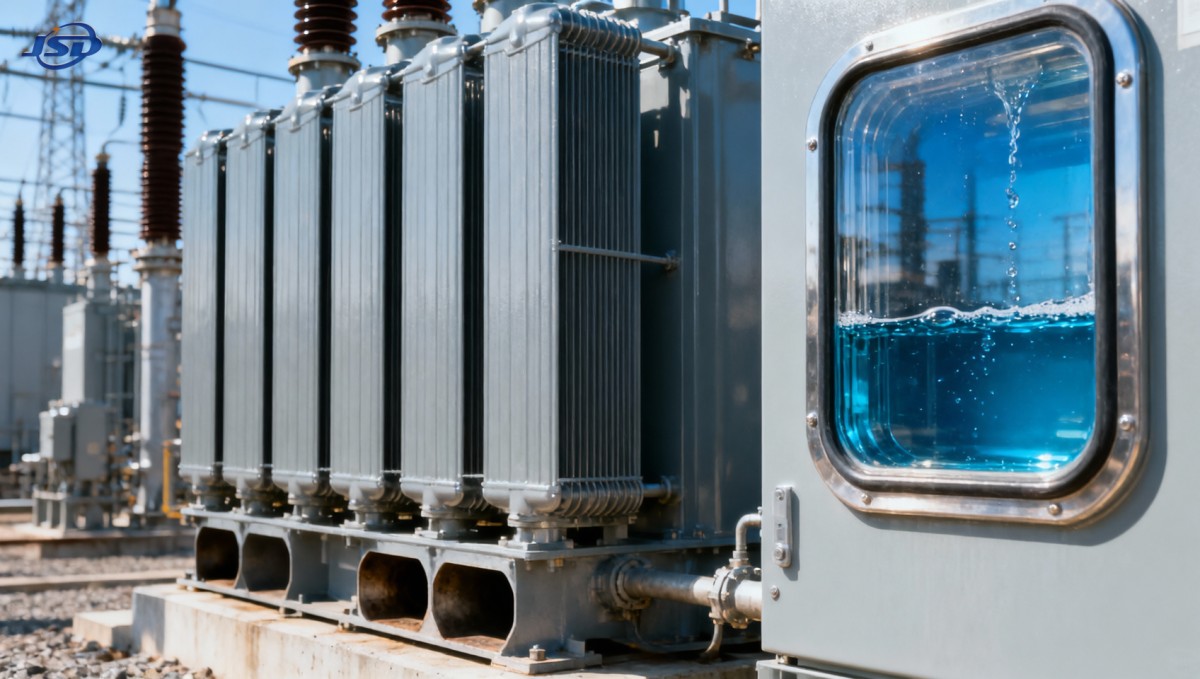
Uneven radiator temperatures can help narrow the investigation. Under stable load, an entire radiator bank that remains unexpectedly cool while the tank is hot may indicate restricted oil circulation or a valve left closed after maintenance. However, temperature differences alone are not proof: load, sunlight, wind, and measurement conditions can distort the pattern. Confirm the intended valve configuration from drawings and service records; valve operation should follow the manufacturer’s procedure and authorized work controls.
Do not turn an improvised fan into a permanent repair. Temporary forced airflow may change the observed temperature, but it does not establish a higher approved transformer rating. If the installation cannot dissipate heat at its specified ONAN duty, correct the ventilation or obtain an engineered cooling assessment.
Read oil level against temperature and tank design
Oil expands as it warms, so “below the middle of the gauge” is not automatically a fault. Check the indicated level against the manufacturer’s temperature reference or level curve, using the prescribed temperature measurement. A cool transformer may legitimately show a lower level than the same unit after several hours of operation.
Identify the tank arrangement before interpreting the indication. Conservator-equipped transformers and sealed-tank designs do not have identical checking procedures. Where a conservator has a bladder or diaphragm, its condition and associated fittings may also affect diagnosis. Never open a filling point, vent, or pressure fitting on an energized or pressurized transformer to verify the level.
Look for evidence that explains a genuinely low reading: wet gasket joints, radiator connections, drain fittings, or oil staining below the tank. Review recent transport, oil treatment, and maintenance records. If the gauge indication disagrees with other evidence, a sticking mechanism or instrument fault is possible, but it must be verified through the approved inspection procedure.
A confirmed low oil level can compromise insulation coverage and circulation, depending on the design and severity. Topping up is not a diagnosis. Locate the cause, verify the required oil specification and compatibility, and follow the prescribed filling, air-removal, testing, and return-to-service process. Overfilling is also undesirable because it reduces the expansion space intended by the design.
Review load history rather than one current reading
A transformer found hot during a quiet shift may have carried a sustained peak earlier. Retrieve a load trend that covers the build-up and cooling period, preferably alongside ambient and temperature trends. Check the actual cooling rating on the nameplate. If multiple ratings are listed, a rating dependent on another cooling mode must not be treated as the available ONAN capacity.
Evaluate apparent power and phase currents, not only billed kilowatts. Poor power factor can increase current for the same useful power, while phase imbalance may leave one winding more heavily loaded than the overall demand suggests. Where variable-speed drives, rectifiers, or charging equipment dominate the load, assess harmonics with suitable instruments. Harmonic-related losses are not reliably judged from a simple kW trend.
- Check whether new equipment has extended the peak-load period rather than merely increased its maximum.
- Compare phase currents with their applicable limits and review voltage and tap-position records.
- Confirm that metering ratios and timestamps are correct before aligning load and temperature data.
- Assess repeated overloads together with ambient conditions and thermal history; a brief acceptable event does not justify routine overload operation.
If temperatures fall after an authorized load reduction, that is useful evidence, but it does not prove the cooling system is healthy. A restricted radiator can also cool when losses decrease. The stronger comparison is how the transformer performs at similar load and ambient conditions before and after a verified correction.
When peak shaving belongs in the discussion
Where inspection confirms that the transformer is serviceable but recurring demand peaks challenge its thermal capacity, load scheduling or energy storage may be worth evaluating. Jinshida Electric’s 125kW/261kWh Commercial & Industrial Energy Storage System provides a potential peak-shaving option for facilities such as manufacturing sites and EV charging stations. Its integrated battery, PCS, BMS, and EMS support coordinated charging and discharging.
The important constraint is where it connects. Discharging must reduce power through the affected transformer, and charging must not create another overload. The stated power and energy ratings do not guarantee coverage of a site’s entire peak; usable energy, conversion losses, reserve requirements, and discharge duration need calculation. Storage is a demand-management measure—not a remedy for low oil, obstructed cooling, or an internal fault.
If the basic checks do not explain the heat
Persistent overheating with adequate airflow, correct oil level, and acceptable loading warrants a deeper investigation. Depending on the symptoms, this may include oil-quality testing, dissolved gas analysis, checks for high-resistance connections, and assessment of internal circulation or winding condition. Test selection should follow the transformer’s history and protection indications rather than a standard list applied without judgment.
A localized hot terminal is different from uniformly elevated top-oil temperature. Likewise, a sudden change after maintenance deserves a different investigation from gradual deterioration over several seasons. Preserve trend data and photograph accessible evidence before corrective work changes the condition. Never bypass a protective function to collect a longer operating record.
For manufacturer support, send the serial number, nameplate details, installation photographs, temperature and load trends, alarm history, and recent maintenance records together. Jinshida Electric Power Technology Co., Ltd.’s focus on power transmission and distribution equipment makes equipment-specific technical review a natural part of the support discussion. Useful evidence lets the manufacturer assess the actual configuration instead of working from “the transformer is hot.”
After correction, verify performance through a representative operating period. Record the revised conditions, confirm that alarms and protection remain in service, and compare the temperature response at similar loading. Closing the job because one reading has dropped is premature; close it when the cause is documented and stable operation has been demonstrated within the approved limits.

Get a Quote
Regardless of whether you require general advice or specific support, we are happy to help you.
Send Us Your Inquiry Today

Jinshida Electric remains committed to contributing to global energy development through professional manufacturing and superior service.